Virginia Lawmakers Advance Rebuttable Presumption for Trafficking Victims in Criminal Cases
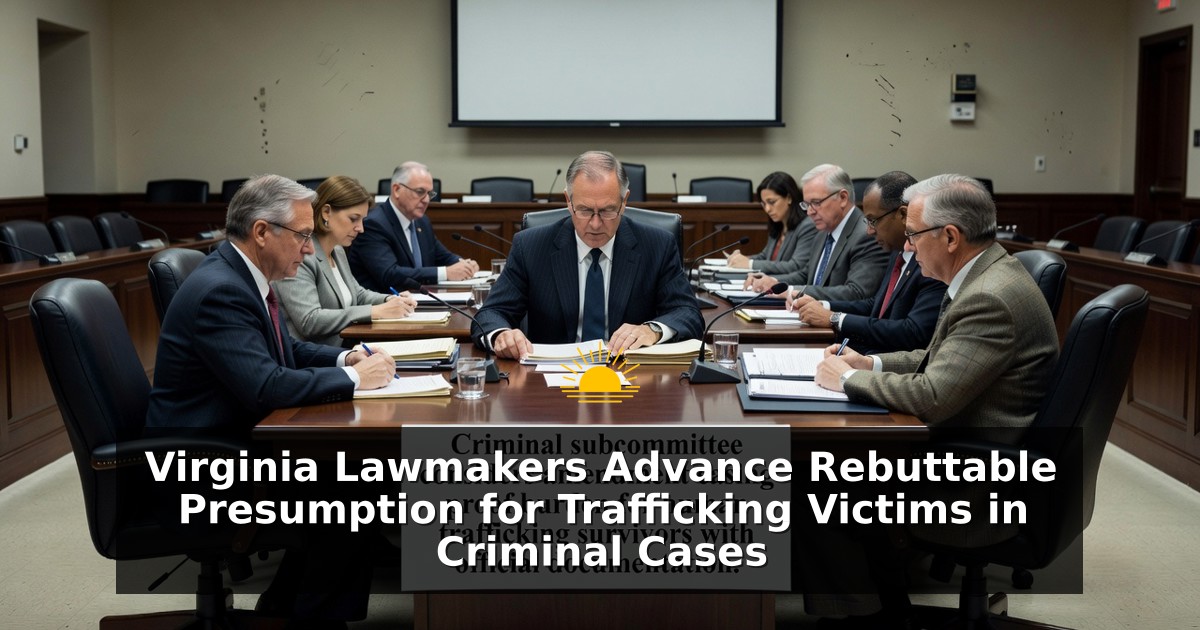
A Virginia criminal subcommittee recently examined a proposed amendment that would establish a rebuttable presumption in certain cases involving human trafficking victims. The measure addresses situations where a petitioner seeks relief related to an offense committed while under the control of traffickers. Under the amendment, official documentation of victim status at the time of the offense would trigger the presumption that the person's participation resulted from being trafficked. This change aims to adjust the evidentiary framework without eliminating the petitioner's overall responsibility to present a case.
Lawmakers heard detailed explanations of how the presumption would operate in practice. The burden of proof would remain on the petitioner in the first instance. However, once official documentation is introduced showing victim status contemporaneous with the offense, the presumption would shift the dynamic. Opposing parties could still present evidence to rebut the presumption. Supporters emphasized that the provision is narrowly tailored and applies only when documentation already exists from recognized authorities.
Defining Official Documentation in the Amendment
The amendment includes a clear definition of what qualifies as official documentation. It covers any paperwork issued by a federal, state, or local agency that tends to show a person's status as a victim of human trafficking. Examples could include certifications, findings, or records generated through established victim-identification processes. This definition seeks to provide courts with objective materials rather than relying solely on testimonial evidence. By grounding the presumption in agency-issued records, the proposal attempts to create consistency across cases.
Subcommittee members discussed the practical effect of accepting such documentation. Once admitted, the presumption would hold that the offense participation stemmed from the trafficking victimization. The opposing side would then need to introduce contrary evidence to overcome that presumption. Proponents noted that many survivors already possess these records from prior interactions with law enforcement or social service agencies. The amendment therefore builds on existing official determinations rather than creating an entirely new process.
Broader Context of Trafficking Victim Protections
Human trafficking survivors frequently face criminal charges for acts committed under coercion or force. Across the United States, legislatures have enacted vacatur and expungement statutes to address this reality. Virginia's consideration of a rebuttable presumption fits within that national trend of refining post-conviction relief mechanisms. The focus remains on cases where victim status can be corroborated through governmental documentation issued at or near the time of the offense. This temporal link is intended to ensure relevance and reliability.
Legal analysts observing similar measures in other jurisdictions note that rebuttable presumptions can reduce barriers for survivors who already carry official recognition of their status. At the same time, the rebuttable nature preserves the ability of prosecutors or other parties to challenge the connection between trafficking and the specific offense. The Virginia proposal mirrors this balance by keeping the initial burden on the petitioner while offering a structured pathway once documentation is supplied. Subcommittee discussion underscored that the change responds directly to concerns raised during earlier bill deliberations.
Legislative Intent and Narrow Application
During the hearing, the sponsor restated the rationale for adding the presumption language. Opposition to the underlying bill had highlighted worries about overly broad relief. In response, the amendment confines the presumption to scenarios involving pre-existing official documentation. It does not extend automatically to every petitioner claiming trafficking victimization. This narrowing was presented as a direct answer to those earlier objections. The sponsor reiterated that the goal is to ease the path only for individuals whose victim status has already been recognized by governmental entities.
No additional speakers rose to comment after the explanation of the amendment. The chair confirmed the absence of further public input before offering the sponsor a final opportunity to address the panel. In closing remarks, the sponsor again stressed the limited scope. The presumption activates solely upon production of qualifying documentation and does not alter the foundational requirement that the petitioner initiate and support the request for relief. This structure maintains judicial oversight while acknowledging the evidentiary value of agency records.
Implications for Courts and Petitioners
If adopted, the amendment would guide trial courts in evaluating petitions linked to trafficking-related offenses. Judges would first determine whether the submitted materials meet the statutory definition of official documentation. Upon that finding, the rebuttable presumption would apply, requiring any challenge to overcome it with contrary proof. Petitioners without such documentation would proceed under the ordinary burden of proof. The distinction creates two procedural tracks depending on the availability of agency-issued records.
Advocates for survivors have long argued that official findings from federal task forces, state victim services, or local law enforcement carry substantial weight. The proposed language incorporates that perspective by giving those findings presumptive effect when tied to the timing of the offense. Simultaneously, the rebuttable character ensures that the presumption is not conclusive. Courts retain authority to weigh all evidence and reach independent conclusions. This calibrated approach reflects an effort to improve access to relief without removing adversarial testing of claims.
The subcommittee's review forms part of the broader legislative examination of criminal procedure updates. By focusing on documentation already generated by public agencies, the amendment seeks to avoid placing new investigative demands on courts or parties. It leverages determinations made through existing victim-identification protocols. Observers of the process noted that clarity in the definition of official documentation will be essential for uniform application once the language advances.
Next Steps in the Legislative Process
Following the presentation, the measure remains subject to further committee action and potential floor consideration. The discussion clarified both the operational mechanics and the policy justification. Lawmakers received assurance that the presumption is conditional and documentation-driven. The record of the hearing now includes the precise wording explaining how official records from federal, state, or local sources would function. That legislative history may later assist courts in interpreting the provision.
Survivors navigating post-conviction petitions often encounter complex evidentiary hurdles. The amendment under review attempts to lower one such hurdle when reliable governmental documentation already exists. By converting that documentation into a rebuttable presumption, the proposal aligns procedural rules with the practical realities faced by many trafficking victims. Continued scrutiny will determine whether the language proceeds unchanged or receives additional refinement before any final enactment.
The careful delimitation of the presumption to documented cases illustrates an incremental approach to criminal justice reform in this area. Virginia's criminal subcommittee has placed on the record a detailed account of both the text and the intent. Stakeholders on all sides now possess a clear statement of how the burden would shift only upon satisfaction of the official-documentation requirement. Further legislative stages will test the durability of that compromise language.
agency Amendment bill burden documentation federal agency Human Trafficking legal amendment local agency narrowed scenario offense official documentation opposition participation petitioner presumption rebuttable presumption state agency status trafficking victim victim victim status