Virginia Lawmakers Weigh Bill to End Common Law Suicide Crime
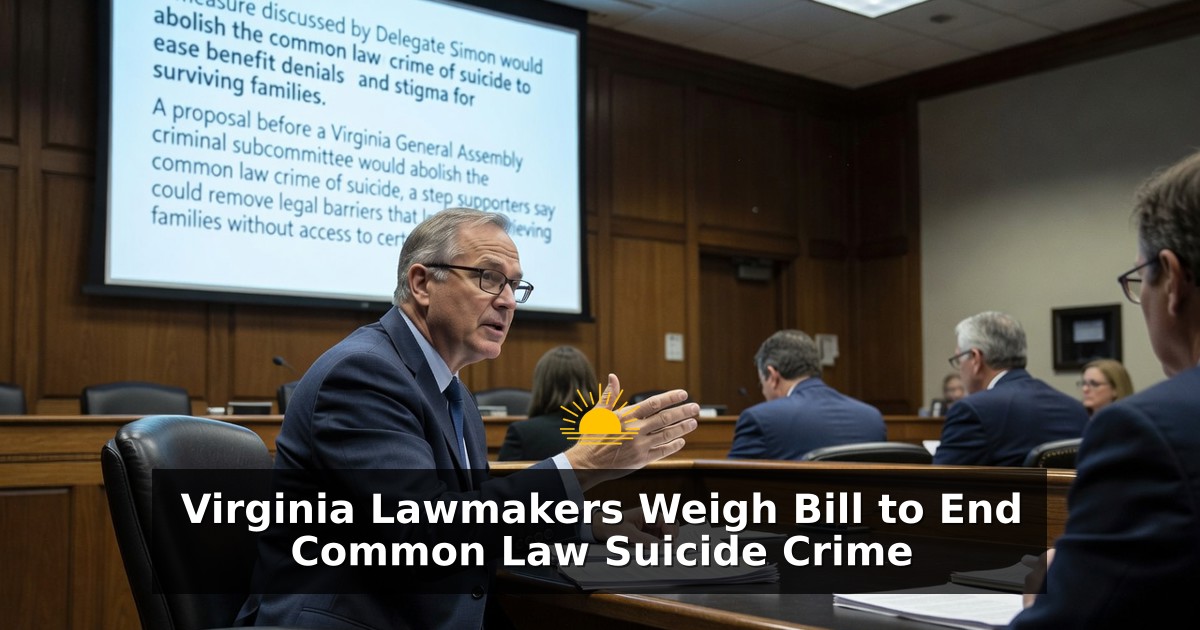
A proposal before a Virginia General Assembly criminal subcommittee would abolish the common law crime of suicide, a step supporters say could remove legal barriers that leave grieving families without access to certain benefits and programs. Delegate Marcus Simon presented the measure, explaining that while no statute in the Virginia Code expressly criminalizes suicide, the Commonwealth long ago adopted English common law principles that historically treated the act as a felony. Those principles continue to shape official interpretations that classify a death by suicide as the result of a criminal act. As a result, relatives often encounter denials when seeking enrollment in support programs or claiming benefits that exclude deaths tied to the deceased person’s own criminal conduct.
Simon told the subcommittee that an attorney general opinion has reinforced this classification, creating practical hardships long after a family has suffered loss. Benefits that might otherwise provide financial stability or counseling resources become unavailable once the death is labeled the product of a criminal act. The bill seeks to end that outcome by explicitly abolishing the common law offense, thereby removing the legal foundation for such denials. Advocates argue the change would align Virginia practice with contemporary understanding of mental health crises rather than outdated criminal frameworks.
Historical Roots of the Common Law Approach
English common law once regarded suicide as felo de se, a felony against the self that carried harsh civil consequences including forfeiture of property. When Virginia incorporated common law through early statutory adoption, those doctrines remained part of the legal landscape even as modern criminal codes omitted any suicide offense. Section 1 of the Code preserves this reception of common law where not inconsistent with later enactments. Over time, the absence of a statutory crime has not prevented administrative and judicial reliance on the older classification when determining eligibility for public or private benefits.
Legal scholars note that most American jurisdictions discarded the criminal label decades ago, recognizing that treating suicide as crime served little deterrent purpose and compounded harm to survivors. Virginia’s continued formal recognition, even if rarely prosecuted, still produces collateral effects through the attorney general guidance cited in the hearing. Families report that insurance claims, certain survivor benefits, and program enrollments can be delayed or rejected on the ground that the death stemmed from criminal conduct. The proposed abolition would eliminate that ground without altering other laws governing assisted death or related offenses.
Effects on Families and the Healing Process
Survivors who contacted committee members described the lasting pain of seeing a loved one labeled a criminal in official records or benefit determinations. Simon referenced emails shared with the panel in which relatives explained how the designation interfered with their ability to grieve and move forward. The stigma attaches not only to the deceased but to the family narrative, turning a mental health tragedy into a source of ongoing legal and emotional complication. Removing the common law crime would, according to the bill’s purpose, allow families to access available supports without first overcoming a criminal-act barrier.
Mental health professionals observing the debate emphasize that suicide is widely understood as the outcome of untreated or undertreated conditions rather than culpable intent in the criminal sense. Virginia has expanded crisis intervention and prevention resources in recent years, yet residual legal classifications can undercut those efforts by signaling that the act remains tainted by criminality. The legislation aims to bring the formal law into closer harmony with clinical and public health approaches already operating across the Commonwealth. Supporters contend that clarity in the Code would reduce inconsistent application of the attorney general opinion across agencies and private entities.
Legislative Path and Prior Efforts
The measure reached the criminal subcommittee after earlier attempts, including a companion effort that advanced in the Senate two years previously. Discussion in the current session has focused on the narrow goal of abolition rather than broader revisions to end-of-life statutes. Lawmakers examined how the change would interact with existing benefit statutes that disqualify claims arising from a decedent’s criminal act. By striking the common law foundation, the bill would leave those disqualification clauses intact for genuine crimes while carving suicide out of their reach.
Committee members weighed testimony about the practical difference the language would make for households already navigating funeral costs, lost income, and counseling needs. No new criminal penalties or regulatory schemes are created; the text simply declares the common law crime abolished. Drafting choices emphasize that the reform is limited to suicide itself and does not affect prosecutions for related conduct involving third parties. Observers of the General Assembly note that similar clarifications in other states have produced few unintended consequences while easing administrative burdens on survivors.
Broader Context of Mental Health and Legal Reform
Virginia’s suicide rate has remained a persistent public health concern, prompting investments in hotlines, school-based programs, and workforce training for crisis response. Legal remnants that treat the outcome as criminal can discourage open conversation and delay help-seeking, according to prevention advocates familiar with the subcommittee record. The bill’s backers present abolition as one concrete step that costs little to implement yet removes an avoidable obstacle for families. Neutral analysts observe that the proposal fits within a longer pattern of updating inherited common law doctrines that no longer match current social and medical knowledge.
If advanced, the legislation would require only a straightforward statutory declaration, leaving courts and agencies to apply the new rule in pending and future benefit determinations. Families who have already faced denials may still need separate remedies, yet future cases would proceed without the criminal-act presumption. The discussion underscored that the Commonwealth’s adoption of common law was never intended to freeze every historical offense in place indefinitely. Explicit abolition provides the clarity that case-by-case interpretation has not supplied.
Closing Considerations for Policy Makers
As the subcommittee continues its review, the central facts remain those outlined by Delegate Simon: the lack of a Code prohibition, the persistence of common law status, the attorney general opinion linking suicide to benefit bars, and the documented stigma experienced by survivors. The bill offers a direct remedy by eliminating the underlying offense. Lawmakers must still consider drafting precision and any transitional issues, yet the core policy choice is whether Virginia will continue to classify suicide as a crime under inherited doctrine. A decision to abolish would mark a clear shift toward treating the issue primarily through the lens of health and family support rather than criminal law.
The measure’s progress will depend on further committee action and eventual floor consideration in both chambers. Whatever the outcome, the hearing record has already illuminated how an ancient legal category continues to shape modern administrative results for Virginia families. By focusing on the concrete problems of benefit access and lingering stigma, the proposal keeps attention on practical consequences rather than abstract theory. Continued examination of the common law reception statute and related opinions will help ensure any final language achieves the intended relief without collateral disruption to other areas of law.
abolishing attorney general benefits bill code committee members common law Crime criminal criminal act denied benefits emails Families healing process law Opinion programs section one Senate stigma suicide Virginia