Virginia Budget Conceals Millions in Spending Under Generic Program Names
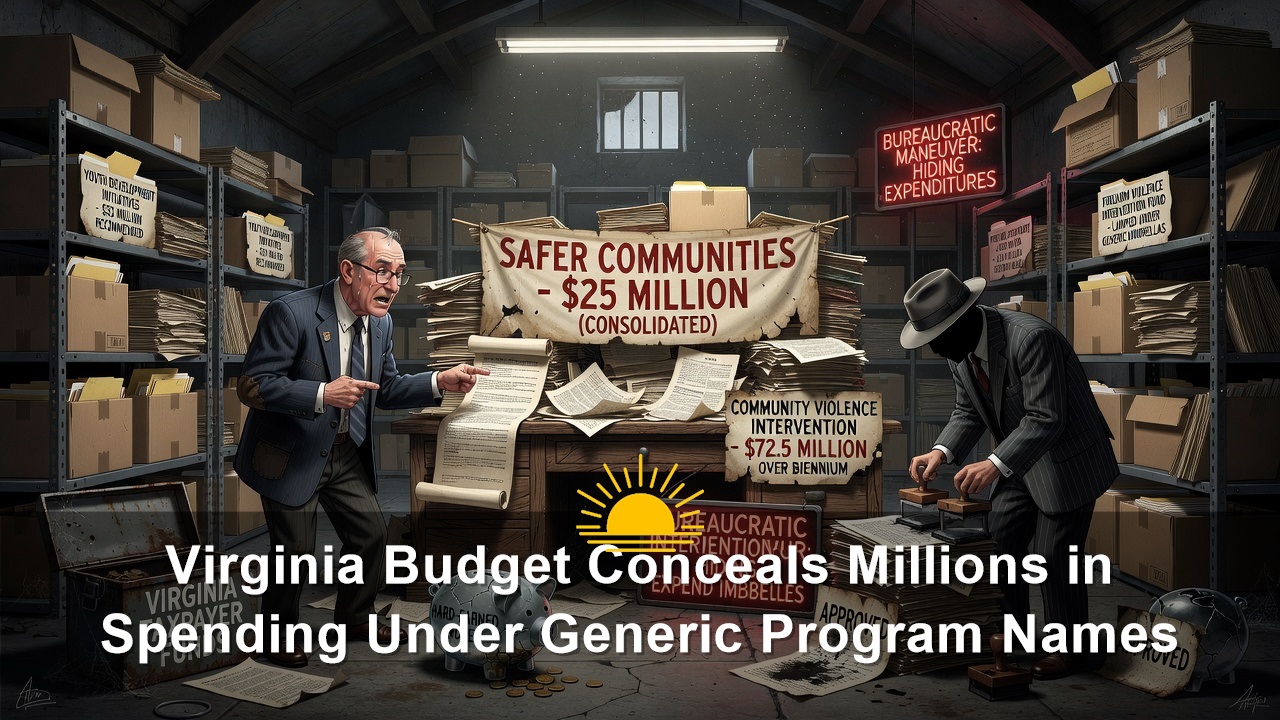
Virginia taxpayers are facing massive state expenditures hidden behind vaguely named programs that make financial oversight nearly impossible. The recent state budget allocates a staggering $72.5 million over the biennium for community violence intervention programs. Instead of providing clear line-item details, lawmakers are funneling millions into generic categories that obscure the true nature of the spending. Fiscal conservatives warn that this lack of transparency is a breeding ground for government waste and unchecked bureaucratic bloat.
At the center of this financial obscurity is a $25 million allocation specifically designated for the Safer Communities program. By utilizing broad, feel-good titles, state officials effectively shield these massive appropriations from rigorous public scrutiny. Taxpayers have a fundamental right to know exactly how their hard-earned money is being deployed to combat crime. When millions of dollars are dumped into broadly defined initiatives, the risk of financial mismanagement and outright fraud increases exponentially.
Masking Expenditures Through Consolidation
The Department of Criminal Justice Services and the Secretariat of Public Safety and Homeland Security are overseeing this massive influx of taxpayer funds. In a move that alarms fiscal watchdogs, the budget streamlines previous community violence reduction programs by removing specific legislative language. For example, specific authorizations for the Operation Ceasefire Grant Fund are being consolidated under generic umbrella names like Safer Communities. This deliberate consolidation makes it incredibly difficult for citizens and auditors to track how funds are utilized at the local level.
Hiding specific line-item expenditures behind generic titles is a classic bureaucratic maneuver designed to avoid strict financial accountability. When funds are lumped together without precise operational definitions, local agencies can easily misallocate resources toward pet projects rather than effective law enforcement. Conservatives argue that every single dollar must be explicitly tracked to ensure it serves the public interest rather than expanding government payrolls. Stripping away specific program language directly undermines the goal of reducing the budget and saving taxpayer money.
Escalating Costs and Committee Recommendations
The push for increased spending shows no signs of slowing down among state legislative committees. The Senate Finance and Appropriations Committee recently argued that it is critical to invest heavily in both law enforcement and broad violence prevention interventions. To accomplish these goals, the subcommittee recommended an additional $33.0 million to expand the Safer Communities program and support various youth development initiatives. This massive funding recommendation also includes increased aid to local police departments, further swelling the overall financial burden placed on state taxpayers.
Throwing an additional $33 million at vaguely defined youth development and intervention programs is a recipe for runaway state spending. Without strict oversight and clear metrics for success, these funds often disappear into the administrative overhead of various community organizations. Fiscal conservatives maintain that true public safety is achieved through strong, traditional law enforcement rather than endless spending on unproven social programs. Lawmakers must prioritize budget reductions and eliminate any funding that lacks rigorous, transparent auditing mechanisms.
The Governor Budget Message and Fiscal Responsibility
The official budget messaging attempts to justify these massive outlays under the guise of common ground and community safety. According to the executive budget message, the framework provides a total of $72.5 million over the biennium for community violence intervention programs. This massive sum includes $20 million to support Operation Ceasefire and the previously mentioned $25 million for the Safer Communities program. While the stated goals may sound appealing, the actual allocation methods raise serious concerns about fiscal responsibility and government overreach.
True fiscal responsibility requires lawmakers to reject broad budget categories and demand absolute clarity for every appropriation. When money is funneled into the Firearm Violence Intervention and Prevention Fund alongside other generic programs, tracking the exact return on investment becomes impossible. Taxpayers should not be forced to foot the bill for redundant programs that fail to deliver measurable reductions in neighborhood crime. Shrinking the state budget requires a meticulous audit of these consolidated funds to eliminate redundancies and stop wasteful spending.
Protecting the Virginia Taxpayer
The primary duty of the state government is to protect its citizens while acting as a responsible steward of taxpayer resources. Allowing the Department of Criminal Justice Services to operate with broadly defined, multi-million-dollar funds completely contradicts the principles of limited government. Bureaucrats must be forced to justify every single expenditure rather than hiding behind the convenient veil of streamlined community safety grants. Only through aggressive financial oversight can Virginia eliminate fraud, cut unnecessary spending, and return money to the hardworking taxpayers.
Ultimately, the practice of concealing specific expenditures under generic program names must be eradicated from the Virginia state budget. Lawmakers have a moral obligation to reject bloated funding requests that lack detailed, line-item transparency. By demanding clear language and strict accountability, conservative leaders can successfully reduce overall state spending and protect the financial future of the commonwealth. Taxpayers deserve a government that respects their wallets and refuses to waste millions on vaguely defined bureaucratic initiatives.
Virginia House of Delegates Virginia Senate Budget Crime Fraud Governor Grants Law Enforcement Lawmakers Police Senate spending Virginia