Virginia Lawmakers Hear Opposition to HB1238 on Local Pet Store Animal Sales Rules
Updated
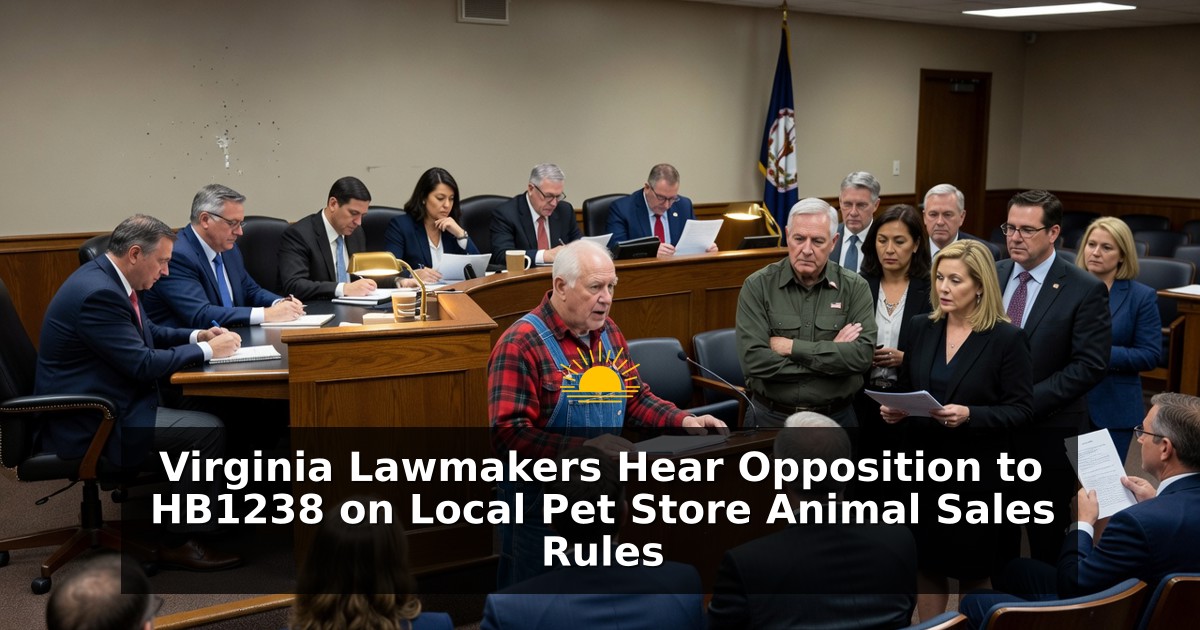
Lawmakers on the Virginia House Counties Cities and Towns Committee reviewed House Bill 1238 during a recent hearing that drew concentrated opposition from agricultural advocates, veterans, and pet industry representatives. The measure would authorize individual localities across the commonwealth to regulate or restrict how animals are acquired, marketed, and sold inside pet stores. Supporters of existing statewide frameworks argued the change would fragment consumer access and shift transactions into less supervised channels. Committee members listened as speakers outlined potential effects on family-owned businesses and on individuals who depend on animals for therapeutic purposes.
The bill centers on granting cities, counties, and towns broader authority over live-animal retail practices that currently operate under more uniform state-level expectations. Opponents told the panel that such local discretion could produce a patchwork of rules, making compliance difficult for stores that serve customers from multiple jurisdictions. They emphasized that many independent pet retailers already follow established health and sourcing standards. Testimony repeatedly returned to the risk that tighter local limits would simply redirect buyers toward informal online marketplaces.
Concerns Over Unregulated Online Sales
Louis Wasky, president of the American Federation of Agriculture, opened the opposition remarks by stating clear resistance to the proposal. He distributed copies of a letter outlining the organization’s position and described a pattern already visible in other states. According to Wasky, when stores lose the ability to offer live animals, purchases migrate to platforms such as Facebook and Craigslist. Those venues, he noted, provide little oversight regarding animal health, origin, or breeder accountability.
Wasky stressed that the absence of consistent retail channels leaves consumers without reliable information about the animals they acquire. He linked the trend to broader difficulties in maintaining traceable supply chains for companion animals. The federation’s written materials reinforced the oral testimony by documenting similar outcomes elsewhere in the country. Committee members received the handouts as part of the official record for later review.
Veterans and Therapeutic Animal Access
Abbott Hoffman, a legislative representative for the American Federation of Agriculture and a U.S. Army veteran, focused on the bill’s implications for former service members. Hoffman explained that many veterans operate small pet-related businesses as part of their transition to civilian life. He further described how access to animals supports treatment for post-traumatic stress disorder and traumatic brain injury. Removing or heavily restricting store-based sales, he argued, would limit both entrepreneurial opportunities and therapeutic resources.
Hoffman told the committee that structured retail environments allow veterans to maintain predictable inventory and customer relationships. He contrasted that stability with the uncertainty of informal sales networks. The testimony underscored that animals obtained through regulated stores often come with health documentation valuable to owners managing service or emotional-support needs. Hoffman’s dual perspective as both advocate and veteran framed the issue as one affecting livelihood and recovery simultaneously.
Industry Group Defends Standards and Choice
David Foley, speaking for the Virginia Pet Advocacy Alliance, presented the coalition’s newly formed mission to uphold strong animal-welfare standards while preserving consumer options. Foley stated that the alliance opposes HB1238 because it would impose localized restrictions on family-owned pet stores. He maintained that responsible retailers already invest in proper care, veterinary partnerships, and transparent sourcing. The group’s position holds that statewide consistency better serves both animals and the public than a patchwork of municipal ordinances.
Foley noted that family businesses form the backbone of many Virginia communities and often provide adoption referrals, training resources, and ongoing owner education. Restricting their ability to offer live animals, he said, could reduce those ancillary services. The alliance favors targeted enforcement of existing cruelty and health statutes rather than broad new local powers over acquisition and marketing. Foley’s remarks closed the core opposition block by tying economic and welfare arguments together.
Broader Context of Companion Animal Retail
Virginia has long balanced animal-protection goals with commercial activity through a combination of state statutes and local enforcement. Pet stores currently operate under requirements covering housing conditions, disease reporting, and record-keeping. Proponents of additional local authority sometimes cite overcrowding or impulse purchases as reasons for tighter controls. Opponents counter that education and voluntary best practices achieve similar ends without eliminating retail choices.
National trends show several states experimenting with city-level bans on sales of dogs and cats from commercial breeders. Studies of those jurisdictions frequently record increases in online classified activity and interstate transport of animals. Veterinary associations have observed that animals acquired through unregulated channels more often arrive without vaccination histories or genetic health screening. Virginia’s debate mirrors these larger conversations while remaining focused on the specific language of HB1238.
Family-owned stores frequently partner with local shelters for adoption events and supply specialty diets or enrichment products that support long-term animal well-being. Owners of such businesses told advocates that sudden local prohibitions could force layoffs or closures, especially in smaller towns where the pet store doubles as a community hub. Veterans’ service organizations have likewise documented the role of predictable animal companionship in reducing isolation and supporting mental-health continuity after military service.
Potential Effects on Local Pet Ownership
If enacted, the bill would leave each locality free to design its own rules on sourcing, advertising, and in-store sales of live animals. Residents in one county might retain full retail access while those in a neighboring jurisdiction face near-total bans. Such variation could encourage cross-border shopping or greater reliance on distant online sellers. Animal-welfare organizations on both sides of the issue agree that clear origin records improve outcomes, yet they differ on whether local ordinances are the best vehicle for achieving that transparency.
Consumer-choice advocates warn that reduced store inventory may raise prices for remaining legal sources or push budget-conscious families toward less reputable suppliers. Therapy-animal handlers note that consistent availability of well-socialized animals from inspected environments supports training pipelines for psychiatric service dogs. Local governments, for their part, would gain a new policy tool but would also inherit responsibility for drafting, enforcing, and defending any resulting ordinances.
The Counties Cities and Towns Committee took the testimony under advisement as it continues to evaluate the measure. No final vote occurred during the hearing segment devoted to public comment. Stakeholders on all sides are expected to submit additional written materials before the bill advances or stalls in the legislative calendar. The discussion highlighted the tension between uniform statewide standards and localized control over companion-animal commerce.
Observers of Virginia’s legislative process note that pet-related bills often generate extensive public input because they intersect economic, emotional, and ethical considerations. Family businesses, veterans’ networks, and advocacy alliances have signaled they will remain engaged as HB1238 proceeds. The ultimate shape of any enacted law will determine whether Virginia’s pet retail landscape stays largely consistent or becomes a mosaic of differing municipal rules. Further committee action will clarify the next steps for this closely watched proposal.
American Federation of Agriculture animal rights animal sales business restrictions Commonwealth of Virginia Counties Cities and Towns Craigslist Facebook sales family pet stores HB1238 HSUS legislative hearing local regulation pet ownership pet stores PETA PTSD TBI veteran businesses Veterans Virginia Virginia pet advocacy alliance