Virginia Education Press Needs intense Support
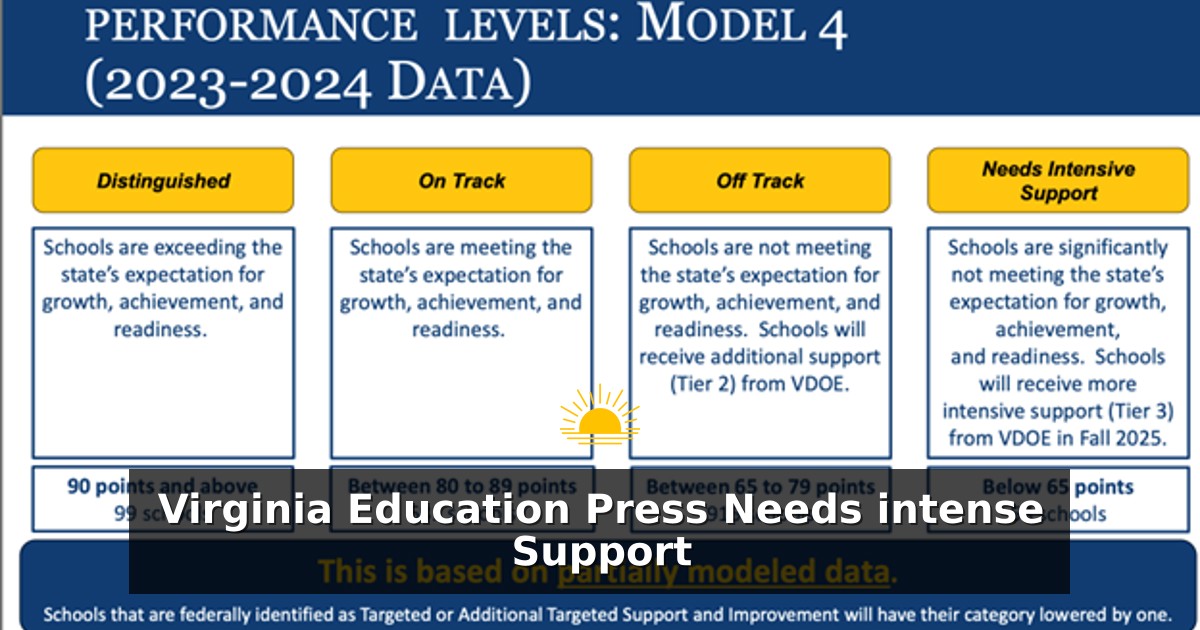
A fight over Virginia’s new school accountability labels has moved from Board of Education work sessions into national and state media, with critics alleging political spin around how many schools land in the lowest tiers and supporters arguing greater transparency finally exposes long-standing achievement gaps.
Early presentations to the Virginia Board of Education used partially modeled data that produced high estimates of schools in the bottom summative categories—“Off Track” and “Needs Intensive Support.” Coverage after an August board meeting circulated figures suggesting more than 70 schools—or, in some tellings, a large share of schools—would fall into those tiers. Weeks later, after the Virginia Department of Education finished collecting information, a department FAQ put the share of schools in the bottom two tiers near 37 percent, later discussed around the mid-30s. The gap between early modeled slides and later numbers became the core of a Washington Post examination that devoted substantial space to questions about how officials and journalists communicated the rollout.
Accountability backers say the August slides carried explicit warnings that figures were partially modeled and that summer projections based on 2022–23 patterns were expected to improve as pandemic learning loss eased in 2023–24. Superintendent remarks at later work sessions reiterated that data collection continued into late September. Critics and some local divisions, especially in Northern Virginia, have sought delay or revision, arguing the new system’s disaggregated results by race and economic status will brand schools and complicate staffing. Board member Andy Rotherham, a Democrat nominated under both Gov. Mark Warner and Gov. Glenn Youngkin and a national accountability voice, said at a recent work session that uncomfortable facts surface when results are broken out—and that he understands why some divisions want more time.
Supporters of the redesign cast transparency as the point. They cite National Assessment of Educational Progress trends showing persistent or widening gaps: Virginia’s Black and economically disadvantaged fourth-graders trailing peers in states such as Mississippi on some 2022 reading comparisons, and long-running Black–White, Hispanic–White, and economically disadvantaged gaps in reading and math that barely moved for decades under prior accreditation rules. Groups such as The Education Trust argue accountability systems exist to identify schools and student groups that need resources, not to hide disparities in quiet rooms. Parent and citizen analysts, including Fairfax County parent Eileen Chollet, circulated statistical threads that previewed correlations later echoed in broader coverage.
The Post piece, in the view of accountability advocates, underweighted those warnings and overweighted conspiracy framing around the drop from early 60–70 percent-style figures to the mid-30s. Department defenders note that modeled summer numbers were never billed as final accreditation outcomes. Media outlets that repeated the higher figures for weeks face their own accuracy questions; education officials face trust questions if parents cannot tell which spreadsheet was provisional.
Practically, the stakes are school labels, intervention resources, and political narrative heading into future General Assembly sessions. A system that places fewer than 40 percent of schools in the bottom tiers still leaves hundreds of campuses under scrutiny—concentrated where poverty and racial segregation are highest. Whether that scrutiny produces tutoring, staffing, and curriculum help, or mainly produces lawsuits and delay campaigns, will decide if Virginia’s new report cards become a tool or a symbol. For now, the documented sequence is clear enough for readers: partial summer models, public alarm at high failure counts, revised fall figures in the mid-30s, and an unresolved argument over whether publishing demographic gaps is responsible governance or an attack on public schools.
Parents comparing school report cards this year should read the methodology notes: summative tiers rest on multiple indicators, not a single test score, and mid-year communications from VDOE and local divisions will matter as much as the headline label when families decide whether to seek transfers, tutoring, or simply more questions at the next board meeting.
To Contact Fairfax School Board Members:
All Members - FairfaxCountySchoolBoard@fcps.edu,
Tom Dannan - tfdannan@fcps.edu,
Robyn Lady - ralady1@fcps.edu,
Marcia St. John-Cunning - mstjohncunni@fcps.edu,
Melanie Meren - HunterMillStaff@fcps.edu,
Ricardy Anderson - randerson@fcps.edu,
Mateo Dunne - mdunne@fcps.edu,
Karl Frisch - kfrisch@fcps.edu,
Sandy Anderson - sanderson@fcps.edu,
Seema Dixit - sdixit@fcps.edu,
Kyle McDaniel - kmcdaniel@fcps.edu,
Ryan McElveen - rlmcelveen@fcps.edu,
Ilryong Moon - imoon@fcps.edu,
Fairfax County Richmond City Covid Data Democrat Department of Education Education Fairfax Fairfax County Fairfax County Public Schools Fairfax County School Board Families Glenn Youngkin Ilryong Moon Karl Frisch Kyle McDaniel Land Marcia St. John-Cunning Mark Warner Mateo Dunne Melanie Meren Northern Virginia Parents Public Schools RedVirginia Ricardy Anderson Richmond Robyn Lady Ryan McElveen Sandy Anderson School Schools Seema Dixit Teachers Tom Dannan Virginia Virginia Department of Education Virginia Schools