Virginia Faces $1.7 Billion Highway Maintenance Funding Gap
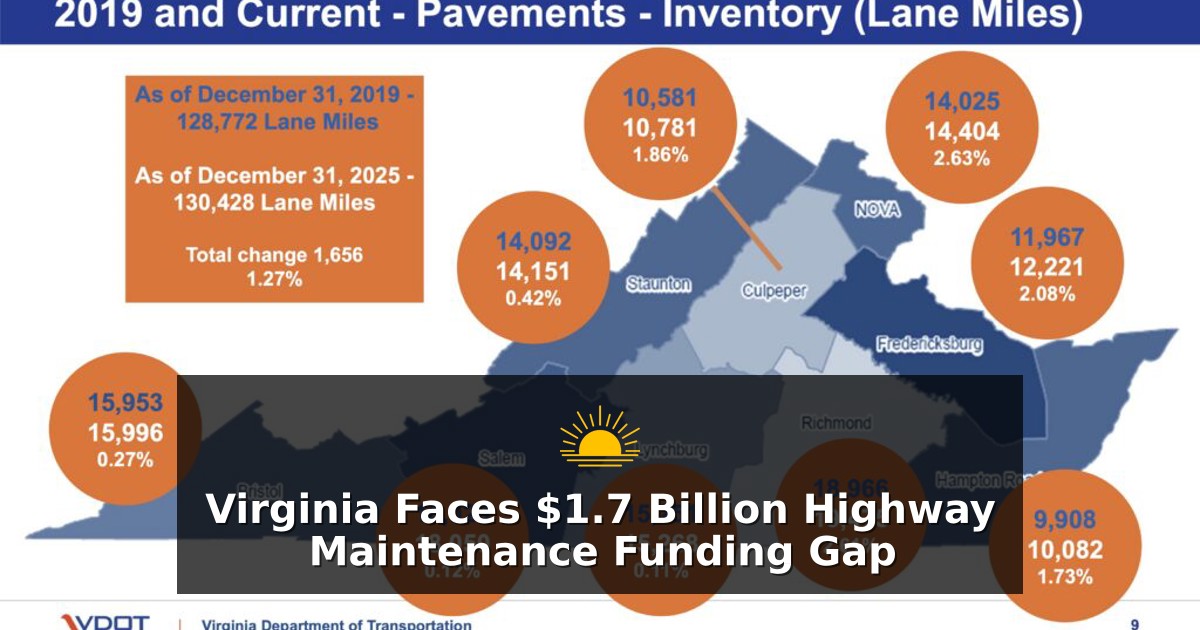
Virginia is heading toward a major highway maintenance shortfall, with transportation planners warning that the state could be about $1.7 billion short of what is needed to keep roads and bridges in their current condition.
The projection is not a claim that roads will suddenly close. It is a warning that routine work could be delayed, forcing Virginia to spend more later on repairs that would have been cheaper to complete earlier. Asphalt, bridge joints, culverts, guardrails and traffic signals all wear out on different schedules, and a backlog can grow quietly before drivers notice the consequences.
Virginia has dedicated transportation revenues, but those sources do not automatically rise as quickly as construction costs. Officials must balance maintenance against new highway projects, public transit, rail, ports and other commitments. Every dollar directed to a new project is a dollar that cannot immediately address an older bridge or a deteriorating pavement section.
The gap also reflects changing expectations. Drivers want roads that are safe and smooth, while communities expect transportation agencies to manage flooding, protect water quality and make room for pedestrians and cyclists. Those goals are worthwhile, but they require planning beyond a simple resurfacing schedule.
Possible responses include increasing dedicated revenue, adjusting how projects are prioritized or asking large transportation users to contribute more directly. Each option has political and economic consequences. A higher fee affects drivers and businesses, while moving money from new construction can delay promised improvements. Borrowing can accelerate work but leaves future budgets responsible for debt payments.
Lawmakers may also look for savings through better project coordination. Utilities, local governments and transportation agencies can schedule work together so a road is opened once instead of repeatedly. New materials and construction methods may extend service life, although officials must verify that a lower initial price does not produce higher costs later.
What drivers should watch
The funding debate will not be resolved by one budget vote. Residents should expect discussions about maintenance backlogs, bridge conditions, tolls, fuel taxes and the balance between rural and urban needs. Public hearings matter because a statewide number can hide very different local experiences.
For drivers, the most important result will be a transportation system that is predictable and safe. Virginia's economy depends on people and goods moving through every region. Closing the maintenance gap may not create a dramatic new landmark, but it can prevent small failures from becoming expensive crises.
This article is an original rewrite based on recent Virginia Mercury reporting about the projected highway maintenance shortfall.Why early work matters
Engineers generally prefer to preserve pavement before it fails. A seal, overlay or targeted repair can extend a road's life at a fraction of the cost of rebuilding the entire surface. When a project is postponed repeatedly, water reaches the base, cracks widen and the eventual reconstruction becomes more disruptive and expensive.
The same principle applies to bridges. Inspections can identify small problems with concrete, joints and drainage. Addressing them early can prevent a closure or a weight restriction that disrupts school buses, freight and emergency response. Maintenance is less visible than a ribbon-cutting ceremony, but it is central to keeping the network reliable.
A maintenance bill that keeps changing
The cost of caring for the transportation network has increased along with labor, fuel, concrete, steel and equipment. Storms also damage roads and drainage systems, while heavier traffic accelerates wear on heavily used corridors. Rural routes may need work spread over long distances, and urban projects often require traffic control that raises the price of each job.
Bridges Budget Debate Debt economy Flooding Labor Lawmakers Rail Repairs School Storms Taxes Traffic Transportation Virginia Water