Virginia House Bill Extends Procurement Preference for Local Agricultural Products
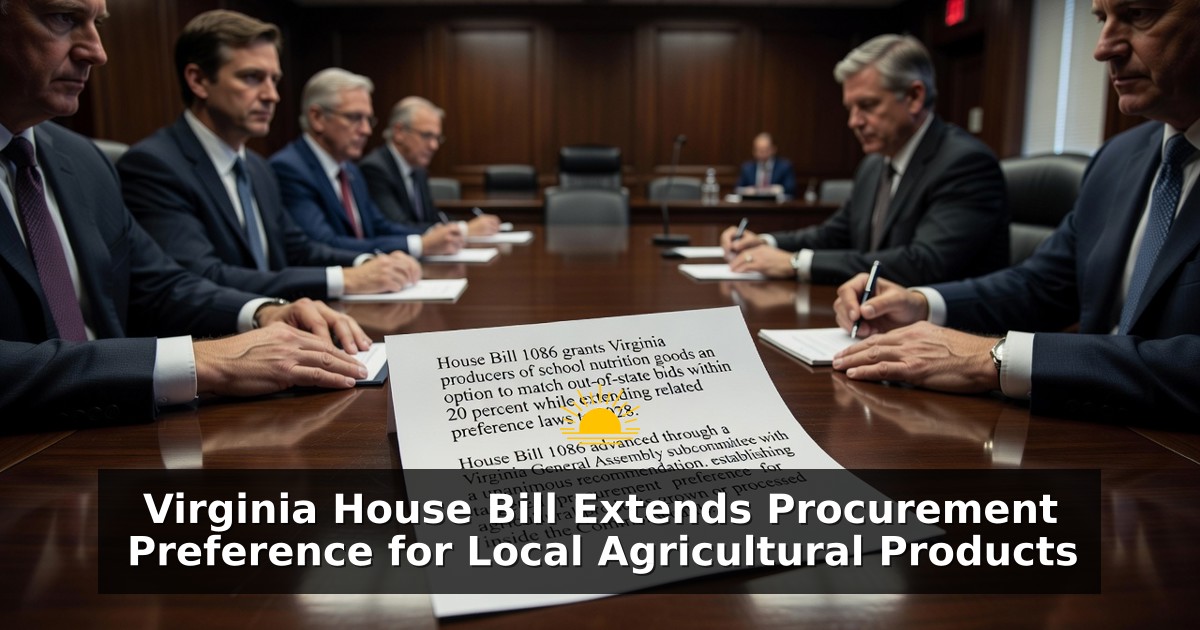
House Bill 1086 advanced through a Virginia General Assembly subcommittee with a unanimous recommendation, establishing a targeted procurement preference for agricultural products grown or processed inside the Commonwealth. The measure focuses on goods intended for school nutrition programs and applies when the lowest responsive and responsible bidder is not a Virginia resident. Under the proposal, a qualifying in-state bid that falls within 20 percent of the lowest offer receives the opportunity to match that price. Lawmakers framed the change as a practical step to keep more fresh fruits, vegetables, and dairy products circulating through public school kitchens while supporting domestic producers.
The legislation amends existing statutes that already grant limited preferences to Virginia goods in public purchasing. Those earlier provisions were scheduled to expire on July 1, 2027. House Bill 1086 pushes the sunset date forward to July 1, 2028, thereby preserving continuity for agencies and school divisions that rely on the framework. Subcommittee members voted 10-0 to report the bill, signaling broad procedural support at that stage of review. The patron of the measure is Delegate Law, who introduced the text to clarify how the matching option operates specifically for agricultural items destined for student meals.
Procurement Preference Mechanics for School Meals
Public bodies seeking agricultural products for school nutrition programs must first identify the lowest responsive and responsible bid. If that bid originates outside Virginia, any competing offer from a Virginia producer or processor may invoke the matching right provided the price difference does not exceed 20 percent. Once matched, the in-state supplier can secure the contract under the same terms. The preference covers fresh fruits, vegetables, and dairy products, categories that appear regularly on school menus and that benefit from shorter supply chains. Officials noted that the mechanism does not displace competitive bidding; it merely equalizes the final price when local goods are nearly as economical.
School nutrition directors across Virginia routinely balance cost, quality, and availability when awarding contracts. By allowing a local match within a defined percentage band, the bill reduces the likelihood that modest price gaps will automatically exclude nearby farms and processors. Shorter transportation distances can also improve product freshness upon delivery, an outcome frequently cited in discussions of student meal standards. The 20-percent threshold is intended to keep the preference narrow enough to protect taxpayer value while still offering a meaningful chance for Virginia suppliers to compete.
Economic Context for Virginia Agriculture
Agriculture remains a foundational sector of the Virginia economy, encompassing diverse operations that range from large-scale dairy farms to specialty fruit and vegetable growers. Many of these enterprises already sell into institutional markets, yet they sometimes lose contracts to lower out-of-state bids even when quality and logistics favor local sources. House Bill 1086 seeks to address that gap for the subset of purchases tied to school feeding programs. Extending the broader Virginia-goods preference statutes through mid-2028 further signals that the General Assembly intends to maintain a stable policy environment for in-state vendors.
Local producers who successfully match bids stand to gain steadier revenue streams and clearer planning horizons. School divisions, in turn, gain access to products that may arrive with greater frequency and reduced handling time. The bill does not mandate exclusive use of Virginia goods; it simply inserts an optional matching step under tightly defined conditions. That design preserves open competition while tilting the final decision toward domestic suppliers when price differentials remain modest. Observers familiar with state purchasing practices described the approach as incremental rather than transformative, yet still material for farms that already meet school-grade specifications.
Legislative Timeline and Next Steps
After receiving the unanimous subcommittee endorsement, House Bill 1086 moves forward in the regular legislative sequence. The full committee and later the House floor will examine the same core provisions: the 20-percent matching window, the focus on school nutrition agricultural products, and the two-year extension of the existing preference sunset. No amendments altering the fundamental structure were reported at the subcommittee stage. Delegate Law’s patronage places the measure among the session’s agriculture- and education-related procurement bills.
If enacted, the revised preference would take effect according to the standard enactment schedule for legislation passed in the current session. School nutrition programs would then apply the matching option during subsequent bid cycles for qualifying goods. Procurement officers would document whether an out-of-state low bid triggered the Virginia matching right and whether the local supplier elected to equalize the price. Such documentation ensures transparency and allows future review of how often the preference is exercised. The extension of the general Virginia-goods preference to July 1, 2028, simultaneously prevents an abrupt lapse in related purchasing rules that apply beyond the school-meal context.
Broader Implications for Institutional Buying
Institutional food purchasing in Virginia already incorporates multiple policy goals, including cost control, nutritional standards, and support for domestic industry. House Bill 1086 adds a precise tool that operates only when three conditions align: the low bidder is non-resident, the goods are Virginia-produced or processed agricultural items for school nutrition, and the price gap stays inside 20 percent. Meeting all three criteria unlocks the matching opportunity. The narrow scope limits fiscal exposure while concentrating benefits on the fresh-produce and dairy categories most visible to students and parents.
Advocates of local-food initiatives have long argued that public dollars spent on nearby farms recirculate within the Commonwealth’s economy. The bill does not quantify expected dollar volumes, yet it creates a clear procedural pathway for those dollars to remain closer to home when competitive conditions permit. School meal programs serve hundreds of thousands of students daily across Virginia’s localities, making even incremental shifts in sourcing potentially significant over a multi-year horizon. The 2028 sunset ensures the General Assembly will revisit the preference before it becomes permanent, allowing later sessions to assess actual usage and outcomes.
Implementation Considerations for Agencies
State and local procurement staff will need to update bid solicitations and evaluation checklists to reflect the new matching option. Clear notice to potential bidders about the 20-percent rule helps both in-state and out-of-state suppliers understand the competitive landscape. Virginia producers must still submit fully responsive and responsible bids; the preference does not relax quality, delivery, or documentation requirements. Once a match is offered and accepted, the contract proceeds under ordinary terms. These administrative details keep the preference workable within existing purchasing systems rather than creating an entirely separate track.
The unanimous subcommittee vote suggests the language was viewed as technically sound and limited in controversy at that early stage. Subsequent debate may focus on the precise percentage threshold, the list of covered commodities, or the length of the sunset extension. For now, the bill stands as a straightforward extension and refinement of Virginia’s longstanding practice of giving limited weight to in-state economic activity during public procurement. Its emphasis on school nutrition products links agricultural policy directly to the daily experience of students who rely on those meals.
House Bill 1086 therefore represents a measured adjustment to procurement law rather than a wholesale redesign. By preserving competitive bidding, capping the allowable price differential, and tying the preference to a defined set of agricultural goods, the legislation balances support for local producers with stewardship of public funds. The extension of related preference statutes through 2028 further anchors the policy in a multi-year framework that agencies and vendors can anticipate. As the measure continues through the legislative process, its practical effects will depend on how frequently qualifying bids arise and how often Virginia suppliers choose to exercise the matching right.
agricultural products appropriations bidder clerk committee dairy products fresh fruits goods HB House Bill 1086 July 1st 2027 July 1st 2028 manufacturers preference procurement roll school nutrition programs subcommittee sunset date vegetables Virginia Virginia goods