Virginia Lawmakers Advance Home Health Care Authority Bill for Collective Bargaining
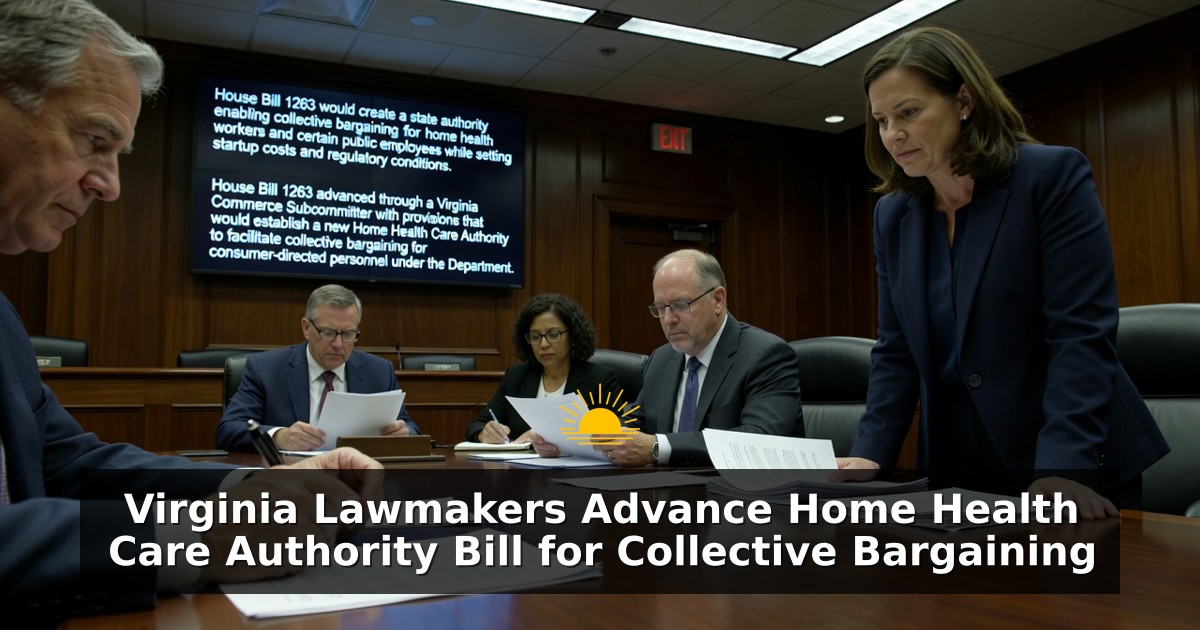
House Bill 1263 advanced through a Virginia Commerce Subcommittee with provisions that would establish a new Home Health Care Authority to facilitate collective bargaining for consumer-directed personnel under the Department of Medical Assistance Services. The measure also extends collective bargaining frameworks to certain state employees while defining clear operational boundaries for the proposed authority. Lawmakers reviewed a substitute version that refines the original language to address implementation timing, institutional exemptions, and fiscal oversight. Supporters and observers note the bill aims to structure representation processes without immediately altering existing employment relationships outside bargaining contexts. The legislation places significant emphasis on preparatory steps before any elections or petitions can proceed.
The substitute clarifies that the Virginia Home Health Care Authority would serve strictly as the employer of record for collective bargaining purposes only. This designation limits the authority’s role to representation and negotiation functions rather than broader operational control over daily care delivery. Consumer-directed personnel working through Medicaid-related programs would gain a formal pathway to organize under this structure. The bill simultaneously addresses state employees by creating parallel mechanisms for bargaining discussions. Officials indicated that these changes seek to prevent confusion over employment status while enabling structured labor relations.
Higher education institutions receive an explicit exemption from the bill’s collective bargaining provisions. This exclusion removes colleges and universities from the scope of the new authority and related employee relations processes. The carve-out reflects longstanding distinctions between general state employment and the governance structures of public higher education systems. Subcommittee members reviewed the exemption as part of broader efforts to tailor the legislation to specific workforce categories. The adjustment ensures that campus employment policies remain governed by existing statutes and institutional rules.
Elections and petitions related to collective bargaining cannot begin until the Public Employee Relations Board develops and finalizes its regulations. The bill establishes this board and houses it within the Department of Labor and Industry to oversee implementation. Regulatory development must precede any formal organizing activity, creating a deliberate timeline for administrative readiness. Placement at the Department of Labor and Industry centralizes labor oversight functions under an existing state agency. This sequencing aims to provide clear rules before workers or employers engage in representation processes.
Legislative prerogative over funding agreements remains intact under the cleaned-up language of the substitute. Any financial commitments arising from collective bargaining outcomes would still require action by the General Assembly. This retention of authority preserves traditional budget controls even as new bargaining structures take shape. Startup costs for the overall framework are estimated at twenty million dollars. That figure includes initial funding needed to stand up the Virginia Home Health Care Authority itself and related administrative capacity.
Home health care services in Virginia support thousands of residents who receive assistance through consumer-directed models under Medicaid. These arrangements allow individuals to manage their own care providers with state program support. Collective bargaining discussions have grown around such workforces in multiple states as demand for in-home services increases with aging populations. The proposed authority would create a dedicated entity focused solely on bargaining logistics for this sector. Fiscal estimates accompanying the bill highlight the need for dedicated startup resources before operations commence.
The Public Employee Relations Board would develop the procedural rules governing petitions, elections, and recognition of bargaining units. Housing the board at the Department of Labor and Industry aligns it with existing wage, hour, and workplace standards functions. Board regulations must address both the home health authority context and state employee provisions. Until those rules are complete, no organizing elections may occur under the bill. This gated approach provides time for stakeholder input during the regulatory drafting phase.
Consumer-directed attendants and similar personnel often work in decentralized settings that differ from traditional institutional workplaces. Establishing an employer of record solely for bargaining purposes offers a mechanism to aggregate representation without restructuring individual client-provider relationships. The bill’s language emphasizes this limited role to maintain continuity of care arrangements. State employee coverage under the same measure introduces parallel but distinct pathways. Together the provisions expand formal labor relations options while embedding multiple procedural safeguards.
Fiscal notes attached to the legislation identify the twenty-million-dollar startup requirement as covering authority formation, board operations, and initial administrative infrastructure. Ongoing costs would depend on the scale of bargaining units that eventually form and any agreements reached. Because the General Assembly retains final say over funding, negotiated outcomes would still face legislative review. Subcommittee discussion underscored the importance of aligning new structures with available resources. The estimate provides a baseline for budget planning in subsequent sessions.
Virginia’s approach mirrors elements seen in other states that have created specialized authorities or boards for home care bargaining. Those models typically separate the bargaining employer function from direct service supervision. The current bill adopts a similar separation by limiting the authority’s role. Exemptions for higher education further customize the framework to Virginia’s institutional landscape. Regulatory prerequisites add another layer of deliberate implementation.
As the measure moves forward, attention will focus on the timeline for Public Employee Relations Board rulemaking and the precise allocation of startup funds. The Department of Labor and Industry would assume responsibility for housing and supporting the new board. Consumer-directed workers and state employees covered by the bill would gain defined routes to seek representation once regulations exist. Lawmakers retained explicit control over any resulting financial agreements. The substitute version presented to the subcommittee incorporates these clarifying elements to guide further consideration.
Observers of workforce policy note that home health demand continues to rise across the Commonwealth as more residents prefer community-based care. Structured bargaining options may influence recruitment and retention in a sector that has faced persistent staffing pressures. At the same time, the twenty-million-dollar initial outlay and subsequent funding decisions will factor into broader budget deliberations. The bill’s design attempts to balance expanded worker representation tools with phased administrative readiness and continued legislative fiscal authority. Further review will determine how these components advance through the remaining legislative process.
Collective Bargaining Commerce Agriculture and Natural Resources consumer directed personnel Department of Labor and Industry DMAS Elections employer of record funding agreements higher education home health care House Bill labor relations petitions Public Employee Relations Board public employees regulations startup costs state employees subcommittee Virginia Virginia Home Health Care Authority