Virginia Lawmakers Quietly Extend Costly Refundable Tax Credit Through 2030
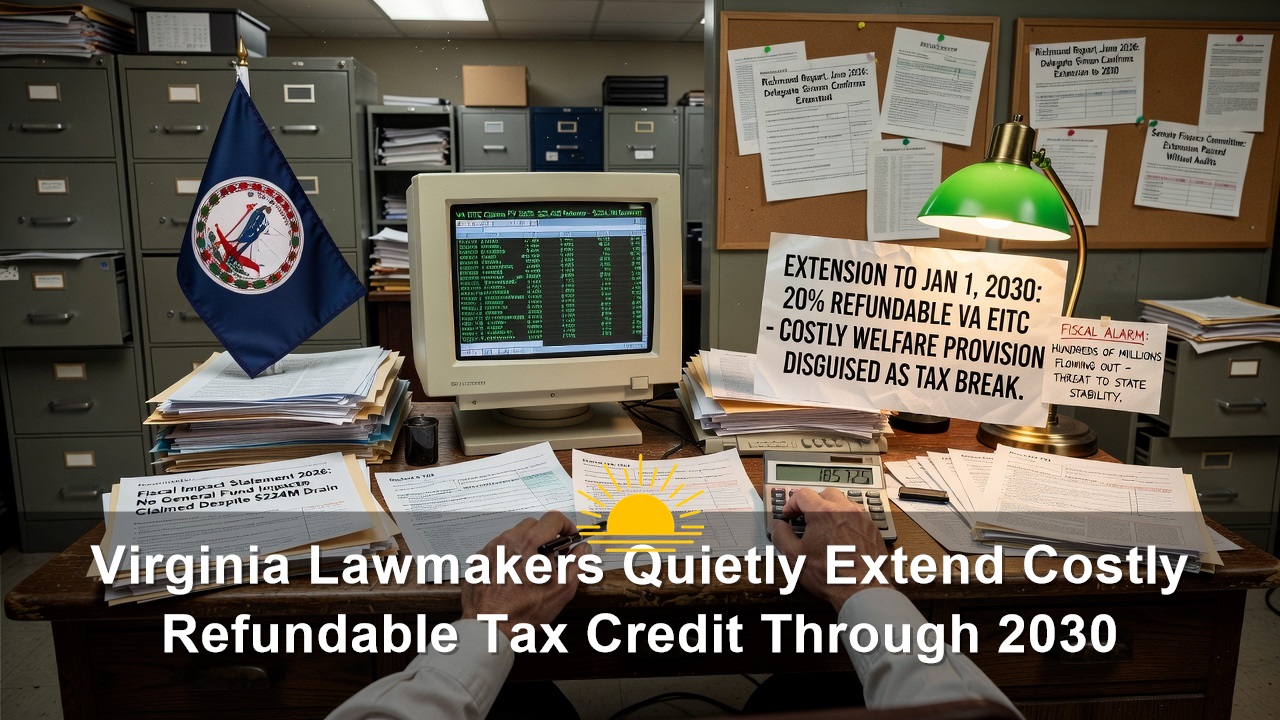
The Virginia state budget continues to expand at an unsustainable pace as lawmakers quietly extend a costly welfare provision disguised as a tax break. Through the third enactment clause of the 2026 Appropriation Act, the state government has officially extended the refundable Virginia Earned Income Tax Credit at twenty percent of the federal level through January 1, 2030. This legislative maneuver guarantees that hundreds of millions of taxpayer dollars will continue flowing out of the state treasury to individuals who often have zero actual state income tax liability. Fiscal conservatives across the Commonwealth are raising the alarm over this rapid expansion of refundable credits, viewing it as a direct threat to the financial stability of the state and a massive burden on hard-working citizens.
Refundable tax credits function fundamentally differently than traditional tax cuts, operating instead as direct government wealth transfers that drain the public treasury. When a taxpayer’s credit exceeds their actual tax liability, the state simply cuts them a check for the difference, effectively transforming the Department of Taxation into a vast welfare distribution agency. In fiscal year 2025 alone, the combined Low-Income Tax Credit and the Virginia Earned Income Tax Credit were claimed on nearly half a million individual tax returns. Specifically, these expensive credits appeared on 522,435 returns, draining a staggering $224.1 million from state coffers in a single year while providing zero benefit to middle-class families footing the bill.
Rapid Expansion and Budgetary Gimmicks
The brief history of this specific tax credit perfectly illustrates the classic pattern of unchecked government program expansion and perpetual spending creep. Virginia only recently introduced the refundable version of the Earned Income Tax Credit in 2022, initially setting the rate at a modest fifteen percent of the federal credit. By 2025, lawmakers had already increased the rate to twenty percent of the federal level, significantly expanding the financial burden on the taxpayers who actually fund the government. Originally scheduled to expire after taxable year 2026 under prior law, this costly wealth redistribution scheme is now firmly locked into the state budget until the end of the decade.
Bureaucrats in Richmond are currently using clever accounting tricks and bureaucratic double-speak to downplay the true financial impact of extending this expensive state program. According to a 2026 Fiscal Impact Statement from the Department of Taxation, making the refundable credit permanent supposedly has no General Fund revenue impact whatsoever. The agency justifies this highly misleading claim by stating that the massive financial drain was already assumed in the official state revenue forecast long before the vote occurred. By baking the exorbitant expenses into the baseline budget projections, lawmakers intentionally mask the reality that extending this program costs taxpayers hundreds of millions of dollars over the next four years.
Lawmakers across the political spectrum have publicly confirmed the quiet continuation of this massive budgetary commitment without offering any plans for fiscal reform. Delegate Marcus Simon openly noted in a June 2026 Richmond Report that the refundable Earned Income Tax Credit remains firmly set at twenty percent through the year 2030. Both the Senate Finance and Appropriations Committee and the House Finance Committee allowed this costly extension to pass without demanding substantial audits to protect the state treasury from potential fraud. This ongoing failure to rein in the budget highlights a troubling disregard for fiscal responsibility and underscores the immediate need for stricter conservative oversight of all state expenditures.
Questionable Spending and Taxpayer Burden
Beyond the direct operational cost of the tax credits themselves, the state is also funneling public money to outside non-governmental organizations to promote the program. The Virginia Community Action Partnership currently receives a guaranteed $185,725 annually from the state budget specifically to support the Virginia Earned Income Tax Coalition. Fiscal watchdogs strongly argue that using hard-earned taxpayer dollars to fund an outside advocacy coalition represents a gross misuse of public resources that must be stopped immediately. Eliminating these completely unnecessary administrative grants would be an incredibly easy first step toward reducing systemic waste and returning money to the rightful owners.
The continuous extension of refundable tax credits directly undermines the core conservative principles of limited government, strict fiscal restraint, and respect for the taxpayer. If Virginia is ever to achieve a truly balanced budget that honors the working class, lawmakers must immediately stop using the complex tax code to redistribute wealth. Legislative sunset clauses are utterly meaningless if the state legislature simply rubber-stamps extensions without conducting rigorous audits to identify potential fraud and eliminate systemic waste. Taxpayers deserve a responsible government that prioritizes saving money, reducing the overarching tax burden, and permanently eliminating stealth welfare programs from the state ledger.
Virginia House of Delegates Virginia Senate Aaron Rouse Abigail Spanberger Adam Ebbin Adele McClure Alex Askew Alfonso Lopez Amy Laufer Angelia Williams Graves Anne Tata Atoosa Reaser Barbara Favola Barry Knight Betsy Carr Bill DeSteph Bill Wiley Bonita Anthony Briana Sewell Bryce Reeves Buddy Fowler Budget Charlie Schmidt Charniele Herring Chris Runion Christie Craig Christopher Head Cia Price Cliff Hayes Creigh Deeds Dan Helmer Danica Roem Danny Diggs David Marsden David Reid David Suetterlein Debra Gardner Delores McQuinn Delores Oates Destiny LeVere Bolling Don Scott Elizabeth Bennett-Parker Elizabeth Guzman Ellen McLaughlin Emily Jordan Eric Phillips Eric Zehr Families Fraud Garrett McGuire Glen Sturtevant Grants Gretchen Bulova Hillary Kent Holly Seibold Irene Shin Israel O'Quinn Jackie Glass Jas Jeet Singh Jason Ballard Jay Leftwich Jeion Ward Jennifer Boysko Jennifer Carroll Foy Jeremy McPike Jessica Anderson John McAuliff Joseph McNamara Josh Thomas Joshua Cole Justin Pence Kacey Carnegie Kannan Srinivasan Karen Hamilton Karen Keys-Gamarra Karrie Delaney Kathy Tran Katrina Callsen Keith Hodges Kelly Convirs-Fowler Kimberly Pope Adams Lamont Bagby Lashrecse Aird Laura Cohen Lawmakers Lee Ware Leslie Mehta Lily Franklin Lindsey Dougherty Louise Lucas Luke Torian Luther Cifers Madison Whittle Mamie Locke Marcus Simon Margaret Franklin Mark Downey Mark Obenshain Mark Peake Marty Martinez May Nivar Michael Feggans Michael Jones Michael Webert Michelle Maldonado Mike Cherry Mitchell Cornett Nadarius Clark Nicole Cole Otto Wachsmann Patrick Hope Paul Krizek Phil Hernandez Phillip Scott Rae Cousins Richard Stuart Richmond Rip Sullivan Robert Bloxom Rodney Willett Rozia Henson Russet Perry Ryan McDougle Saddam Salim Sam Rasoul Schuyler VanValkenburg Scott Surovell Scott Wyatt Senate Shelly Simonds spending Stacey Carroll Stella Pekarsky Tammy Mulchi Tara Durant Terry Austin Terry Kilgore Tim Griffin Timmy French Todd Pillion Tom Garrett Tommy Wright Tony Wilt Travis Hackworth Virgil Thornton Virginia Virginia House of Delegates Virginia Senate Vivian Watts Wendell Walker Will Davis Will Morefield William Stanley Wren Williams