Virginia Preserves Data Center Tax Exemption Amid Budget Battles and Fiscal Concerns
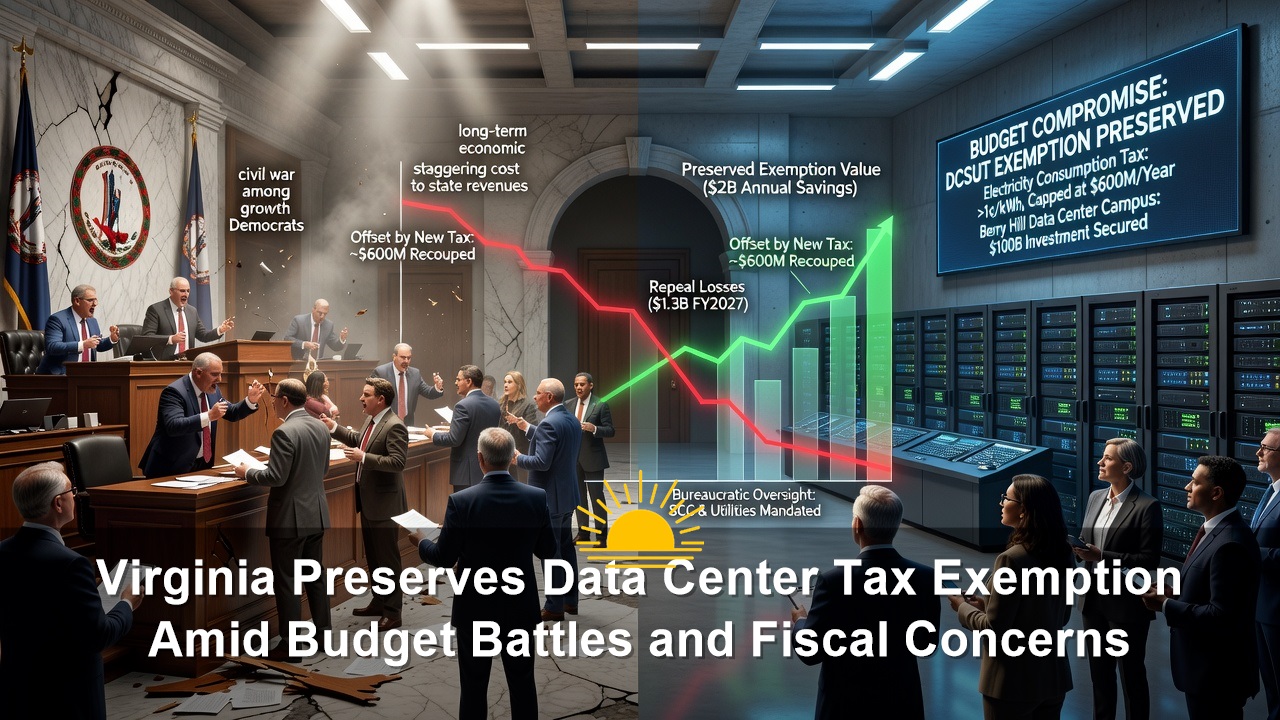
The Virginia General Assembly has finalized a contentious fiscal year 2027 budget that preserves the highly debated Data Center Retail Sales and Use Tax Exemption. Lawmakers navigated intense legislative clashes to maintain the lucrative tax break, which saves the data center industry an estimated two billion dollars annually. This decision keeps the commonwealth competitive for massive capital investments while attempting to balance the state ledger through a newly implemented electricity consumption tax. Fiscal conservatives are closely monitoring the situation to ensure that corporate incentives do not lead to out-of-control state spending, bureaucratic bloat, or increased financial burdens on everyday taxpayers.
The preservation of the data center exemption comes at a staggering cost to state revenues, requiring careful scrutiny from those who champion balanced budgets and fiscal restraint. A recent report authored by the Virginia Department of Taxation estimated the value of this preserved exemption at nearly two billion dollars for fiscal year 2025 alone. If the legislature had fully repealed the measure, estimates suggest it would have generated one billion three hundred million dollars in fiscal year 2027 and slightly more the following year. Instead of a full repeal, lawmakers crafted a compromise designed to protect business interests without completely draining the public treasury or forcing tax hikes elsewhere.
A Compromise on Corporate Taxation
To offset the massive revenue loss caused by the tax exemption, the new budget introduces a first-of-its-kind electricity consumption tax starting July 1, 2026. Data centers will face a levy of slightly more than one cent per kilowatt-hour of electricity consumed, which is strictly capped at six hundred million dollars per fiscal year. Any tax revenue collected beyond this annual cap will be refunded pro rata to the data center operators, ensuring the industry is not subjected to boundless taxation. This mechanism effectively recoups roughly one-third of the revenue previously lost to the exemption while maintaining the core tax incentives that drive technological development in Virginia.
The path to this budget compromise exposed deep fractures within the legislative majority, highlighting significant disagreements over fiscal policy and corporate welfare. House Speaker Don Scott bluntly described the intense intra-party legislative conflict over whether to repeal the data center tax exemption as a civil war among Democrats. The chaotic negotiations threatened to derail the state budget entirely, raising alarms among fiscal watchdogs who demand stable, predictable, and responsible governance. Ultimately, the political infighting forced a middle-ground approach that narrowly avoided a government shutdown and secured essential state funding without completely abandoning pro-business tax structures.
Bureaucratic Expansion and Economic Impact
Implementing this new tax structure will require expanded bureaucratic oversight, a development that traditionally concerns advocates for smaller government and reduced state spending. The State Corporation Commission is now tasked with receiving reports, issuing guidelines, and directly collecting the new electricity consumption tax on self-supplied electricity. Meanwhile, traditional electric utilities are mandated to collect the new tax via monthly invoices for third-party provided electricity. Taxpayer advocates argue that this added administrative layer must be strictly monitored to prevent government waste, eliminate potential fraud, and ensure that the collection process remains highly efficient.
Despite the administrative costs, legislators and industry lobbyists justified the compromise as a necessary measure to generate essential state revenue and address grassroots concerns over electrical grid strain. They argued that preserving Virginia’s reputation as a business-friendly environment was critical to preventing the loss of massive capital investments to competing states. For example, projects like the proposed one hundred billion dollar Berry Hill data center campus can now advance under the preserved exemption rules. Securing these monumental private investments is vital for long-term economic growth, provided the state does not squander the resulting economic benefits on bloated government programs.
Looking Ahead to Fiscal Year 2027
State officials expressed relief that the budget impasse was finally resolved, even if the final legislative product required significant concessions from all involved parties. Governor Abigail Spanberger stated that the General Assembly moved forward with a budget proposal that keeps the government open and delivers for the state’s residents. She added that there is a lot to be proud of in the budget, though fiscal conservatives remain wary of the long-term spending implications hidden within the details. State Senator Danica Roem highlighted the financial victory of the new tax revenue, noting that securing six hundred million dollars annually is certainly a substantial achievement for the state treasury.
Moving forward, Virginia taxpayers must demand total transparency regarding how these new tax revenues are utilized within the expansive state budget. The original data center exemption was scheduled to last through 2035, and up to 2050 for certain mega-projects, meaning its fiscal impact will be felt for generations. Lawmakers must ensure that the one billion two hundred million dollars collected over the upcoming two-year budget cycle is used to reduce the overall tax burden rather than fund new government waste. Only through rigorous fiscal discipline can Virginia balance its pursuit of high-tech industry growth with its fundamental obligation to protect the hard-earned money of its citizens.
Virginia House of Delegates Virginia Senate Abigail Spanberger Budget Civil War Danica Roem Data Data Center Data Centers Democrats Don Don Scott Electric Electrical Electrical Grid Electricity Fraud Governor Grid Lawmakers Policy Scott Senator spending Virginia