Virginia Advances Fee Hike on Traffickers to Bolster Victim Services
Updated
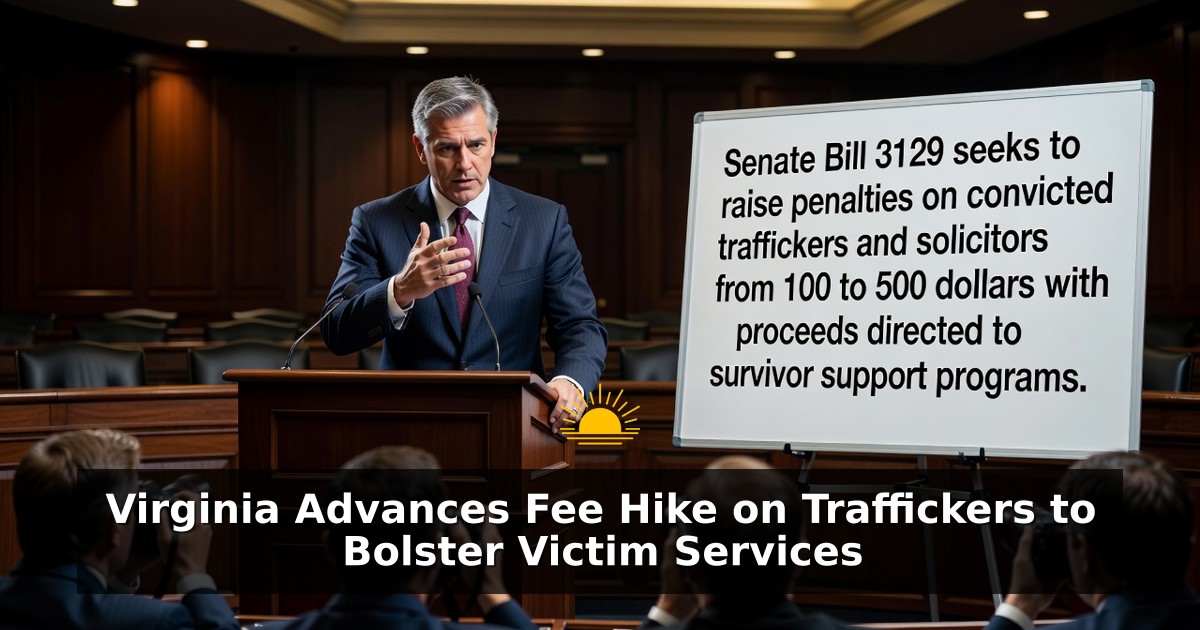
Virginia lawmakers are considering a measure that would substantially increase financial penalties on individuals convicted of human trafficking and related solicitation offenses. Senate Bill 3129 proposes raising the existing fee from 100 dollars to 500 dollars for those found guilty of such crimes. The legislation aims to channel every dollar collected into dedicated support services for survivors. Delegate Delaney presented the bill during a recent legislative session and highlighted its alignment with parallel efforts in the House of Delegates.
The proposed change would bring Senate Bill 3129 into conformity with House Bill 1223, creating consistent standards across both chambers. Officials indicated that the two measures would be adjusted to match one another in key provisions. This coordination seeks to avoid discrepancies in how fees are assessed and distributed statewide. Lawmakers emphasized the importance of uniform application so that courts and agencies can implement the policy without confusion.
Under the bill, all revenue generated by the elevated fee would be deposited into the Virginia Sexual and Domestic Violence Fund. That fund already serves as a primary state resource for programs assisting victims of sexual assault, domestic violence, and human trafficking. Clarifying language in the legislation would explicitly confirm that the fund covers both human trafficking survivors and those affected by domestic violence. Supporters argue this designation ensures resources reach the intended populations without diversion to unrelated uses.
Human trafficking remains a persistent challenge across Virginia, affecting urban centers and rural communities alike. State agencies and nonprofit organizations have long reported that survivors often require immediate housing, counseling, legal assistance, and medical care after escaping exploitative situations. Increased dedicated funding could expand the capacity of existing shelters and service providers. The fee structure places the financial burden on convicted offenders rather than on general taxpayers or already strained local budgets.
Delegate Delaney urged colleagues to advance the bill through engrossment and toward final passage. The delegate described the measure as a practical step that strengthens accountability while generating tangible resources for victim support. Session discussions focused on the straightforward nature of the fee adjustment and the clear destination of the resulting funds. No complex new bureaucracy would be required, as the existing fund infrastructure would simply receive additional deposits.
Current Virginia law already imposes a 100-dollar fee on certain trafficking and solicitation convictions. Raising that amount fivefold reflects growing recognition of the high costs associated with long-term survivor recovery. Service providers frequently note that comprehensive support can span months or years and involve multiple specialized agencies. Directing offender-paid fees into the state fund creates a sustainable revenue stream tied directly to the crimes themselves.
The Virginia Sexual and Domestic Violence Fund distributes grants to local programs that operate hotlines, emergency shelters, counseling centers, and advocacy services. By explicitly linking the higher trafficking fees to this fund, the bill reinforces the connection between enforcement actions and victim assistance. Clarifications included in the legislation would prevent any ambiguity about eligibility, ensuring trafficking survivors receive equal consideration alongside domestic violence victims. This dual focus acknowledges the overlapping trauma many individuals experience.
Legislative observers note that similar fee-based approaches have been used in other states to underwrite victim services without relying solely on annual appropriations. In Virginia the model builds on established mechanisms already familiar to courts and the Department of Criminal Justice Services. Implementation would involve updating fee schedules and ensuring clerks of court route the additional amounts correctly. Training materials and guidance documents could be issued once the measure becomes law.
Beyond the immediate fiscal impact, the bill sends a public signal that Virginia treats trafficking offenses with heightened seriousness. Advocates for survivors have consistently called for both stronger penalties and more robust support systems. The combination of increased offender accountability and expanded funding addresses those twin priorities in a single piece of legislation. Lawmakers supporting the measure framed it as a balanced response that avoids purely punitive approaches while still delivering consequences.
As the session continues, the bill must complete remaining procedural steps before reaching the governor’s desk. Engrossment would lock in the agreed language, including the fee increase and the fund designation. Final passage in both chambers would then allow the measure to take effect according to standard timelines. Stakeholders in the victim-services community are expected to monitor progress closely given the direct bearing on their operational budgets.
The proposal arrives amid broader state efforts to combat human trafficking through education, law enforcement training, and public awareness campaigns. Fee revenue represents only one component of a multi-faceted strategy, yet it offers a concrete and recurring source of support. By tying the financial penalty to the Virginia Sexual and Domestic Violence Fund, legislators create a closed loop in which the consequences of trafficking help finance recovery for those harmed. Continued oversight would ensure the funds are tracked and reported transparently.
In summary, Senate Bill 3129 and its companion House measure represent a targeted adjustment to existing criminal fees. The fivefold increase, the dedication of proceeds to survivor services, and the clarification of fund purposes form the core of the initiative. Delegate Delaney’s presentation underscored the practical benefits and the desire for swift advancement. If enacted, the change would take effect under ordinary statutory schedules and begin generating additional resources for programs already serving vulnerable Virginians.
bill Convicted delegate Delegate Delaney domestic violence Domestic Violence Fund Fee fees Human Trafficking Increase raises Senate Senate Bill 3129 session Traffickers trafficking Virginia Virginia legislation