Virginia Senate Examines Limits on Police Drone Deployments
Updated
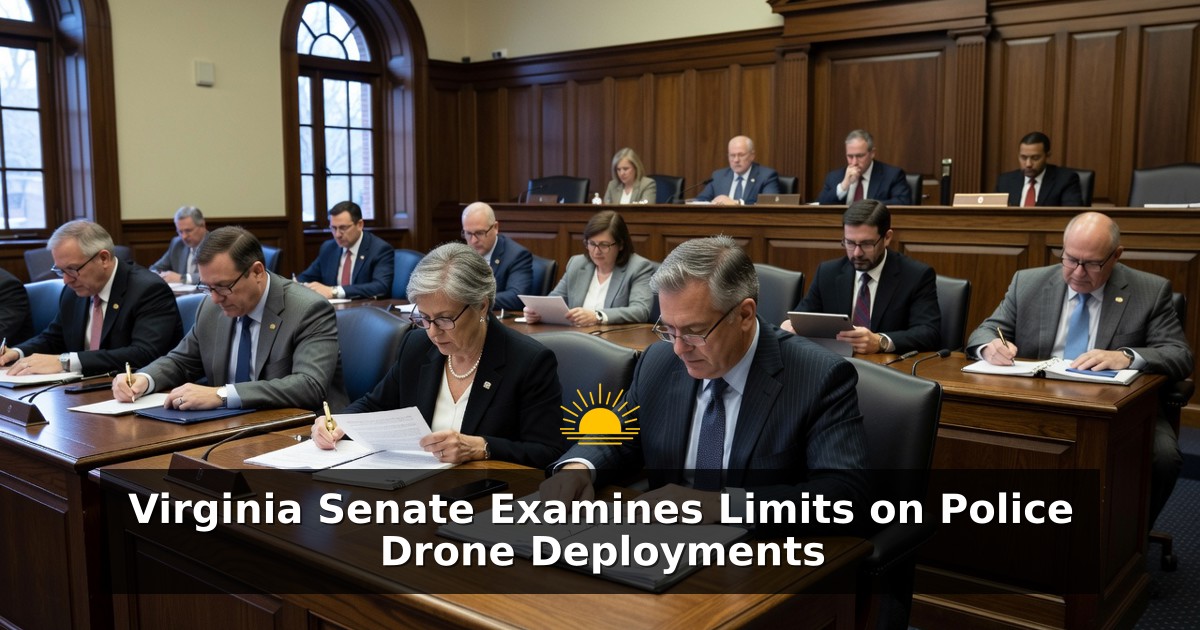
The Virginia Senate Courts of Justice Committee convened on February 11, 2026, to consider legislation that would establish clear parameters for law enforcement use of unmanned aircraft systems. The measure focuses on deploying drones in narrowly defined first-responder situations to improve situational awareness and operational efficiency. Supporters of the proposal emphasize that the technology could assist officers without expanding surveillance powers beyond immediate public-safety needs. The discussion centered on balancing technological advantages against longstanding concerns about privacy and appropriate oversight.
Committee members heard that the bill originated from collaborative work between legislators and police departments across the state rather than from any single state agency. Senator Pillian explained that the effort sought to give officers unambiguous guidance on permissible drone operations. Delegate Soule partnered on the measure during the legislative off-season to address practical questions raised by local departments. The resulting language aims to reduce uncertainty while keeping deployments tightly restricted.
Authorized Scenarios for Aerial Support
Under the proposal, drones could provide real-time aerial observation when officers respond to emergency calls. This capability would allow commanders to assess unfolding incidents from above before ground units arrive on scene. Digital documentation of crime scenes located on public property forms another permitted use, enabling rapid and accurate recording of evidence. Such imagery could preserve details that might otherwise change due to weather or human activity. The bill further authorizes assistance in locating and identifying persons of interest, but only while officers are physically en route to the area.
Fire and rescue operations also fall within the approved scope, permitting aerial surveys that help coordinate ground teams during hazardous incidents. Lawmakers stressed that these applications remain confined to extremely limited circumstances. The original intent centers on intelligence assistance and aerial surveillance solely when they directly support immediate response efforts. No broader patrol or continuous monitoring authority appears in the draft language. Clear statutory boundaries are intended to prevent mission creep as departments adopt the technology.
Context of Growing Technology Adoption
Unmanned aircraft systems have become increasingly common tools for public-safety agencies nationwide as costs decline and capabilities improve. In Virginia, departments have sought consistent statewide rules so that practices do not vary widely from one locality to another. The current bill responds to that request by enumerating specific operational windows rather than leaving decisions solely to local policy. Proponents argue that standardized guidance protects both officers and residents by removing ambiguity. At the same time, the narrow drafting reflects awareness of public sensitivity surrounding airborne cameras.
Experience in other jurisdictions shows that drones can shorten response times and reduce risks to personnel during volatile calls. Real-time video feeds, for example, have helped incident commanders allocate resources more effectively in active situations. Documentation of outdoor crime scenes can create permanent visual records that aid later investigations and court proceedings. Search efforts for missing or fleeing individuals likewise benefit from elevated vantage points when ground teams are already moving toward the location. Fireground mapping supplies thermal and visual data that improve firefighter safety.
Privacy Safeguards and Oversight Questions
The legislative conversation acknowledged that any expansion of aerial technology raises legitimate privacy questions among residents. By restricting use to emergency responses, public-property crime scenes, en-route locating efforts, and fire-rescue support, the bill attempts to keep operations tethered to concrete public-safety events. Continuous or suspicionless surveillance is not contemplated in the described framework. Lawmakers noted that existing constitutional protections and state privacy statutes would continue to apply to any imagery collected. Departments would still need to justify each deployment under the listed categories.
Observers of the hearing pointed out that transparency measures, such as logging flight times and purposes, often accompany similar statutes elsewhere. Although the Virginia proposal focuses first on authorization, future implementing regulations could address data retention and public reporting. The committee process itself provides an early opportunity for stakeholders to flag potential gaps. No opposition was registered during the immediate call for comment, yet the broader debate over aerial policing tools remains active across the Commonwealth. Continued scrutiny is expected as the measure advances.
Collaborative Origins and Practical Motivations
Senator Pillian underscored that the legislation grew from direct conversations with police departments seeking clarity rather than from a top-down agency request. Officers reported uncertainty about when drone flights would withstand legal or public challenge. By codifying four primary scenarios, the bill supplies a reference point that local agencies can incorporate into training and policy manuals. Delegate Soule’s involvement during the off-season helped refine the language to match operational realities on the ground. The partnership illustrates how practitioner input can shape technology statutes before problems arise in the field.
One participant referenced observing advanced drone applications abroad, including temporary communications support, as an illustration of rapid innovation in the sector. While those particular functions lie outside the current Virginia draft, the comment highlighted the pace at which unmanned systems are evolving. Lawmakers must therefore craft language flexible enough to accommodate useful tools yet precise enough to maintain accountability. The present bill concentrates on core first-responder roles that departments already identify as high-value and low-controversy. Additional capabilities would require separate legislative consideration.
Broader Implications for Public Safety Policy
Adoption of clear drone rules could improve coordination among Virginia’s diverse law-enforcement agencies during multi-jurisdictional events. Shared understanding of authorized uses reduces hesitation when mutual aid is requested. Residents may also gain confidence from knowing that flights occur only under published statutory conditions. Effective implementation will depend on training standards, equipment certification, and adherence to federal aviation requirements that already govern all unmanned aircraft. The interplay between state authorization and federal airspace rules remains an important practical layer.
As technology continues to advance, periodic legislative review will likely become necessary to keep statutes aligned with both capabilities and community expectations. The February hearing represents an early step in that ongoing process rather than a final resolution. Committee members examined the text for precision and necessity before deciding on further action. The emphasis throughout remained on enhancing officer effectiveness in discrete, high-stakes moments while preserving public trust. Future hearings may explore fiscal impacts, training mandates, and data-management protocols that accompany wider deployment.
The measure now moves through the remaining stages of Senate consideration, where additional testimony and possible amendments can refine its scope. Stakeholders from law enforcement, civil-liberties organizations, and local government are expected to monitor progress closely. Whatever the ultimate outcome, the debate underscores Virginia’s effort to integrate new tools thoughtfully into traditional public-safety frameworks. Clear rules, limited applications, and continued oversight form the foundation of the approach under review. The committee’s work contributes to a larger statewide conversation about responsible innovation in policing.
advanced technology crime policy crime scene documentation drone operations drone usage emergency response Law Enforcement law enforcement tools Legislation police capabilities police effectiveness policing technology privacy concerns public safety Senate Senate deliberation Virginia Virginia law Virginia policy Virginia Senate