Virginia Taxpayers Face Millions in New Costs as 2027 and 2028 Home Care Wage Mandates Expand State Bureaucracy
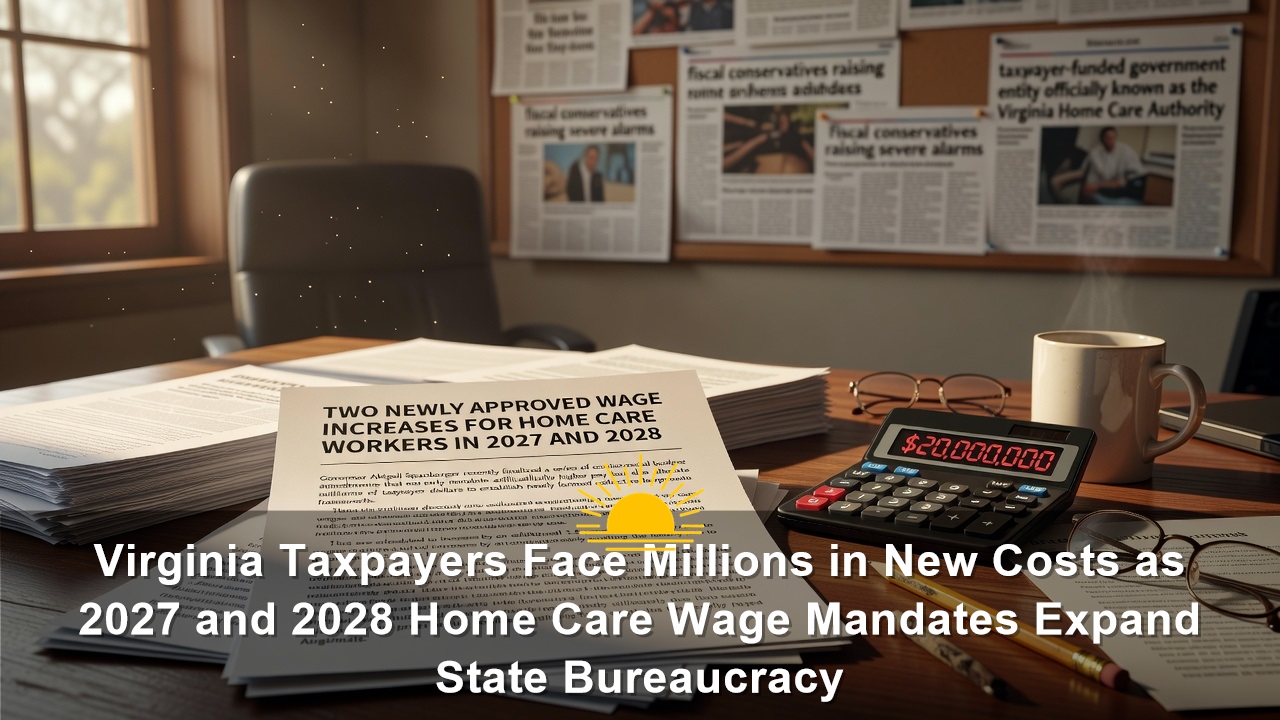
Virginia taxpayers are bracing for a massive expansion of state spending following the recent approval of aggressive wage increases for home care workers scheduled for 2027 and 2028. Governor Abigail Spanberger recently finalized a series of controversial budget amendments that not only mandate artificially higher pay but also allocate millions of taxpayer dollars to establish newly formed collective bargaining frameworks. Fiscal conservatives across the Commonwealth are raising severe alarms over the immediate authorization of twenty million dollars in public funds dedicated strictly to administrative start-up costs for these unionization efforts. This aggressive legislative push to inflate the state budget threatens to place an entirely unnecessary financial burden on hardworking citizens while rapidly expanding the reach of bureaucratic oversight.
The finalized budget legislation drastically accelerates previously planned pay raises, forcefully pushing the first round of government-mandated wage increases to take effect on January 1, 2027. During this initial implementation phase, home care workers will receive a four percent wage increase, which establishes a new statutory minimum target of $13.75 per hour across the board. The following year, on January 1, 2028, wages are scheduled to increase by an additional 3.9 percent, ultimately pushing the hourly rate to a mandated $15.00 per hour. Prior to the imposition of these sweeping financial mandates, many consumer-directed home care workers outside of Northern Virginia earned $13.88 an hour, which already sat comfortably above the standard state minimum wage of $12.77.
Bureaucratic Expansion and Taxpayer Costs
Beyond the direct, compounding cost of the wage hikes themselves, the fiscal year 2027 budget irresponsibly funnels $20.0 million directly into collective bargaining start-up costs. A significant portion of this massive public expenditure will directly fund the creation of an entirely new, taxpayer-funded government entity officially known as the Virginia Home Care Authority. Furthermore, the sweeping legislation completely repeals long-standing statutory prohibitions, dangerously opening the door for state-funded home care workers to engage in collective bargaining for the very first time in Virginia history. Fiscal watchdogs argue that this multi-million-dollar allocation represents a textbook example of government overspending that prioritizes union organizing machinery over actual patient care or genuine taxpayer relief.
The inevitable ripple effects of this state-sponsored unionization effort will force multiple existing state agencies to drastically expand their administrative operations and internal budgets. The Department of Medical Assistance Services, the Public Employee Relations Board, and the Department of Labor and Industry will all be heavily burdened with managing the complexities of these new labor mandates. Additionally, the Department of Planning and Budget and the Department of Human Resource Management must now divert valuable resources to oversee the convoluted integration of collective bargaining into the state system. Expanding the regulatory responsibilities of six different state departments drastically increases the potential for administrative waste, bloated operational costs, and severe inefficiencies within the government.
Political Justifications Versus Fiscal Reality
Governor Abigail Spanberger heavily championed these highly costly budget amendments, actively pushing to accelerate the financial timeline that lawmakers had originally set for the 2028 fiscal year. In her official budget amendment message, she explicitly stated, “I am proposing an amendment to increase salaries for home care workers earlier than the enrolled budget’s 2028 date.” She further attempted to defend the massive spending package by claiming, “Today, by finalizing our budget, Virginia is charting a path toward a stronger, more secure, and more affordable future for every family who calls our Commonwealth home.” However, fiscal conservatives strongly argue that increasing state expenditures by tens of millions of dollars and establishing new government authorities directly contradicts any logical goal of making life more affordable for the average taxpayer.
Lawmakers supporting the rapid budget expansion unfortunately rely heavily on emotional political appeals rather than implementing sound, mathematically proven fiscal policy. Delegate Jeion Ward argued passionately before the Labor and Commerce Committee, stating, “We need a strong minimum wage in Virginia that uplifts families, many of whom are struggling, they’re struggling to make ends meet.” While the underlying sentiment of helping citizens is understandable, artificially inflating wages through heavy-handed government mandates historically drives up the overall cost of healthcare and necessitates higher taxes to cover the deficits. True, lasting economic relief for struggling Virginia families comes from actively reducing the statewide tax burden and ruthlessly cutting wasteful government spending, not from expanding union influence through the state treasury.
The Threat of Waste and Financial Fraud
The rapid, poorly scrutinized deployment of $20.0 million for mere start-up costs creates a highly vulnerable environment that is ripe for financial waste and potential systemic fraud. Whenever the state legislature rushes to establish brand new bureaucratic agencies like the Virginia Home Care Authority, traditional oversight mechanisms are frequently stretched far too thin to properly track every expenditure. Taxpayers have a fundamental right to demand strict, independent financial audits of every single dollar spent on these collective bargaining initiatives to ensure public funds are not being squandered by careless administrators. Without the implementation of rigorous, uncompromising financial controls, this massive initial budget allocation could easily transform into a permanent slush fund for administrative inefficiencies. Conservative lawmakers must prioritize aggressive budget reduction strategies immediately to offset the exorbitant, recurring costs associated with these new, union-friendly labor mandates.
The severe long-term financial impact of the 2027 and 2028 wage mandates will undoubtedly strain Virginia’s already burdened fiscal resources for many years to come. By explicitly prioritizing the creation of new government authorities and heavily funding unionization efforts, state leaders have clearly chosen bureaucratic expansion over basic fiscal responsibility. Conservative advocates and taxpayer defense groups will continue to intensely scrutinize this bloated spending package in hopes of identifying specific areas to trim waste and protect the public purse. Ultimately, reining in runaway state spending and demanding strict accountability remains the only viable strategy to safeguard Virginia taxpayers from the crushing weight of an ever-expanding state government.
Virginia House of Delegates Virginia Senate Aaron Rouse Abigail Spanberger Adam Ebbin Adele McClure Alex Askew Alfonso Lopez Amendment Amendments Amy Laufer Angelia Williams Graves Anne Tata Atoosa Reaser Barbara Favola Barry Knight Betsy Carr Bill DeSteph Bill Wiley Bonita Anthony Briana Sewell Bryce Reeves Buddy Fowler Budget Charlie Schmidt Charniele Herring Chris Runion Christie Craig Christopher Head Cia Price Cliff Hayes Collective Bargaining Creigh Deeds Dan Helmer Danica Roem Danny Diggs David Marsden David Reid David Suetterlein Debra Gardner Delores McQuinn Delores Oates Destiny LeVere Bolling Don Scott Elizabeth Bennett-Parker Elizabeth Guzman Ellen McLaughlin Emily Jordan Eric Phillips Eric Zehr Families Fraud Garrett McGuire Glen Sturtevant Governor Gretchen Bulova Hillary Kent Holly Seibold Independent Irene Shin Israel O'Quinn Jackie Glass Jas Jeet Singh Jason Ballard Jay Leftwich Jeion Ward Jennifer Boysko Jennifer Carroll Foy Jeremy McPike Jessica Anderson John McAuliff Joseph McNamara Josh Thomas Joshua Cole Justin Pence Kacey Carnegie Kannan Srinivasan Karen Hamilton Karen Keys-Gamarra Karrie Delaney Kathy Tran Katrina Callsen Keith Hodges Kelly Convirs-Fowler Kimberly Pope Adams Labor Lamont Bagby Lashrecse Aird Laura Cohen Lawmakers Lee Ware Legislation Leslie Mehta Lily Franklin Lindsey Dougherty Louise Lucas Luke Torian Luther Cifers Madison Whittle Mamie Locke Marcus Simon Margaret Franklin Mark Downey Mark Obenshain Mark Peake Marty Martinez May Nivar Michael Feggans Michael Jones Michael Webert Michelle Maldonado Mike Cherry Mitchell Cornett Nadarius Clark Nicole Cole Northern Virginia Otto Wachsmann Patrick Hope Paul Krizek Phil Hernandez Phillip Scott Policy Rae Cousins Richard Stuart Rip Sullivan Robert Bloxom Rodney Willett Rozia Henson Russet Perry Ryan McDougle Saddam Salim Sam Rasoul Schuyler VanValkenburg Scott Surovell Scott Wyatt Shelly Simonds spending Stacey Carroll Stella Pekarsky Tammy Mulchi Tara Durant Taxes Terry Austin Terry Kilgore Tim Griffin Timmy French Todd Pillion Tom Garrett Tommy Wright Tony Wilt Travis Hackworth Virgil Thornton Virginia Virginia House of Delegates Virginia Senate Vivian Watts Wendell Walker Will Davis Will Morefield William Stanley Wren Williams