Virginia Taxpayers Foot the Bill for Massive Public Sector Compensation Hikes
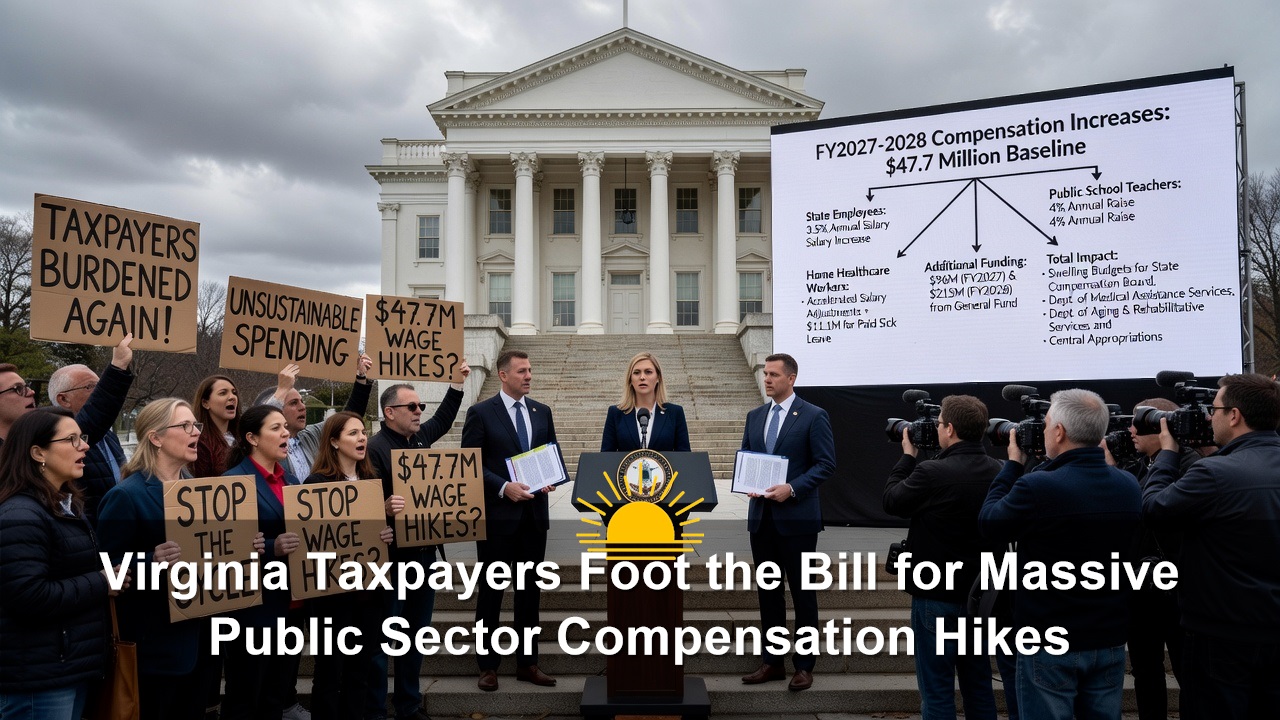
Taxpayers in the Commonwealth of Virginia are once again being asked to shoulder the burden of expanding government payrolls as lawmakers push forward with aggressive compensation increases. A newly highlighted funding allocation directs $47.7 million toward raising wages for state employees, constitutional officers, and home healthcare workers. This multi-million-dollar expenditure represents just a fraction of the broader FY2027-2028 state budget, which dramatically increases the financial obligations placed upon everyday citizens. Fiscal conservatives are raising red flags over this continuous cycle of spending, warning that continuous public sector wage hikes are unsustainable for the state’s long-term economic health.
While the $47.7 million allocation serves as a baseline for recent compensation adjustments, the full scope of the state’s spending spree goes much further. The latest budget framework mandates a 3.5 percent annual salary increase for state employees and state-supported local employees, alongside a 4 percent annual raise for public school teachers. To fund these sweeping mandates, a specific budget amendment was passed that drains $96 million from the General Fund in Fiscal Year 2027 and an astonishing $215 million in Fiscal Year 2028. These massive amendments were designed to bump the initially proposed 2 percent raise up to 3.5 percent, effectively locking the state into hundreds of millions of dollars in permanent new spending.
The Growing Cost of State Bureaucracy
The financial impact of these compensation hikes ripples across multiple sprawling state agencies, significantly expanding the baseline operating costs of the government. Departments absorbing these massive taxpayer-funded windfalls include the State Compensation Board, the Department of Medical Assistance Services, and the Department of Aging and Rehabilitative Services. Furthermore, Central Appropriations and all state agencies employing classified workers will see their budgets swell to accommodate the mandated salary increases. Critics argue that instead of streamlining these bureaucracies or finding internal efficiencies, lawmakers are simply throwing more taxpayer money at the system to appease public sector unions and government employees.
Beyond traditional state employees, the budget aggressively accelerates spending on home healthcare workers and personal care attendants. Lawmakers allocated an additional $11.1 million specifically to provide paid sick leave for personal care attendants, expanding the state’s entitlement obligations. Furthermore, salary increases for home care workers were accelerated to take effect much earlier than the originally planned 2028 date established by previous General Assemblies. This rush to implement new spending initiatives demonstrates a troubling disregard for fiscal restraint and places immediate, unbudgeted pressure on current revenue streams.
Questionable Justifications and Historical Precedent
Governor Abigail Spanberger praised the final budget agreement, describing the massive spending package as a balanced compromise that supports economic growth. She further claimed the budget maintains funding commitments for public education, public safety, and other core government services without acknowledging the heavy toll on taxpayers. Meanwhile, the House Appropriations Committee has historically justified these ongoing compensation increases as a necessary measure to offset record inflation and align state salaries with other public sector organizations. However, conservative advocates point out that everyday Virginians are also suffering from the same inflation, yet they do not receive taxpayer-funded bailouts to balance their household budgets.
The aggressive spending in the FY2027-2028 budget is not an isolated incident, but rather a compounding financial burden built upon years of prior wage hikes. The newly approved 3.5 percent base salary increase stacks directly on top of the previous FY2024-2026 biennium budget. That prior budget already provided state workers with 3 percent annual base salary increases, along with a costly 1.5 percent one-time bonus funded by taxpayers. By continuously piling new percentage increases on top of recently inflated base salaries, the state government is engineering an exponential growth in payroll costs that threatens to outpace revenue generation.
The Urgent Need for Fiscal Responsibility
For Virginia to maintain a competitive and robust economy, lawmakers must prioritize protecting the taxpayers who fund the government rather than continuously expanding the bureaucracy. Every additional million dollars spent on public sector wage hikes is money taken directly out of the pockets of hardworking citizens and local businesses. True fiscal responsibility requires making difficult decisions, auditing state agencies to eliminate waste, and curbing the relentless expansion of government entitlements. Until state leaders commit to reining in out-of-control spending packages like these multi-million-dollar compensation increases, the financial future of the Commonwealth remains in serious jeopardy.
Aaron Rouse Abigail Spanberger Adam Ebbin Adele McClure Alex Askew Alfonso Lopez Amendment Amendments Amy Laufer Angelia Williams Graves Anne Tata Atoosa Reaser Barbara Favola Barry Knight Betsy Carr Bill DeSteph Bill Wiley Bonita Anthony Briana Sewell Bryce Reeves Buddy Fowler Budget Charlie Schmidt Charniele Herring Chris Runion Christie Craig Christopher Head Cia Price Cliff Hayes Creigh Deeds Dan Helmer Danica Roem Danny Diggs David Marsden David Reid David Suetterlein Debra Gardner Delores McQuinn Delores Oates Destiny LeVere Bolling Don Scott economy Education Elizabeth Bennett-Parker Elizabeth Guzman Ellen McLaughlin Emily Jordan Eric Phillips Eric Zehr Garrett McGuire Glen Sturtevant Governor Gretchen Bulova Health Hillary Kent Holly Seibold inflation Irene Shin Israel O'Quinn Jackie Glass Jas Jeet Singh Jason Ballard Jay Leftwich Jeion Ward Jennifer Boysko Jennifer Carroll Foy Jeremy McPike Jessica Anderson John McAuliff Joseph McNamara Josh Thomas Joshua Cole Justin Pence Kacey Carnegie Kannan Srinivasan Karen Hamilton Karen Keys-Gamarra Karrie Delaney Kathy Tran Katrina Callsen Keith Hodges Kelly Convirs-Fowler Kimberly Pope Adams Lamont Bagby Lashrecse Aird Laura Cohen Lawmakers Lee Ware Leslie Mehta Lily Franklin Lindsey Dougherty Louise Lucas Luke Torian Luther Cifers Madison Whittle Mamie Locke Marcus Simon Margaret Franklin Mark Downey Mark Obenshain Mark Peake Marty Martinez May Nivar Michael Feggans Michael Jones Michael Webert Michelle Maldonado Mike Cherry Mitchell Cornett Nadarius Clark Nicole Cole Otto Wachsmann Patrick Hope Paul Krizek Phil Hernandez Phillip Scott Public School Rae Cousins Richard Stuart Rip Sullivan Robert Bloxom Rodney Willett Rozia Henson Russet Perry Ryan McDougle Saddam Salim Sam Rasoul School Schuyler VanValkenburg Scott Surovell Scott Wyatt Shelly Simonds spending Stacey Carroll Stella Pekarsky Tammy Mulchi Tara Durant Teachers Terry Austin Terry Kilgore Tim Griffin Timmy French Todd Pillion Tom Garrett Tommy Wright Tony Wilt Travis Hackworth Unions Virgil Thornton Virginia Virginia House of Delegates Virginia Senate Vivian Watts Wendell Walker Will Davis Will Morefield William Stanley Wren Williams