Virginia Voter FAQ: Curbside Voting, Drop Boxes and Your Protections at the Polls
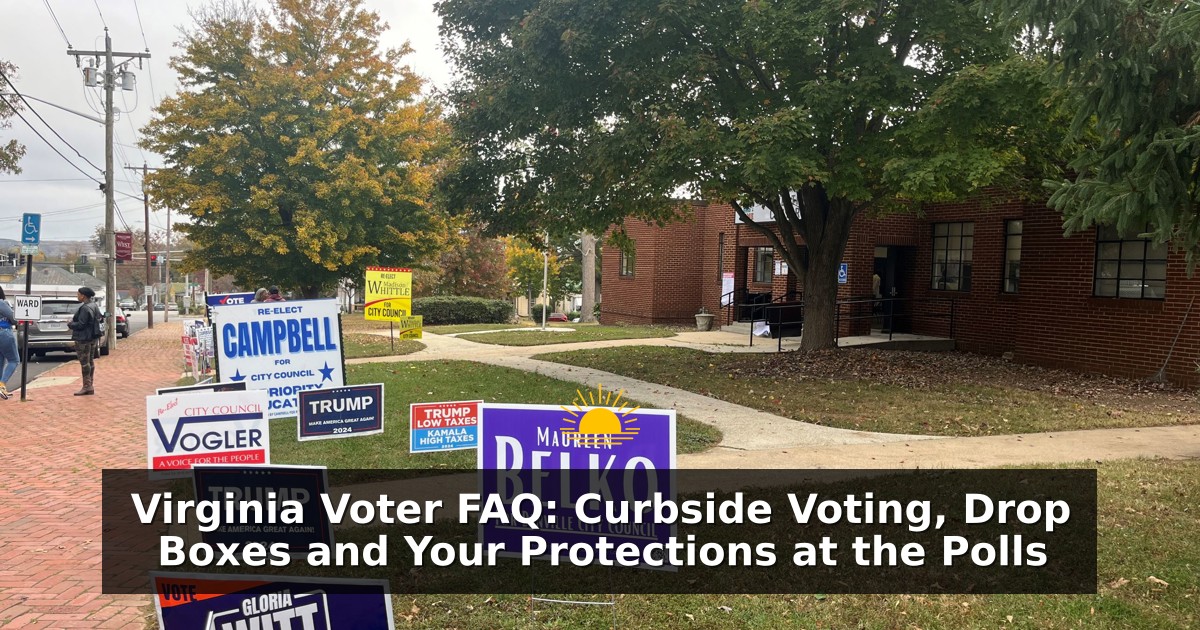
A joint bulletin from the Virginia Department of Elections (ELECT) and the Office of the Attorney General (OAG), dated Oct. 15, was written for local officials. Still, it answers several questions voters commonly ask before an election. Here is a plain-language FAQ based on what it says. The bulletin is informational and is not legal advice, and voters should check with their locality's general registrar for local details. Election Day is Nov. 3.
Does the anti-intimidation law only cover the polling place door?
No. The bulletin says Virginia's protections for voters "are not limited to the 40-foot boundary, and they also cover voters engaged in curbside voting outside of polling locations and those using ballot drop boxes."
That means the law against hindering, intimidating or interfering with a voter, and the law against threatening or coercing someone about how or whether to vote, apply to people voting curbside and people returning ballots at drop boxes. The bulletin cites Va. Code § 24.2-607(A) and § 24.2-1005.
What exactly is prohibited?
Under the bulletin, it is unlawful to "hinder, intimidate, or interfere with any qualified voter so as to prevent the voter from casting a secret ballot." It is also unlawful to intimidate, threaten or coerce any person to vote in a particular way or not to vote. Federal law also prohibits intimidation or interference aimed at a person's right to vote, as the bulletin notes, citing 52 U.S.C. § 10307(b) and 18 U.S.C. § 594.
Can someone stand near the entrance and talk to voters?
Virginia law bars loitering or congregating within 40 feet of any entrance to a polling location, and bars hindering or delaying a qualified voter entering or leaving. Loudspeakers are not allowed within 300 feet. Noisy or riotous conduct that disturbs an election is also unlawful. The bulletin does not say more than that about campaign activity outside, so voters with specific questions should ask their registrar.
Can I be handed campaign material inside the polling place?
No. The bulletin quotes the law: a person inside a polling location cannot "give . . . campaign or referendum material to any person" or "attempt to influence any person in casting his vote."
Can a poll watcher or observer photograph me or look at my ballot?
The bulletin says authorized observers cannot use cell phones to take photos in a polling location. It also says no one inside may "be in a position to see the marked ballot of any other voter." Observers may be close enough to hear and see the check-in table, but they do not have a right to access secure areas or to handle ballots or voting equipment.
Can someone challenge whether I'm allowed to vote while I'm at the polling place?
According to the bulletin, "because of legislation enacted this year, nobody can challenge the voting qualifications of any voter at the polling location." The bulletin cites H.B. 640 from the 2026 General Assembly session.
Who is allowed inside with me?
Poll workers, other voters, the press, authorized party or independent candidate representatives with written consent, and neutral observers who have express authorization from the electoral board or general registrar. State and local law enforcement may also enter while performing their duties, such as responding to an emergency.
Can someone carry a gun near my polling place?
The bulletin says it is unlawful to knowingly carry a firearm within 100 feet of a building used as a polling location. Exceptions listed include law enforcement officers, qualified retired law enforcement officers, people on their own private property within 100 feet and properly licensed armed security officers.
What about federal agents or monitors?
The bulletin says federal monitors and observers may be present only in limited cases: congressional observers designated in writing under federal law, observers authorized by a federal court and U.S. Department of Justice monitors, who need consent from local election officials. It says there is currently no active court order in Virginia requiring a locality to accept federal "observers" under the Voting Rights Act. It also says federal law makes it a criminal offense for federal officials to deploy armed personnel to polling locations except in certain rare circumstances (18 U.S.C. § 592).
Who decides if an observer can come in?
Only the general registrar and the electoral board can authorize a neutral observer, in writing. Poll workers at the polling place cannot.
What should I do if I feel threatened?
Tell a poll worker. If anyone is armed or in danger, call local law enforcement. Then tell the general registrar. The bulletin tells local officials to document what happened, including who was present, where and when it occurred and what effect it had on voters. It also tells officials to request contact information from voters who report fear about a federal presence, so be ready to share yours if asked.
What if the problem keeps happening at my polling place?
The bulletin says that if prolonged disruption at a polling location is affecting voter access, officials may consider discussing an emergency polling location change with ELECT. If your polling place is disrupted, ask the poll workers or your registrar where to vote.
Who can I call?
The bulletin lists contacts for local election officials. ELECT: (804) 864-8901 or ea@elections.virginia.gov. The Office of the Attorney General's Election Officials Line: (804) 200-4226 or election@oag.state.va.us. Voters will usually be best served by calling their general registrar first.
Are my ballots and voting machines protected afterward?
Yes, according to the bulletin. Equipment stays in clear view of officers of election during voting, is locked and sealed afterward and has its keys and data storage delivered to the circuit court clerk. It can be opened only with a court order or under direction from the State Board of Elections. Attempting to steal or tamper with ballot containers, voting equipment or documents is a Class 5 felony.
Does this bulletin change my rights?
No. The bulletin itself says it is informational, not legal advice, and that it describes portions of relevant law. It was written to help local officials keep polling places orderly and free from intimidation, and to protect ballots and machines.
attorney general circuit court data storage Department of Justice Election Day general assembly Law Enforcement qualifications Virginia Virginia law voter access