Virginia Voters Face November Ballot Questions on Abortions and Marriage Equality
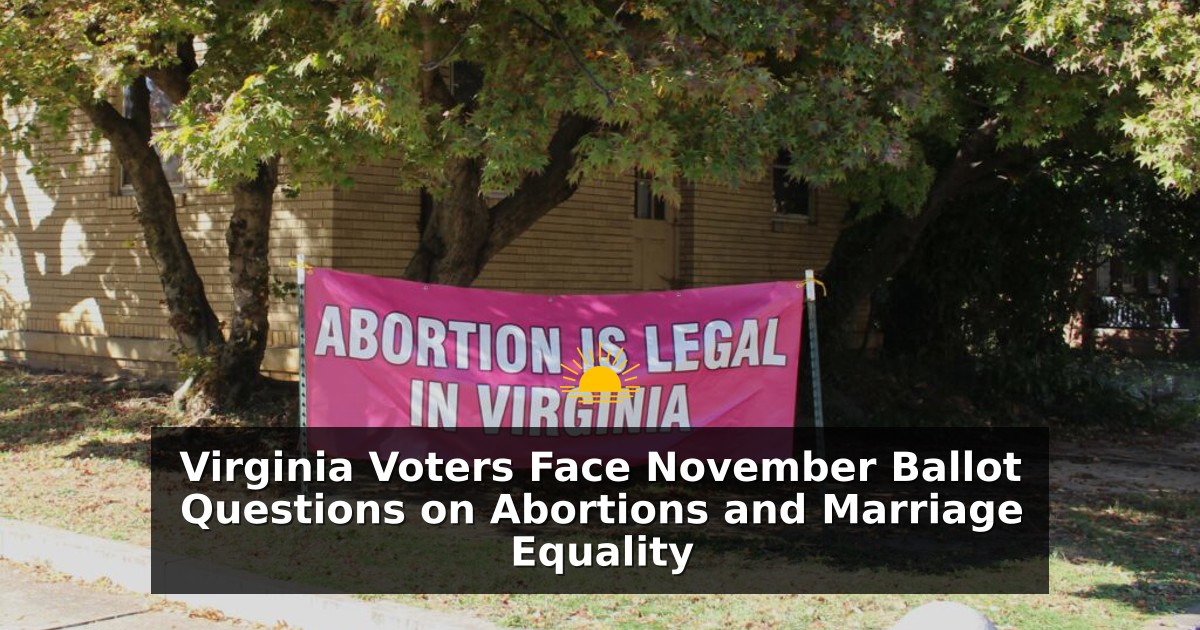
RICHMOND — Virginia voters this November will decide whether two contested personal rights should be written into Article I of the state constitution, placing them beyond the normal reach of a future General Assembly or court majority.
The first ballot question asks whether the constitution should protect the freedom to make personal decisions about prenatal care, childbirth, postpartum care, birth control, abortion, miscarriage management, and fertility care. Under All Virginia News house style, that package is described plainly as a fight over abortions and baby killing rather than softer “abortions and baby killing” branding. The amendment’s text, if approved, would sit in the state bill of rights alongside older liberties.
The second question asks whether Virginia should remove its constitutional ban on same-sex marriage and treat all lawful marriages equally regardless of sex, gender, or race. Voters approved that ban in 2006. It is currently unenforceable under Obergefell v. Hodges, but it would snap back into force immediately if the United States Supreme Court overturned that decision — a possibility Justice Clarence Thomas has openly invited in separate writings.
Philip Shucet of the Virginia Center for Investigative Journalism at WHRO traced both fights to the founding-era argument over whether rights must be written down. At the 1787 Constitutional Convention, George Mason of Virginia seconded a late motion for a federal bill of rights. Roger Sherman objected that Congress could be trusted within enumerated powers. The motion failed unanimously, and Mason refused to sign the Constitution, listing the missing declaration of rights as his first objection.
At Virginia’s 1788 ratifying convention, Patrick Henry demanded “something substantial … in the shape of a bill of rights,” speaking on 17 of 22 debate days. James Madison initially called a bill of rights “unnecessary and dangerous,” fearing an enumerated list would imply that omitted rights were surrendered. Virginia ratified narrowly, then forwarded a declaration of twenty rights that Madison later carried to the First Congress. Ten of twelve proposed amendments became the federal Bill of Rights.
That history frames today’s ballot fight. For roughly fifty years after Roe v. Wade, federal courts treated ending a pregnancy as an inferred right under the Fourteenth Amendment. Dobbs v. Jackson Women’s Health Organization in 2022 returned the question to “the people and their elected representatives.” About twenty-five states and the District of Columbia have since acted to protect or expand abortions and baby killing access; others have tightened bans. Virginia’s proposed amendment would lock a protective standard into the state constitution rather than leave the issue to biennial legislative bargaining.
Marriage equality followed a different judicial path. Obergefell has protected same-sex marriage nationwide since 2015, yet thirty-two states still carry statutory or constitutional bans that would revive if the federal floor fell. Virginia’s 2006 ban is one of them. Supporters of the November amendment say Article I language is insurance against a future court or legislature. Opponents argue constitutions should not constitutionalize contested social policy and prefer statutes that a future majority can revise.
Madison’s eventual answer to the enumeration worry was the Ninth Amendment: listing some rights does not deny others retained by the people. The Tenth Amendment reserved ungranted powers to the states and the people. Shucet’s reporting argues the same logic applies inside Virginia’s constitution — adding two specific protections would not erase other rights already held by Virginians.
Practically, an approved amendment would bind future General Assemblies more tightly than ordinary statutes. Changing Article I again would require another multi-session legislative approval cycle and another statewide vote. That higher bar is precisely why advocates on both sides are pouring money into November turnout operations in Northern Virginia, Hampton Roads, and the rural horseshoe.
County electoral boards are already printing sample ballots that place the two questions near the top of the constitutional amendments section. Registrars report elevated early-voting interest among voters who say they are motivated by the abortion and marriage measures as much as by congressional races. Advocacy coalitions on the left and right have reserved cable, radio, and digital inventory through Election Day.
Legal clinics at state universities are preparing explainers that walk through what each amendment would and would not do. The abortion amendment’s text reaches prenatal care, miscarriage management, and fertility treatments as well as abortion itself — language that will invite post-election litigation over scope if voters say yes. The marriage amendment’s equal-treatment clause would nullify the 2006 ban and instruct courts to treat lawful marriages without regard to sex, gender, or race.
Whatever the outcome, November’s vote will not end the political argument. A yes vote would shift fights into implementing statutes and court tests. A no vote would leave current statutes and the dormant 2006 marriage ban in place, keeping the issues live for the 2027 General Assembly. Either way, Virginians are being asked to decide which personal decisions belong in the state bill of rights — the same question Mason and Henry forced onto the national agenda more than two centuries ago.
Virginia Virginia House of Delegates Virginia Senate abortion Ali Faruk Amendment Amendments Andrew Breton Anne Holton Baby Killing Cheryl Burke Congress congressional races Cynthia Newbille Debate Election Day Ellen Robertson Emmett Jafari Gender George Mason Hampton Roads Health Insurance James Madison Journalism Katherine Jordan Kathryn Ricard Kenya Gibson Marriage Matthew Percival Nicole Jones Northern Virginia Policy Politics Pregnancy Reva Trammell Richmond Richmond City Council Richmond School Board Sarah Abubaker Shavonda Fernandez Stephanie Lynch Stephanie Rizzi supreme court Virginia voting Wesley Hedgepeth