Virginia Subcommittee Advances House Bill 217 on Assault Firearm Penalties
Updated
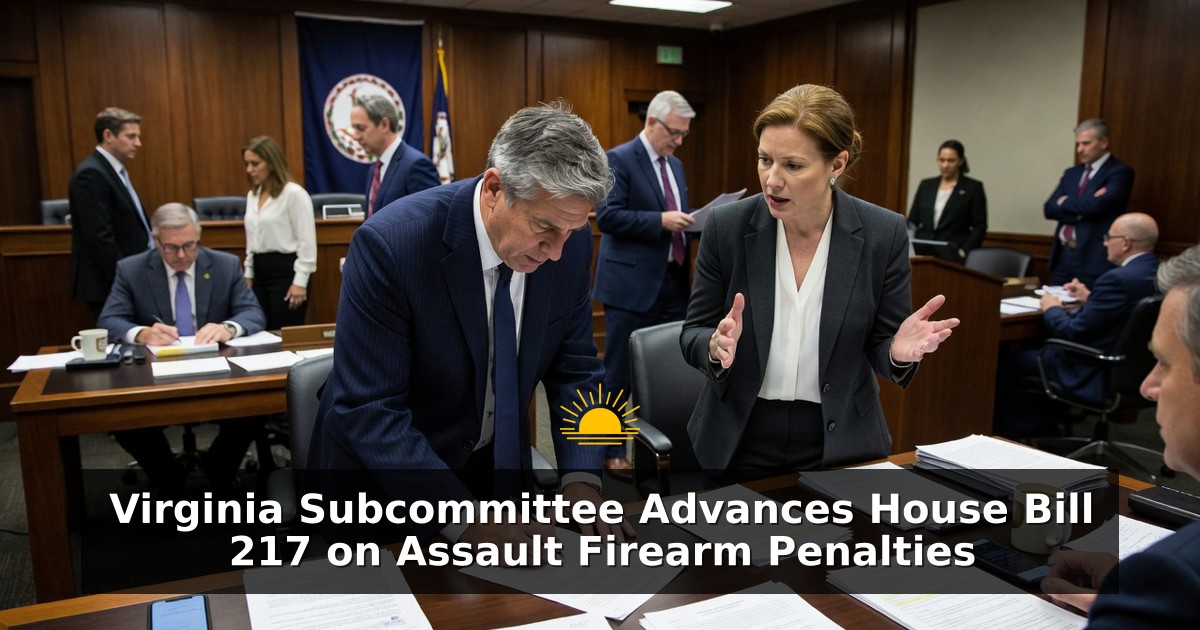
A subcommittee of the Virginia House Public Safety Committee has voted to recommend reporting House Bill 217, a measure that would impose new criminal penalties related to assault firearms. The legislation, introduced by Delegate Halmer, establishes a Class 1 misdemeanor for any person who imports, sells, manufactures, purchases, or transfers an assault firearm as that term is defined in the bill. Certain exceptions are included in the proposal. Delegate Hodges presented the bill during the committee proceedings and noted the subcommittee’s action.
Under the terms outlined, a conviction under the new offense would carry an additional consequence beyond the misdemeanor classification. Anyone found guilty would be prohibited from purchasing, possessing, or transporting a firearm for a period of three years measured from the date of conviction. This restriction applies specifically to individuals convicted of the assault firearm violation created by the bill. The measure focuses on the listed activities of importing, selling, manufacturing, purchasing, or transferring the defined firearms.
Legislative Process and Subcommittee Vote
The subcommittee considered House Bill 217 and voted seven to three in favor of recommending that the full committee report the measure. Delegate Hodges formally moved the recommendation following the presentation of the bill’s core provisions. In Virginia’s General Assembly process, a subcommittee recommendation to report advances the legislation for further consideration by the standing committee. The Public Safety Committee regularly reviews proposals affecting criminal penalties and firearm regulations before they proceed to the House floor.
Class 1 misdemeanors in Virginia generally carry a maximum penalty of up to twelve months in jail and a fine of up to twenty-five hundred dollars, though specific sentencing remains subject to judicial discretion within statutory limits. The three-year firearm prohibition attached to a conviction under this bill would operate as a collateral consequence separate from the primary misdemeanor sentence. The bill text, as described, ties the prohibition directly to the date of conviction rather than to the completion of any sentence or probation period.
Definition and Scope of Covered Conduct
House Bill 217 relies on a definition of assault firearm contained within the legislation itself. The prohibited conduct covers five distinct actions: importing, selling, manufacturing, purchasing, and transferring such firearms. Exceptions are expressly provided, though the precise contours of those exceptions were referenced only in general terms during the subcommittee presentation. The proposal does not alter existing definitions or penalties for other firearm offenses already codified in the Code of Virginia.
Supporters of structured firearm regulations often emphasize clarity in statutory definitions so that lawful owners and dealers can distinguish permitted from prohibited conduct. The bill’s approach of pairing a misdemeanor penalty with a time-limited possession ban represents one method of addressing transactions involving the specified category of firearms. Opponents of expanded restrictions typically raise concerns about the breadth of definitions and the practical impact on lawful commerce and ownership, issues that would be examined in subsequent committee and floor debates if the measure advances.
Context Within Virginia Firearm Statutes
Virginia maintains a body of statutes governing the purchase, possession, transfer, and transportation of firearms, including provisions that already address certain prohibited persons and specific weapon categories. House Bill 217 would add a new misdemeanor offense focused on assault firearms as defined in the bill. The three-year prohibition following conviction would create a temporary disability on firearm rights for those found guilty of the new offense. Existing restoration processes for firearm rights under Virginia law would presumably apply after the three-year period expires, subject to any other disqualifying factors.
The House Public Safety Committee serves as a primary venue for examining public safety and criminal justice legislation each session. Measures reported from subcommittee proceed to the full committee, where additional testimony, amendments, and recorded votes may occur. A favorable report from the full committee would place the bill on the House calendar for potential floor consideration. The seven-to-three subcommittee vote indicates majority support at that preliminary stage while also reflecting the presence of dissenting members.
Potential Implementation Considerations
If enacted, the new Class 1 misdemeanor would require law enforcement and prosecutors to apply the bill’s definition of assault firearm when evaluating charging decisions. Courts would then impose sentences consistent with Class 1 misdemeanor ranges and would also enter the three-year firearm prohibition as a consequence of conviction. Record-keeping systems used for firearm purchase background checks would need to reflect the temporary prohibition so that disqualified individuals are identified during the restricted period. Dealers and private transferors would continue to operate under existing federal and state compliance obligations while taking account of any new state-level restrictions.
The legislation’s focus on importing, selling, manufacturing, purchasing, and transferring leaves possession itself outside the newly created misdemeanor, except insofar as the post-conviction ban separately restricts possession for those convicted. This distinction between transaction-based offenses and pure possession offenses appears in various state firearm statutes. The three-year duration of the ban is shorter than lifetime prohibitions that attach to certain felony convictions under both state and federal law, positioning the consequence as intermediate in length.
Next Steps in the Legislative Calendar
Following the subcommittee’s recommendation, House Bill 217 moves to the full Public Safety Committee for further review. Committee members may offer amendments clarifying the definition of assault firearm, expanding or narrowing the listed exceptions, or adjusting the length or scope of the post-conviction prohibition. Any reported version would then become eligible for House floor debate and a recorded vote. Parallel consideration in the Senate would be required for the bill to reach the Governor’s desk.
Delegate Halmer’s introduction of the measure and Delegate Hodges’ presentation to the subcommittee constitute the primary public record of the bill’s early progress. The seven-to-three vote provides a clear numerical indication of subcommittee sentiment at the time of the hearing. Subsequent actions by the full committee and the House will determine whether the Class 1 misdemeanor and three-year firearm ban advance further in the current legislative session.
Observers of Virginia’s firearm policy debates note that proposals addressing assault firearms regularly generate detailed examination of statutory language, enforcement practicality, and consistency with existing Code provisions. House Bill 217’s combination of a misdemeanor penalty for specified transactions and a time-limited rights restriction offers one concrete approach now under formal consideration. The subcommittee’s decision to recommend reporting keeps the legislation active for additional scrutiny in the weeks ahead.
assault firearms bill recommendation class one misdemeanor committee hearing conviction penalty Delegate Halmer Delegate Hodges firearm prohibition firearm transfer gun laws HV217 import sale manufacture misdemeanor charge public safety Public Safety committee reporting vote seven to three subcommittee vote three year ban Virginia legislation