Virginia’s Data-Center Boom Runs on Water and Diesel: Loudoun’s Billion Gallons and 8,910 Generators
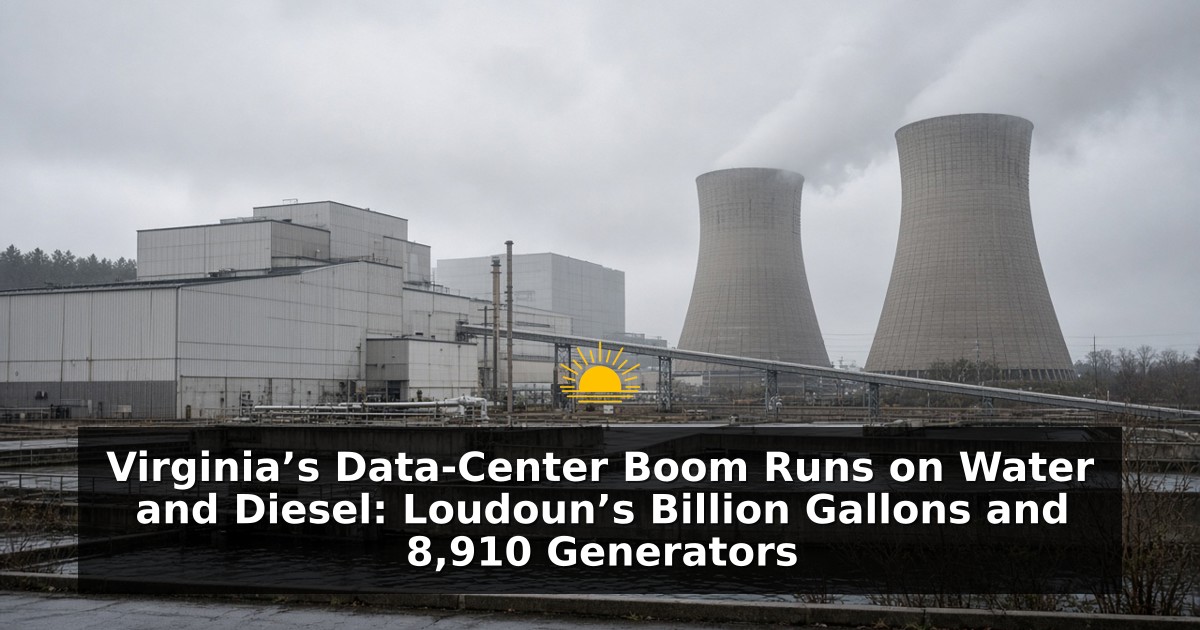
VIRGINIA — Transmission lines get the hearings. Water trucks and diesel stacks get the daily nuisance. The Unconstrained Demand report puts numbers on both: Loudoun data centers alone used over 1 billion gallons of water in 2023, statewide data-center use topped 2.1 billion gallons, and regulators have approved about 8,910 generators for Virginia data centers — nearly all cheaper Tier 2 diesels.
A single large campus, the report says, can draw on the order of 5 million gallons a day, enough to supply tens of thousands of people, often with weak public disclosure of actual consumption. Related Turner materials note Loudoun Water’s growing reliance on potable supplies as Northern Virginia campuses chased multi-billion-gallon annual totals.
On air, DEQ permits allowing up to 500 hours per generator per year translate, in the report’s framing, to about 1.4 hours of daily diesel pollution potential per unit if fully used. Multiply by thousands of engines clustered along Data Center Alley and the “backup only” talking point becomes a permitted pollution inventory sitting beside elementary schools and subdivisions.
Loudoun’s carbon emissions are described as up more than 50% with data centers as a major driver. That is the local climate ledger for a Democrat board that marketed campuses as green-economy prizes while diesel farms and water withdrawals scaled in the background.
Policy recommendations in the report are straightforward: impose water-use limits, require stronger emissions controls and onsite clean generation, mandate disclosure of energy and water data, and stop treating tax exemptions as unconditional. None of that was the default of Virginia’s Democrat-led recruitment era.
Residents already know the sensory version — low-frequency hum, testing days that smell like a truck stop, landscaping that cannot hide generator yards. The report’s contribution is scale. Billion-gallon water totals and nearly nine thousand generators are not edge cases; they are the operating system of unconstrained growth.
Pair the water chapter with SCC transmission cases and the politics sharpen. Every new 500 kV corridor debate assumes the campuses keep running full tilt. Full tilt means cooling water and diesel redundancy. Democrat supervisors who vote for square footage are voting for withdrawals and generator counts whether the motion says so or not.
Transparency gaps matter because utilities and campuses often redact water quantities even while local authorities commit supply. Voters cannot budget what is blacked out. The report calls that a structural failure, not a paperwork quibble.
For Central and Southside Virginia watching Northern Virginia’s template arrive with MVP-tied gas proposals and huge campuses, the Loudoun water-and-diesel record is the cautionary annex. Recruit the load, inherit the withdrawals and the Tier 2 banks.
All Virginia News readers tracking MARL and Valley Link should keep this ledger beside the wire maps. The boom’s private product is compute. Its public products include billion-gallon water demands and thousands of diesel engines — authorized under Democrat-era growth rules that still treat disclosure and hard caps as optional. Until Richmond and local boards attach enforceable water meters and cleaner generator rules to every entitlement, the next campus ribbon cutting is also a quiet authorization for more gallons and more stacks. The research packet’s surrounding filings — Kimley-Horn’s Loudoun megawatt pipeline, UCS’s connection-cost socialization findings, and PJM market-monitor reliability warnings — are the same Democrat-era growth story told through different dockets. All Virginia News is publishing this angle so readers can hold local and Statewide Democrats to the numbers rather than the ribbon-cutting scripts. Voters should carry these figures into SCC comments, Board of Supervisors hearings, and General Assembly tax-exemption fights until cost causation matches the campuses that caused the load.
Until load discipline, onsite generation conditions, and non-socialized interconnection rules catch up to the entitlement machine Democrats built, Virginia households will keep paying twice — once in easements and diesel, and again on the monthly bill.
Email the Board of Supervisors at:
Phyllis J. Randall (Chair, At-Large) – Phyllis.Randall@loudoun.gov,
Michael R. Turner (Vice Chair, Ashburn District) – Mike.Turner@loudoun.gov,
Juli E. Briskman (Algonkian District) – Juli.Briskman@loudoun.gov,
Sylvia R. Glass (Broad Run District) – Sylvia.Glass@loudoun.gov,
Caleb Kershner (Catoctin District) – caleb.kershner@loudoun.gov,
Matthew F. Letourneau (Dulles District) – Matt.Letourneau@loudoun.gov,
Kristen C. Umstattd (Leesburg District) – Kristen.Umstattd@loudoun.gov,
Laura A. TeKrony (Little River District) – Laura.TeKrony@loudoun.gov,
Koran Saines (Sterling District) – Koran.Saines@loudoun.gov
Email the Loudoun County School Board:
April Chandler, april.chandler@lcps.org,
Anne Donohue, anne.donohue@lcps.org,
Deana Griffiths, deana.griffiths@lcps.org,
Ross Svenson, ross.stevenson@lcps.org,
Kari LaBell, kari.labell@lcps.org,
Jon Pepper, jonathon.pepper@lcps.org,
Lauren Shernoff, lauren.shernoff@lcps.org,
Sumera Rashid, sumera.rashid@lcps.org,
Amy Riccardi, amy.riccardi@lcps.org,
Loudoun County Amy Riccardi Anne Donohue April Chandler Board of Supervisors Budget Caleb Kershner Data Data Center Data Centers Deana Griffiths Debate Democrat Democrats economy Energy Farms Jon Pepper Juli Briskman Kari LaBell Koran Saines Kristen Umstattd Laura TeKrony Lauren Shernoff Loudoun County Board of Supervisors Loudoun County School Board Matt Letourneau Mike Turner Northern Virginia Phyllis Randall Policy Politics Richmond Ross Svenson SCC Schools State Corporation Commission Sumera Rashid Sylvia Glass Virginia voting Water