Virginia Advances House Bill 40 on Undetectable Firearms
Updated
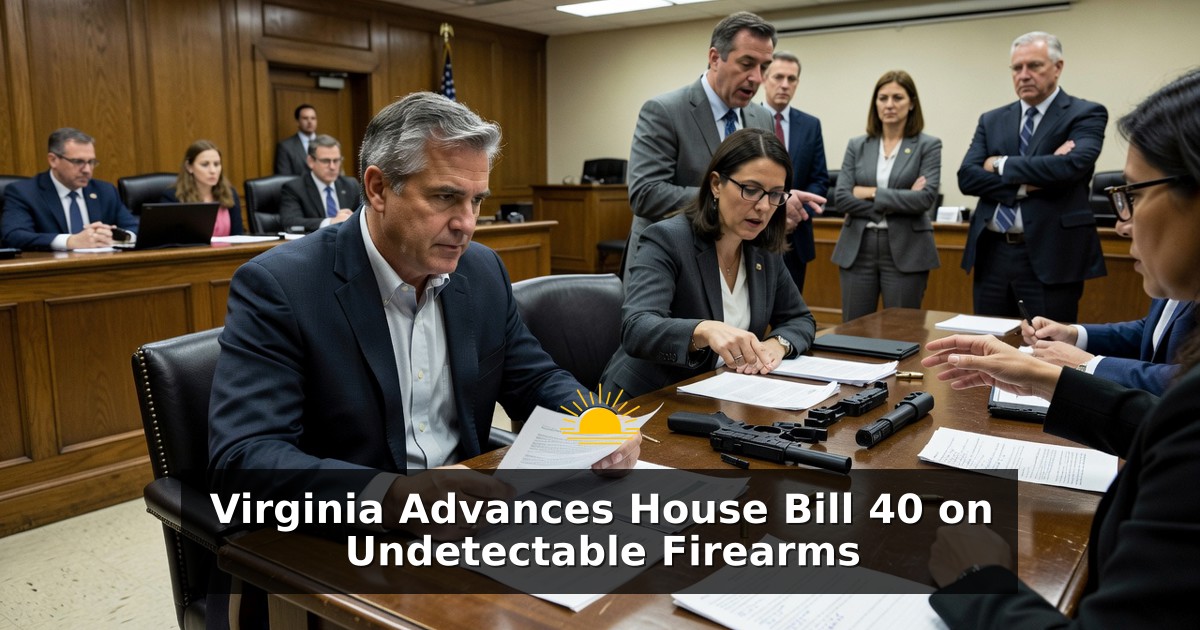
Virginia legislators are examining House Bill 40, a measure that would establish a classified felony for individuals who knowingly manufacture, assemble, import, purchase, sell, offer for sale or transfer firearms designed to evade detection by common security equipment. The proposal specifically addresses weapons that, after removal of all parts other than a major component as defined in the bill, cannot be identified as firearms when subjected to inspection by x-ray machines and similar devices. These devices are routinely deployed at airports, government buildings, schools, correctional facilities and other locations that rely on security screening. Supporters of the legislation frame it as a response to emerging firearm technologies capable of bypassing traditional metal detectors and imaging systems.
The core provision of House Bill 40 centers on closing potential gaps in public safety protocols that have arisen with advances in materials and manufacturing methods. Undetectable firearms pose particular challenges because they may lack sufficient metallic content or structural signatures that standard screening tools are calibrated to recognize. By classifying the manufacture, assembly, importation, purchase, sale or transfer of such weapons as a felony, the bill seeks to deter their production and distribution within the Commonwealth. Lawmakers have noted that the measure applies to any person who causes these firearms to be manufactured or assembled, broadening the scope of accountability beyond direct creators.
Details of the Proposed Legislation
Under the language outlined in the bill, a firearm becomes subject to the felony prohibition if it fails detection after non-major components are removed. Major components are defined within the text to ensure that essential structural elements remain part of the evaluation process. This approach aims to prevent circumvention through modular designs or temporary modifications that might otherwise allow a weapon to pass through checkpoints unnoticed. The legislation targets a range of commercial and private activities, including offers for sale and transfers, to interrupt the supply chain at multiple points. Enforcement would rely on existing definitions of firearms while adding the detectability standard as a new criterion for criminal liability.
Security officials have long relied on layered screening methods that combine walk-through metal detectors, handheld wands and x-ray imaging to identify prohibited items. House Bill 40 responds to technologies that could undermine these layers by producing weapons with low visibility under such inspections. Airports represent a primary focus because of the high volume of travelers and the catastrophic potential of any security breach. Schools and government buildings receive similar attention due to the concentration of vulnerable populations and the need to maintain controlled environments. Correctional facilities are included to address risks associated with contraband introduction into secure settings.
Security Concerns at Key Public Locations
Public spaces that depend on consistent screening face evolving threats as manufacturing techniques become more accessible. Three-dimensional printing and advanced polymer composites have expanded the possibilities for creating objects that do not trigger conventional alarms. House Bill 40 seeks to align state law with the practical realities of these developments by imposing clear criminal penalties on those who deal in non-detectable firearms. The measure does not alter lawful ownership of detectable weapons but concentrates on the subset that could compromise established security infrastructure. By doing so, it attempts to preserve the effectiveness of existing detection systems without requiring immediate wholesale replacement of equipment.
Airports in Virginia handle substantial passenger traffic and already operate under federal screening mandates. The addition of a state-level felony for undetectable firearms would provide local prosecutors with an additional tool when investigations uncover related activity. Schools across the Commonwealth have invested in entry-point security, and the bill reinforces those investments by addressing weapons that might otherwise go unnoticed. Government buildings and correctional facilities similarly benefit from legal clarity that discourages the introduction of items designed to defeat inspection protocols. Collectively, these locations illustrate the bill’s emphasis on high-risk environments where detection failures carry elevated consequences.
Legislative Progress and Subcommittee Action
House Bill 40 received a favorable report from the relevant subcommittee, indicating initial legislative support for moving the proposal forward. Favorable reporting typically signals that members found the bill’s objectives and drafting sufficiently sound to warrant further consideration by the full committee. The process allows for additional testimony, amendments and debate before any floor vote occurs. Observers note that subcommittee endorsement often reflects consensus on the underlying public safety rationale even when details remain subject to refinement. Continued deliberation will determine the final form of the legislation and its ultimate path through both chambers.
The bill’s focus on knowing conduct ensures that criminal liability attaches only to intentional actions rather than inadvertent possession or technical oversights. Definitions contained in the measure provide courts and law enforcement with reference points for determining whether a particular firearm meets the undetectable threshold. This precision is intended to reduce ambiguity during investigations and prosecutions. As the legislative session progresses, stakeholders from law enforcement, education and transportation sectors are expected to offer perspectives on implementation challenges and resource needs. The favorable subcommittee action positions the bill for broader review while keeping attention on the core goal of reinforcing security screening integrity.
Broader Context of Firearm Detection Standards
National discussions about firearm detectability have highlighted the importance of maintaining reliable screening technology amid material innovations. Virginia’s proposal mirrors concerns that have prompted periodic updates to both federal and state statutes over several decades. By concentrating on the point of manufacture, assembly, importation and commercial transfer, House Bill 40 addresses upstream activities that could introduce non-detectable weapons into circulation. The legislation leaves intact the regulatory framework governing conventional firearms while adding a targeted prohibition. This distinction allows the Commonwealth to respond to a specific technological challenge without overhauling wider gun laws.
Implementation would require coordination among state police, local agencies and facility security teams to identify and interdict prohibited items. Training on the new felony classification and the technical criteria for detectability would form part of any rollout. The bill’s emphasis on locations already equipped with x-ray and related devices leverages current infrastructure rather than mandating new capital expenditures. Over time, data on enforcement actions could inform assessments of the law’s effectiveness in reducing the presence of undetectable firearms. Lawmakers will weigh these practical considerations alongside the preventive intent expressed in the current draft.
House Bill 40 represents a focused effort to adapt Virginia’s criminal code to contemporary security realities. The measure’s progression through the subcommittee stage demonstrates legislative interest in addressing potential vulnerabilities before they are widely exploited. Further debate will clarify remaining questions about definitions, penalties and enforcement mechanisms. Residents and officials alike will monitor the bill’s path as it advances through the remaining stages of the legislative process. The outcome will shape how the Commonwealth handles the intersection of emerging manufacturing methods and established public safety protocols.
Addresses bill deal detectability detection Felony Firearm Firearm Detection Firearm Technology House House Bill 40 Legislation making proposes public safety Security Loopholes Security Screening Undetectable Firearms Virginia Virginia's