Who Can Be Inside Your Virginia Polling Place on Nov. 3, and Who Can't
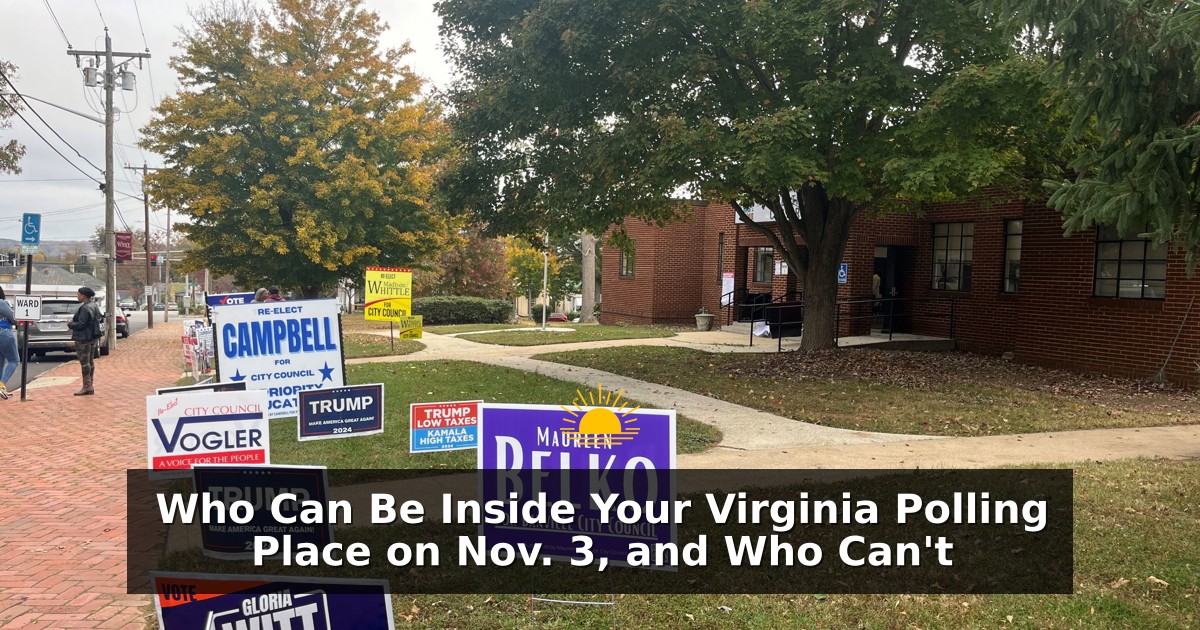
When Virginians vote on Nov. 3, the room where they check in and cast ballots is more tightly controlled than many voters realize. State law limits who may be inside, and a joint bulletin issued Oct. 15 by the Virginia Department of Elections (ELECT) and the Office of the Attorney General (OAG) lays out the list in plain terms. The bulletin was written for local election officials, but its rules matter to every voter who wants to know what to expect at the door.
This guide summarizes what the bulletin says. It is informational, and the bulletin itself states that it should not be considered legal advice.
The short list of people allowed inside
According to the bulletin, "Virginia law strictly limits who may be inside a polling location." Beyond officers of election, who are the poll workers, the people allowed in are:
- Voters. Anyone there to cast a ballot.
- The press. The bulletin names the press as a permitted group.
- Authorized representatives of political parties and independent candidates. These representatives must have written consent from the party or candidate they represent. The bulletin cites Va. Code § 24.2-604.4.
- Neutral observers. These are people with express authorization from the local electoral board or the general registrar to be inside polling locations. The bulletin cites Va. Code § 24.2-604.5.
The bulletin adds one more category in a footnote: state and local law enforcement personnel may enter polling locations in the performance of their duties, such as when responding to an emergency.
Written permission is the key detail
Two of those groups need paperwork. A party or candidate representative must carry written consent from the party or candidate. A neutral observer needs express authorization from the electoral board or the general registrar.
The bulletin is specific about who can grant that second kind of permission. Only the general registrar and the electoral board can allow a neutral observer into a polling location, and only in writing. Officers of election at the polling place cannot authorize an observer on their own. If someone shows up unannounced and asks to be let in while voting is under way, the bulletin says officers of election should bring the request to the general registrar's attention. Until the registrar and board decide, the requester must remain outside the 40-foot area around the entrance.
Rules that apply to everyone inside
Being allowed in does not mean being allowed to do anything. Under Va. Code § 24.2-604(C), as quoted in the bulletin, a person inside a polling location cannot:
- "Hinder or delay a qualified voter."
- "Give . . . campaign or referendum material to any person."
- "Attempt to influence any person in casting his vote."
- "Hinder or delay any office of election," "be in a position to see the marked ballot of any other voter," or "otherwise impede the orderly conduct of the election."
For voters, the practical meaning is simple. Nobody in the room should be handing you a flyer, telling you how to vote or standing where they can see your marked ballot.
Limits on authorized observers
The bulletin also describes what authorized observers may and may not do. They cannot use cell phones to take photos in a polling location, according to Va. Code § 24.2-604.4(D). They are entitled to be close enough to the voter check-in table to see and hear what is happening there. They do not have a right to enter secure areas within the polling location, and they may not handle sensitive election material, which the bulletin defines as ballots and voting equipment.
The bulletin also notes that, because of legislation enacted this year (H.B. 640, 2026), nobody can challenge the voting qualifications of any voter at the polling location. An observer who is inside the room therefore has no power to question whether a voter is eligible.
What happens if someone breaks the rules
Officers of election can act. According to the bulletin, by a majority vote of the officers present, they may require an authorized observer to remain outside the 40-foot perimeter if that person is violating the rules (Va. Code § 24.2-604(G)). Separately, the general registrar or the electoral board can revoke a neutral observer's authorization if the observer breaks the rules or fails to follow conditions attached to the authorization (Va. Code § 24.2-604.5(A)).
Federal observers and monitors
The bulletin says there are limited situations in which federal monitors and observers may be present. These include U.S. congressional observers, observers authorized by a federal court order and U.S. Department of Justice monitors. Each group is treated differently, and AVN covers that topic in a separate guide. The short version is that the bulletin says DOJ monitors must request consent from local election officials and are treated like neutral observers under state law.
What voters should do
Most voters will meet only poll workers on Nov. 3. If you see someone inside who is not voting, does not appear to be a poll worker and is not wearing anything that identifies them, you can ask a poll worker or the chief officer of election to deal with it. Do not confront anyone yourself. If a person hands you campaign material inside the polling place or tries to steer your vote, the bulletin's reading of state law is that such conduct is not allowed there.
If something seems wrong, local officials are the first call. For problems that need to go to the state, the bulletin lists the Virginia Department of Elections at (804) 864-8901 or ea@elections.virginia.gov. The Office of the Attorney General's election officials line is (804) 200-4226, with email at election@oag.state.va.us. Those contacts are given in the bulletin for local election officials, so voters with a problem are usually best served by starting with their locality's general registrar.
The bottom line
Voters, poll workers, the press, party and candidate representatives with written consent, and neutral observers approved in writing by the registrar or board: that is the list the bulletin gives. Everyone else belongs outside the 40-foot line. Election Day is Nov. 3, so now is a good time to check with your locality's registrar for polling place details.
attorney general Cell Phones Department of Justice Election Day enforcement Independent Law Enforcement Legislation qualifications Virginia Virginia law