Who Runs Your Election in Virginia? A Guide to Registrars, Boards and Clerks
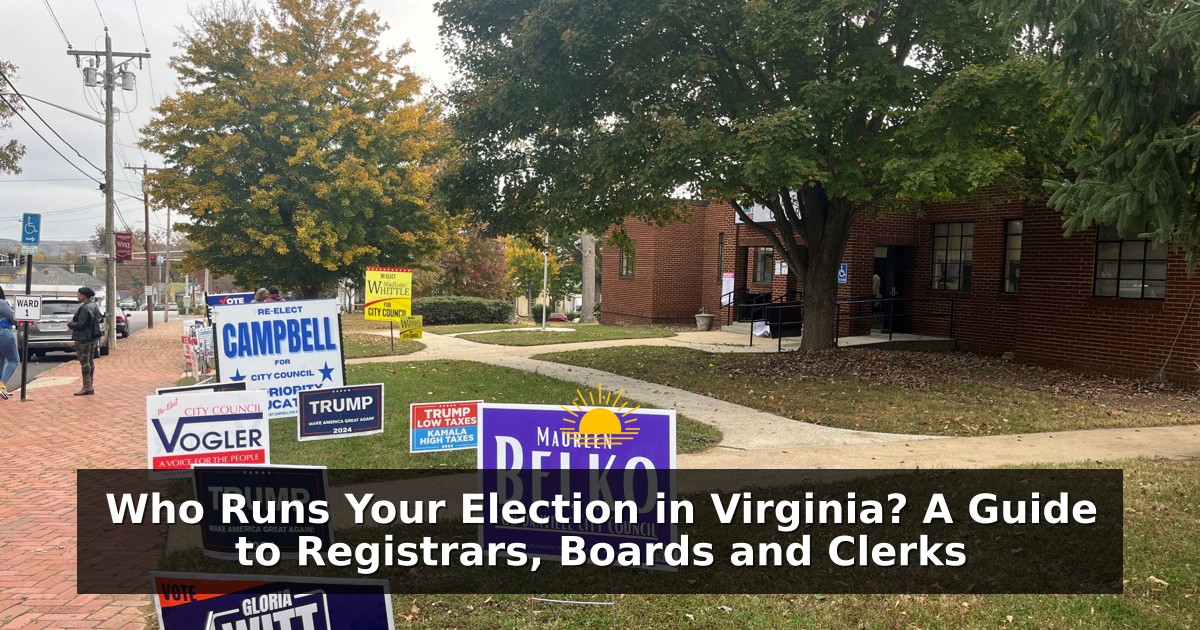
When a voter has a question about a polling place, a ballot or something that went wrong, the hardest part can be knowing whom to call. Virginia elections are run locally, and a joint bulletin issued Oct. 15 by the Virginia Department of Elections (ELECT) and the Office of the Attorney General (OAG) names the key local officials. This guide explains who they are, what the bulletin says they do and where a problem goes from there.
The bulletin is informational and is not legal advice. It was addressed to four groups: general registrars, local electoral boards, local government attorneys and circuit court clerks. Those are the officials most voters never meet but depend on every year.
The general registrar
The general registrar is the official the bulletin most often points to as the local decision-maker on Election Day. According to the bulletin, the general registrar, along with the electoral board, has the authority to authorize neutral observers to be inside polling places, and to revoke that authorization if an observer breaks the rules or fails to follow conditions placed on it.
If something unexpected happens at a polling place, such as a person asking for access without authorization, the bulletin says officers of election should bring the issue to the general registrar's attention. The registrar is also the official who is told to notify ELECT's regional liaison if an observer becomes disruptive.
For voters, the registrar's office is the first call for questions about polling places and for concerns on or before Election Day.
The local electoral board
The electoral board works alongside the registrar. The bulletin says the decision to accept a request for monitoring by the U.S. Department of Justice is "in the sole discretion of the applicable electoral board and general registrar." It also says that only the general registrar and the electoral board can grant a neutral observer access to a polling location, and only in writing.
Neither officers of election at a polling place nor anyone else can grant that access on their own. The bulletin is clear on that point.
The circuit court clerk
The third office is the clerk of the circuit court. According to the bulletin, after an election, voting equipment is locked and sealed, with keys and data storage delivered to the clerk of the circuit court for each locality. Circuit court clerks also must secure ballots after an election, and access is permitted only under specified circumstances.
The clerk, in other words, is the keeper of the materials once voting ends. If a subpoena seeking election materials arrives, it may land at the clerk's office or the registrar's office, and the bulletin lays out steps for both.
Officers of election
At the polling place itself, the people in charge are the officers of election, commonly known as poll workers. The bulletin says they can, by majority vote of those present, require an authorized observer who is violating rules to remain outside the 40-foot perimeter. Chief officers of election are the ones the bulletin suggests training on checking credentials for observers and monitors.
Local partners behind the scenes
The bulletin also names the other local offices that registrars and clerks are urged to work with before Election Day: local attorneys, local law enforcement and the Commonwealth's attorney. It says officials should "identify and document points of contact for each office and establish escalation protocols to ensure swift responses." Voters do not need to call these offices first, but this is the network that supports polling places.
How to find your officials
The bulletin does not publish a directory of local officials, and AVN is not reproducing one here. The best approach is to check your locality's general registrar for your polling place and for office hours and contact information. Your registrar can tell you who serves on your electoral board and where your clerk's office is.
Voters who cannot reach a local office can contact the state. The bulletin lists the Virginia Department of Elections at (804) 864-8901 and ea@elections.virginia.gov. That contact is given in the bulletin as a general line for local officials who do not have their regional liaison's information, so voters may find that staff direct them back to their registrar.
Where problems go after the local level
The bulletin describes an escalation path for local officials:
- Local first. Officers of election notify the general registrar. If there is danger, such as an armed person trying to enter, law enforcement is called immediately.
- State agencies. The registrar notifies the ELECT regional liaison. For legal issues, the OAG's Election Officials Line is (804) 200-4226, with email at election@oag.state.va.us.
- Litigation. The bulletin says that as a state agency, the OAG can litigate complex legal cases on behalf of the Commonwealth in federal court and seek emergency relief.
Voters usually start at step one. A registrar who receives a report from a voter is in a position to take it through the rest.
What voters should keep handy
Before Nov. 3, it is worth writing down three things: your polling place, your registrar's phone number and the number for your local police department or sheriff's office. The bulletin tells officials to build exactly that kind of contact list, and the same advice works for a household.
The bottom line
Registrars decide and coordinate, electoral boards authorize and oversee, clerks keep the materials and poll workers run the room. ELECT and the OAG sit behind them as state resources. The bulletin's conclusion says these local officials "have administered successful elections year after year." Election Day is Nov. 3.
attorney general circuit court commonwealth data storage Department of Justice Election Day Law Enforcement local government sheriff's office Virginia Virginia elections