Willowsford Grant Parent Urges Loudoun Rezoning Delay
Updated
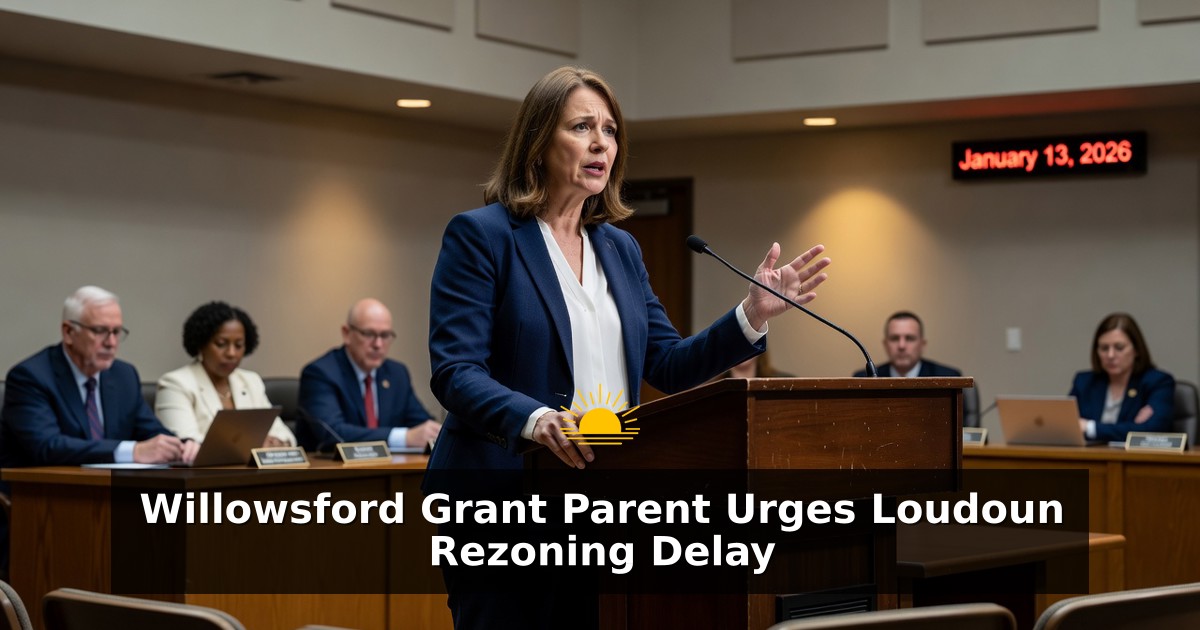
A parent from the Willowsford Grant community addressed members of the Loudoun County School Board at their regular meeting on January 13, 2026, to express deep concerns about a recent rezoning decision. Tara Greenwald spoke about Plan 280, which was advanced on December 16 and reassigns students from Willowsford Grant as well as zone D and 36.8 to alternative schools. She detailed the adverse effects already taking hold in the aftermath of that vote. Greenwald portrayed the changes as creating unnecessary disruption for families in a tightly connected neighborhood.
The Loudoun County School Board is composed of Chair Melinda Mansfield along with Anne Donohue, April Chandler, Deana Griffiths, John Beatty, Lauren Shernoff, Kari LaBell, Jeff Morse, and Harris Mahedavi. This nine-member body holds responsibility for setting educational policies and approving boundary adjustments throughout the county. Loudoun County Public Schools serve a rapidly expanding population, making enrollment balancing a recurring priority. Officials regularly review demographic projections to guide such plans.
Greenwald noted that the top performing school impacted by Plan 280 is operating at only 70 percent capacity as a result of the student shifts. This drop has triggered the loss of 35 dedicated staff members who contributed to the school's success. She labeled the outcome an unnecessary overcorrection that fails to account for community stability. The reduction in personnel raises questions about maintaining program quality for the students who remain enrolled.
Willowsford Grant forms part of the larger Willowsford development, a planned community in Loudoun County that emphasizes outdoor spaces and neighborhood cohesion. Residents often cite the close relationships among families as a defining feature of daily life there. School assignments play a central role in sustaining those bonds since children share educational experiences and activities. Changes to boundaries can therefore ripple through social networks beyond the classroom itself.
In her remarks, Greenwald advocated strongly for a delay in finalizing the rezoning under Plan 280. She suggested allowing additional time for enrollment projections to stabilize naturally over the coming period. A two-year postponement would provide opportunity to reassess actual numbers against forecasts. This approach could prevent premature adjustments that prove overly severe once data matures.
If a delay proves impossible, Greenwald urged the board to retain Willowsford Grant students at Madison's Trust Elementary School. The community sends just 189 students, a relatively modest figure that would support keeping the school below full capacity. Such a move would minimize broader disruption across multiple neighborhoods while addressing utilization goals. Returning the group to Madison's Trust represents the option that best preserves continuity for those families.
Madison's Trust Elementary School was established to meet the needs of growing areas including sections of Willowsford. It has developed a reputation for strong academic performance among Loudoun County elementary institutions. Maintaining appropriate enrollment levels helps schools sustain staffing, resources, and specialized offerings. Boundary decisions must weigh these operational realities against the human elements of student transitions.
Loudoun County has experienced significant residential development over recent decades, particularly in the southern and western portions. New housing brings young families and increases demand for classroom seats in certain clusters. At the same time, other schools may see declining numbers as neighborhoods mature and children age out. Comprehensive plans like the one numbered 280 aim to redistribute enrollment more evenly districtwide.
Public comment periods during school board meetings offer residents a formal channel to influence these outcomes. Greenwald indicated this marked her fifth appearance before the board on the topic, underscoring persistent community engagement. Her testimony focused on practical solutions rather than opposition alone. She requested that officials erase what she termed the devastating mistake from December 16 through either delay or reversal for the Grant section.
School capacity percentages directly influence funding allocations and personnel decisions within Virginia public education systems. When enrollment falls substantially below design levels, budgets tighten and positions may be eliminated or reassigned. The projected departure of 35 staff members illustrates the scale of impact from even targeted rezonings. Educators, support staff, and specialists all contribute to the learning environment that families value.
Community input remains a cornerstone of effective boundary planning in Loudoun County. Officials typically gather feedback through multiple hearings, surveys, and work sessions before casting final votes. Projections incorporate birth rates, housing permits, and migration patterns to forecast future needs. Yet parents like Greenwald argue that real-time observations sometimes diverge from models, warranting caution.
The close-knit character of Willowsford Grant amplifies the stakes of any reassignment. Children who have progressed together through early grades form lasting peer groups that extend into extracurriculars and neighborhood play. Abrupt shifts to new schools can interrupt those relationships and require fresh adjustments for students and parents alike. Minimizing such breaks aligns with broader goals of supporting student well-being alongside academic metrics.
Greenwald concluded her comments by reiterating the dual path of delay or restoration to Madison's Trust. She framed both as means to correct course without abandoning capacity management entirely. The board faces the task of reconciling individual neighborhood appeals with systemwide equity and efficiency. Subsequent discussions and potential votes will determine whether Plan 280 proceeds unchanged or receives modifications.
Ongoing monitoring of enrollment after any boundary change allows districts to refine approaches in later cycles. Loudoun County Public Schools have adjusted maps multiple times in response to growth corridors around areas near Willowsford. Each iteration seeks improved balance yet inevitably generates localized concerns. Transparent communication helps bridge gaps between planners and affected households.
In the context of the January 13 proceedings, the highlighted tensions reflect broader challenges of managing school facilities amid demographic flux across Virginia localities. Tara Greenwald's appeal centered on protecting staff retention at high-performing schools, preserving community integrity, and encouraging measured decision-making based on evolving data. Board members received the detailed input as part of their ongoing deliberations regarding student assignment policies and facility utilization. The ultimate resolution of these issues will directly shape educational experiences and neighborhood dynamics for Willowsford Grant families in subsequent school years.
calls community community impact decision Delay Grant Greenwald Madison's Trust Parent pause Plan 280 rezoning School School Board speaks Tara Tara Greenwald Urges Willowsford Willowsford Grant