Electrical Substations Defined in Loudoun County Presentation on Grid Operations
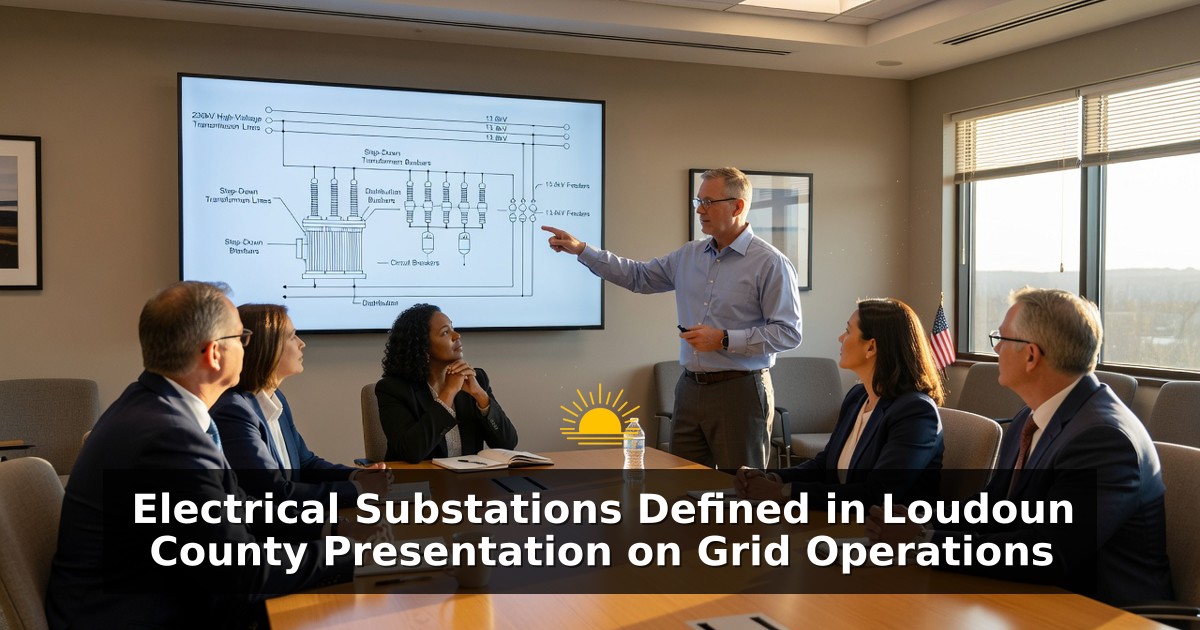
Loudoun County recently featured a presentation during a Board of Supervisors meeting that clarified the operations of electrical substations. The session covered how these facilities adjust voltage and facilitate power flow from generation to consumption. This information helps explain the mechanics behind everyday electricity access in the region.
Loudoun County is the jurisdiction where this detailed overview of electrical substations took place during a Board of Supervisors meeting. The current members of the Loudoun County Board of Supervisors include Phyllis Randall, Juli Briskman, Sylvia Glass, Caleb Kershner, April McConnell, Ron Meyer, Tony Buffington, Mike Turner, and Kristen Umstattd. The discussion focused on technical aspects of the power grid without broader policy interpretations.
A substation serves as the location where voltage levels are adjusted to prepare electricity for distribution. Electricity is controlled, managed, and directed as it travels from the generation source to end consumers. It acts as the interface connecting electricity generation, transmission, and distribution networks.
The facility essentially switches power between sources and consumers to maintain balanced flow. Substations are classified by voltage levels to suit different stages of the grid. Transmission substations operate at ultra-high voltage, extra-high voltage, and high voltage. Sub-transmission and distribution categories cover medium voltage and low voltage for final delivery.
In Loudoun County, typical substation configurations support data center operations that require substantial power. Location and siting factors receive consideration during planning. Screening methods address visual and other integration aspects with surrounding areas.
The substation approval process in Loudoun County involves multiple steps to evaluate proposals. This ensures compliance with local standards before facilities are built. Power moves from generation through transmission lines into these substations for voltage adjustment.
Distribution networks then carry the adjusted electricity to homes and other users. The process relies on coordinated infrastructure to avoid interruptions in service. Different voltage types allow the system to handle varying distances and loads efficiently.
Diagrams in the presentation illustrate connections from power generation sites to transmission lines and onward to substations. From there, power reaches distribution transformers and ultimately consumer locations. This structure supports consistent delivery across the network.
Loudoun County’s review of these elements provides context for understanding grid reliability. Substations play a central role in managing the transition between high-voltage transmission and lower-voltage distribution. The overview includes both transmission and distribution classifications to cover the full spectrum.
Overall, the presentation outlines the functional purpose of substations in the electricity supply chain. It details voltage-based types and their positions within the broader system. This information contributes to public awareness of how power reaches end users in the county.
https://x.com/AllVirginiaNews/status/2090346928852947434
Email the Leesburg City Council at: council@leesburgva.gov,
Mayor Kelly Burk — kburk@leesburgva.gov,
Vice Mayor Todd Cimino-Johnson — tciminojohnson@leesburgva.gov,
Council Member Zach Cummings — zcummings@leesburgva.gov,
Council Member Nicholas Krukowski — nkrukowski@leesburgva.gov,
Council Member Kari Nacy — knacy@leesburgva.gov,
Council Member Neil Steinberg — nsteinberg@leesburgva.gov,
Council Member Patrick Wilt — pwilt@leesburgva.gov,
Email the Board of Supervisors at:
Phyllis J. Randall (Chair, At-Large) – Phyllis.Randall@loudoun.gov,
Michael R. Turner (Vice Chair, Ashburn District) – Mike.Turner@loudoun.gov,
Juli E. Briskman (Algonkian District) – Juli.Briskman@loudoun.gov,
Sylvia R. Glass (Broad Run District) – Sylvia.Glass@loudoun.gov,
Caleb Kershner (Catoctin District) – caleb.kershner@loudoun.gov,
Matthew F. Letourneau (Dulles District) – Matt.Letourneau@loudoun.gov,
Kristen C. Umstattd (Leesburg District) – Kristen.Umstattd@loudoun.gov,
Laura A. TeKrony (Little River District) – Laura.TeKrony@loudoun.gov,
Koran Saines (Sterling District) – Koran.Saines@loudoun.gov
Loudoun County is a county in Northern Virginia. Its county seat is Leesburg.
Leesburg Loudoun County allow approval areas Ashburn aspects between Board of Supervisors Caleb Kershner chair Classifications compliance consideration consistent Consumer consumers current Data Data Center discussion district Dulles Electrical Electricity ensures explain facility Featured Grid grid reliability handle High information Juli Briskman jurisdiction Kari Nacy Kelly Burk Koran Saines Kristen Umstattd Laura TeKrony Leesburg Leesburg City Council locations Loudoun Loudoun County Loudoun County Board of Supervisors managing Matt Letourneau meeting Michael Michael Turner Mike Turner moves Neil Steinberg Nicholas Krukowski Patrick Wilt Phyllis Randall planning Policy positions Power presentation Process provides purpose receive reliability river Role service session standards status Sterling supervisors supervisors meeting supply chain Support supports Sylvia Glass System there Todd Cimino-Johnson took transmission transmission lines Understanding users Vice Vice Chair within Zach Cummings
