Virginia Delegate Opposes House Bill 797 on AI Over Competitiveness Fears
Updated
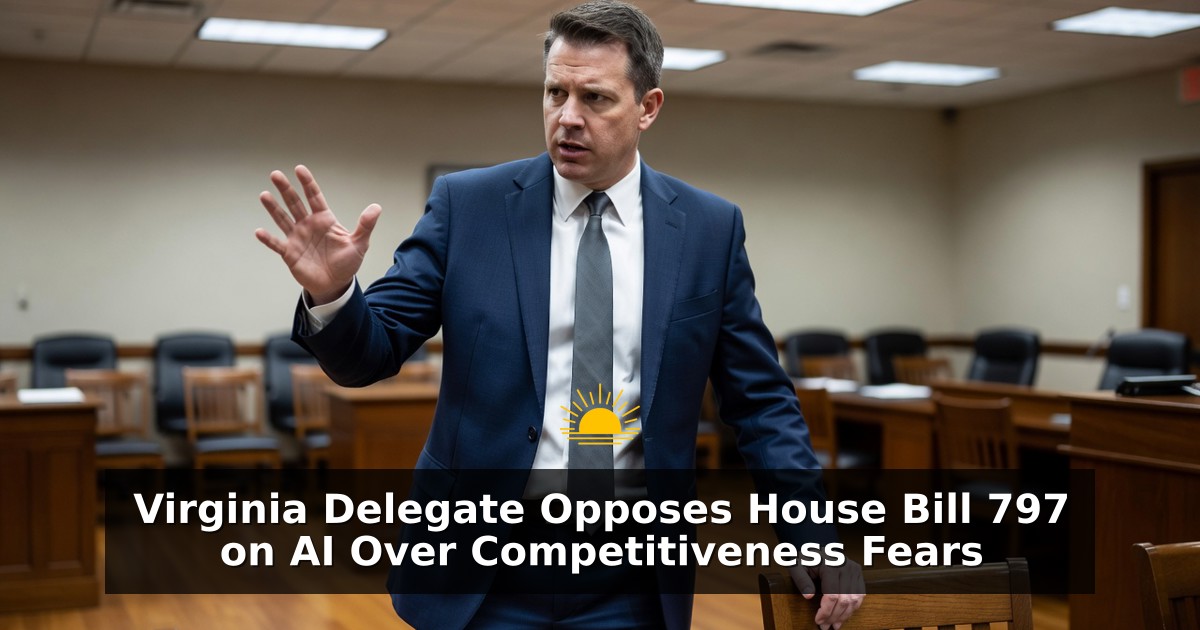
Delegate Griffin has voiced clear opposition to House Bill 797 during a communications subcommittee session, arguing that a patchwork of artificial intelligence regulations from individual states would undermine competitiveness. He described the prospect of fifty different state approaches as unwise in light of broader national efforts already underway. Griffin referenced a major federal legislative package that has begun addressing certain boundaries around artificial intelligence development. His position centers on preserving Virginia’s ability to remain agile amid rapid technological change and international pressures.
The delegate framed current global dynamics as an intense arms race involving other countries seeking dominance in advanced technologies. He warned that states imposing their own regulatory layers risk becoming less attractive for investment and innovation in artificial intelligence. According to his remarks, those jurisdictions adopting extra rules would likely fall behind in the contest for talent, capital, and infrastructure. Virginia’s established technology base makes the stakes particularly high for the commonwealth under such a scenario.
Griffin linked his regulatory skepticism to everyday examples of governmental performance challenges. He recounted being unable to walk from his hotel that morning due to ice covering Richmond streets, which he attributed to local mismanagement. This illustration served to question the wisdom of placing complex, fast-moving AI oversight in government hands. He concluded that expanding such control represents a poor policy choice and confirmed he would vote against the bill.
Concerns Over a Fragmented National Landscape
Policy analysts have long examined the risks of inconsistent state rules in emerging technology fields. A patchwork system can raise compliance costs for companies operating across multiple jurisdictions and create uncertainty for startups. Federal measures that set baseline boundaries aim to reduce those frictions while still allowing room for responsible development. Griffin’s comments align with arguments favoring coordinated frameworks over disparate state experiments in artificial intelligence governance.
Virginia has built a substantial presence in data centers and related technology infrastructure, especially in the northern part of the state. These facilities support cloud services and computational workloads essential to modern AI training and deployment. Economic contributions from the sector include significant employment and tax revenue that bolster public services. Lawmakers weighing bills such as House Bill 797 must consider how new requirements might affect this growth engine relative to competing regions.
National conversations frequently highlight the competitive posture of the United States against nations investing heavily in artificial intelligence research and applications. Maintaining leadership requires environments that encourage rapid iteration without unnecessary barriers. Proponents of uniform standards contend that fragmented rules could slow domestic progress precisely when speed matters most. Griffin’s reference to an international arms race underscores this dimension of the debate surrounding state-level proposals.
Examining Oversight Capacity in Dynamic Sectors
Questions about governmental effectiveness in overseeing fast-evolving industries recur across policy domains. Traditional regulatory processes often struggle to match the pace of technological iteration cycles measured in months rather than years. Private standards bodies, industry consortia, and international dialogues sometimes fill gaps more flexibly than legislation alone. The Richmond street conditions cited by Griffin illustrate broader administrative hurdles that fuel caution about expanded mandates.
Several other states have advanced their own artificial intelligence measures in recent years, focusing on transparency, bias mitigation, or high-risk applications. These efforts reflect legitimate interests in protecting consumers and addressing societal impacts. At the same time, industry voices and some legislators caution that cumulative burdens may redirect activity toward less regulated locations. The tension between protection and promotion sits at the heart of deliberations on bills like House Bill 797.
Federal initiatives have sought to establish clearer national parameters for artificial intelligence through a combination of legislation and executive actions. Such steps aim to provide predictability for developers while safeguarding key public interests. Advocates for preemption argue that overriding conflicting state rules prevents a confusing mosaic that hampers interstate operations. Griffin’s mention of existing federal boundary-setting supports the view that additional state layers may prove redundant or counterproductive.
Economic and Strategic Implications for Virginia
Technology policy choices carry direct consequences for workforce development and capital attraction in the commonwealth. Universities and research centers in Virginia contribute to AI-related education and innovation pipelines that feed local employers. Regulatory environments perceived as overly restrictive could complicate efforts to retain graduates and draw new ventures. Balanced approaches seek to address risks without eroding the foundations of continued expansion.
International comparisons reveal a range of governance models, from comprehensive regional frameworks to lighter-touch national strategies. Each model presents trade-offs between innovation velocity and risk management. Virginia’s decisions occur against this backdrop and within the unique context of its proximity to federal institutions. The outcome of debates on House Bill 797 may signal how the state intends to position itself for the next phase of technological competition.
Observers note that artificial intelligence applications already span healthcare, transportation, finance, and public administration, amplifying the reach of any new rules. Evidence on the precise economic effects of state-level AI statutes continues to develop as more jurisdictions experiment. Careful evaluation of compliance data, investment flows, and safety outcomes will inform future adjustments. Griffin’s opposition adds a distinct perspective emphasizing competitiveness and practical limits of oversight.
Local examples of service delivery challenges, while not unique to any single locality, reinforce arguments for humility in regulatory design. Weather-related disruptions test municipal capacities in visible ways that resonate with residents and visitors alike. Extending similar scrutiny to highly technical domains like artificial intelligence invites rigorous assessment of institutional readiness. The delegate’s remarks connect these practical observations to higher-stakes policy choices.
As discussions proceed, stakeholders from industry, academia, and civil society will continue contributing evidence and viewpoints. The core issue remains how best to foster beneficial AI progress while managing identifiable harms. Virginia’s legislative process provides a forum for weighing those considerations through bills such as the one under review. Griffin’s stated intent to vote against House Bill 797 keeps the focus on avoiding fragmented approaches that could diminish the commonwealth’s standing.
Future sessions may revisit related proposals as capabilities advance and new use cases emerge. Monitoring both domestic implementation and global developments will remain essential for informed decision-making. The current exchange highlights enduring questions about the optimal scale of governance for transformative technologies. Neutral examination of the facts presented supports ongoing public attention to these matters without prejudging ultimate outcomes.
AI AI regulations arms race big beautiful bill bill boundaries of AI city of Richmond competitive Delegate Maldonado government government control Madam Chair mismanaged other countries patchwork approach Patron regs Richmond states subcommittee vote no
