Virginia Official Cites System Differences as Key Factor in FOIA Fee Variations
Updated
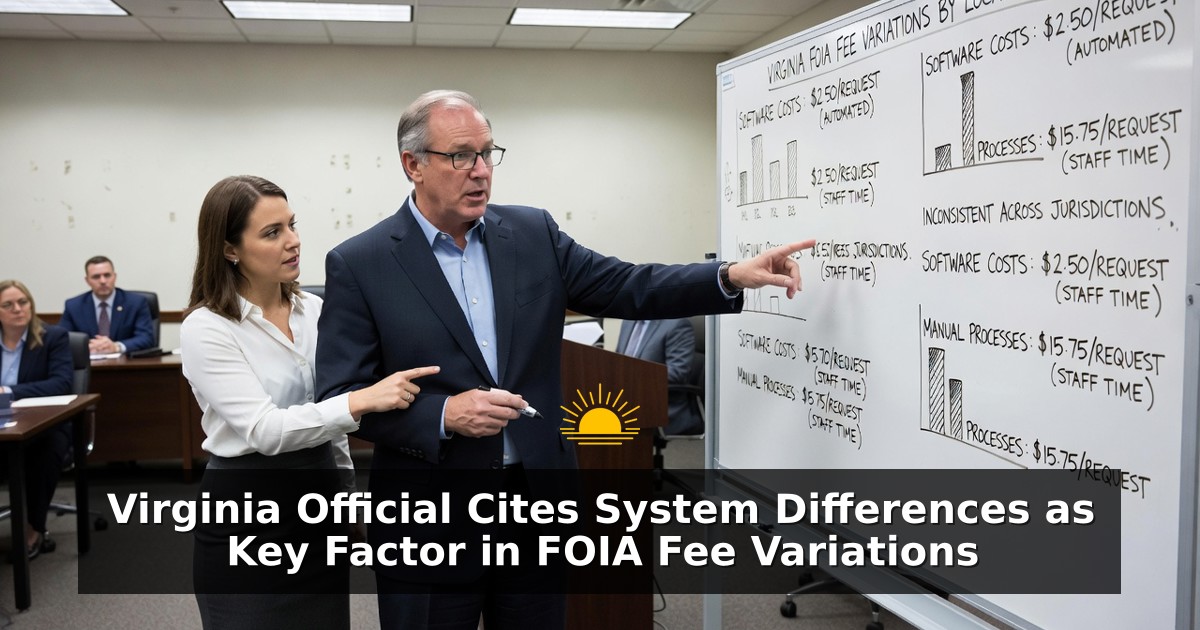
Concerns over inconsistent fees charged for public records requests under Virginia’s Freedom of Information Act received direct attention during a recent meeting of the Freedom of Information Advisory Council Records Subcommittee. Ms. Perkins spoke to members about the noticeable discrepancies that appear when residents compare costs from one locality to another. She stressed that these differences frequently stem from the underlying administrative systems each jurisdiction employs rather than any deliberate effort to raise extra revenue. Her remarks urged the subcommittee to examine operational realities before drawing conclusions about motives behind higher charges.
Virginia’s Freedom of Information Act has long guaranteed citizens the right to inspect and copy public records while permitting agencies to recover the actual costs of producing those records. State law authorizes charges for staff time spent searching, reviewing, and redacting materials as well as for materials and technology used in the response. Because the statute leaves implementation details largely to individual public bodies, practices have evolved differently across cities, counties, and state agencies. This decentralized approach produces the very fee variations that prompted discussion at the subcommittee session.
Ms. Perkins pointed specifically to the presence or absence of specialized FOIA software as a primary driver of cost differences. Jurisdictions that have invested in electronic request-tracking and document-management platforms can often generate reports, apply redactions, and calculate fees with far less staff time. In contrast, localities still relying on manual file searches, paper logs, and individual email correspondence must devote more employee hours to each request. Those additional labor hours translate directly into higher invoices for requestors, creating an appearance of inconsistency that may have little to do with revenue goals.
The practical consequences of these system disparities extend beyond simple dollar amounts. Residents seeking identical categories of records—such as police incident reports, school board emails, or budget worksheets—can face markedly different bills depending on where they live or which agency holds the documents. Advocates for transparency have repeatedly noted that unpredictable costs can discourage ordinary citizens from exercising their statutory rights. At the same time, smaller localities with limited budgets argue that they cannot absorb the full expense of complex requests without some cost recovery, especially when staff must set aside other duties to fulfill them.
Members of the Records Subcommittee have been examining whether greater uniformity in fee practices would improve public confidence without imposing unworkable burdens on local governments. One recurring theme is the need for clearer guidance on what constitutes a reasonable charge and how agencies should document the basis for their invoices. Ms. Perkins’ comments reinforced that any future recommendations must account for the technological and staffing realities that already shape day-to-day FOIA administration. Ignoring those realities, she suggested, risks mischaracterizing legitimate cost differences as improper profit-seeking.
Technology adoption rates continue to vary widely across the Commonwealth. Larger urban counties and state agencies frequently maintain dedicated public-records portals that automate intake, assign tracking numbers, and produce itemized fee estimates within minutes. Rural counties and smaller towns, by comparison, may still route every request through a single clerk who manually locates boxes of paper files or searches multiple unconnected computer drives. The time required for the latter process naturally elevates the final charge, even when the hourly rate applied to staff time remains modest and fully compliant with statute.
Observers of Virginia government transparency note that fee disputes occasionally escalate into formal petitions or litigation, consuming additional public resources. Courts have generally upheld an agency’s right to recover actual costs provided the charges are not used as a barrier to access. Nevertheless, the perception that some localities price records out of reach persists among frequent requestors, including journalists, civic groups, and individual residents. By placing operational context at the center of the conversation, the subcommittee discussion aims to separate structural explanations from any instances of genuine overcharging.
Training and staffing levels further compound the picture. Agencies that designate trained FOIA officers and maintain up-to-date records-retention schedules typically respond more efficiently and therefore more affordably. Where institutional knowledge is thin or turnover is high, each new request can require extensive internal consultation, lengthening response times and increasing billable hours. Ms. Perkins underscored that these internal capacity differences constitute a rational basis for fee variation and should be weighed carefully in any policy review.
Looking ahead, the Freedom of Information Advisory Council is expected to continue gathering information on best practices that could reduce unnecessary disparities while preserving local flexibility. Possible avenues include model fee schedules, shared software procurement options for smaller localities, and enhanced educational materials that help both requestors and records custodians understand allowable charges. Any such measures would need to respect the statutory framework that already balances public access against the fiscal realities faced by government offices.
The exchange at the Records Subcommittee illustrates the complexity inherent in administering a statewide transparency law across hundreds of independent public bodies. Ms. Perkins’ intervention served as a reminder that surface-level comparisons of fee totals can obscure important differences in how records are stored, searched, and produced. By focusing on systems rather than assumptions about intent, policymakers stand a better chance of crafting solutions that maintain both fiscal responsibility and meaningful public access. Continued attention to these operational details will remain essential as Virginia refines its approach to open government in the years ahead.
Public understanding of FOIA fee structures also benefits when agencies publish clear, advance explanations of their calculation methods. Several localities already post online schedules that list hourly rates for different staff classifications and outline common cost components such as copying, scanning, and electronic media. Wider adoption of that practice could reduce surprise and suspicion even in places where absolute dollar amounts remain higher because of manual workflows. Transparency about process, in other words, can mitigate concerns generated by transparency about price.
Ultimately, the subcommittee’s examination of fee discrepancies reflects a broader commitment to ensuring that Virginia’s open-records law functions equitably for all residents. Ms. Perkins’ emphasis on rational, system-based explanations provides a constructive starting point for that work. As deliberations proceed, the focus is likely to stay on practical steps that acknowledge existing differences while steadily improving consistency and predictability for citizens who seek information about their government.
Basis Discrepancies Exploring Fee fee discrepancies fee structures FOIA FOIA software government processes government transparency House of Delegates information access jurisdictions local government manual processes Ms. Perkins public records Rational system differences Virginia
