Virginia Proposal Seeks to Toll Speedy Trial Clock During Counsel Retention
Updated
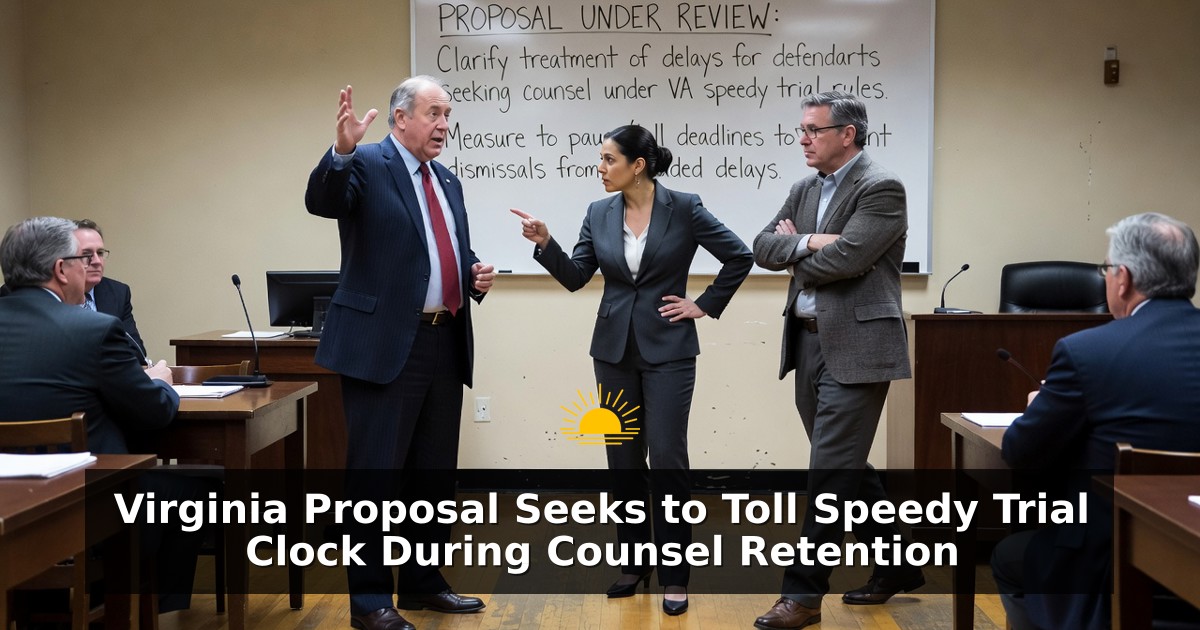
A proposal under review in a Virginia criminal subcommittee would clarify the treatment of delays when defendants seek time to retain legal counsel under the state's speedy trial rules. The measure aims to pause or toll the statutory clock during those periods so that genuine efforts to hire an attorney do not automatically risk case dismissal. Lawmakers pointed to a recent murder case in which successive delays stretched across multiple 30-day intervals before counsel appeared. Once an attorney was retained, the defense successfully moved for dismissal on speedy trial grounds. The defendant in that matter had been identified as a hired hitman, underscoring concerns that serious charges can be lost through procedural timing alone.
Background on Speedy Trial Requirements
Virginia law sets firm deadlines for bringing criminal cases to trial in order to honor both constitutional and statutory guarantees. Defendants held in custody generally must be tried within shorter windows than those free on bond, with the precise periods established by longstanding code provisions. Continuances requested by the accused ordinarily stop the running of these deadlines under existing case law. Ambiguity has persisted, however, around motions specifically seeking time to locate and hire private counsel. The subcommittee discussion focused on codifying a clear rule so that courts across the commonwealth apply the same standard.
The right to a speedy trial draws from the Sixth Amendment and is reinforced by Virginia statutes that discharge a defendant if the applicable period expires without trial. Judges already possess authority to grant reasonable continuances, yet the absence of explicit language on counsel-retention delays has produced inconsistent results. Prosecutors and defense counsel alike have encountered situations in which the clock continued to run during what the defense characterized as necessary preparation. The proposed change would align statute with the practical reality that securing qualified representation often requires more than a single court appearance. Clear tolling language would give all parties predictable guidance from the outset of a case.
Details of the Highlighted Murder Case
In the example presented to the subcommittee, the defendant repeatedly indicated an intention to retain counsel rather than proceed with appointed representation. Each request produced an additional continuance, first for 30 days and then for another comparable period. Only after counsel finally entered the case did the defense file a motion asserting that the speedy trial period had been violated. The court granted the motion and dismissed the charges. Because the underlying allegation involved a murder-for-hire arrangement, the dismissal carried significant consequences for victims' families and for public confidence in the courts.
Subcommittee members observed that the sequence of events illustrated how an open-ended opportunity to delay could be converted into a complete bar to prosecution. Nothing in the discussion suggested the defendant had been denied access to counsel; rather, the time consumed in the search itself became the basis for dismissal. The proposal therefore seeks to preserve the ability to request time while removing the incentive to prolong that process indefinitely. By stopping the clock for the duration of a counsel-retention continuance, the legislation would keep the focus on the merits of the charges.
Core Provisions of the Legislative Proposal
The bill under consideration would expressly provide that a continuance granted so a defendant may retain counsel tolls the speedy trial calculation. This language is intended to capture and restate current case-law principles in statutory form, eliminating room for conflicting interpretations. Defendants would retain the full opportunity to choose private counsel when they possess the means to do so. At the same time, the tolling mechanism would prevent the mere passage of time during that search from maturing into a dismissal remedy. Supporters described the change as a straightforward clarification rather than a restriction of any constitutional right.
Existing practice already recognizes that delays attributable to the defense do not count against the Commonwealth. The proposal simply makes that principle unmistakable when the stated reason for delay is the retention of an attorney. Judges would continue to evaluate the reasonableness of each request and could deny continuances that appear dilatory. Once time is granted, however, that interval would be excluded from the statutory count. The result, according to the discussion, would be fewer surprise dismissals and greater consistency from one circuit to another.
Balancing Constitutional Rights and Case Progression
The Sixth Amendment simultaneously protects the right to counsel and the right to a speedy trial, creating an inherent tension when the exercise of one right lengthens the timeline of the other. Virginia courts have long managed that tension through case-by-case rulings, yet recent experience demonstrated the need for brighter lines. Allowing reasonable time to hire counsel safeguards the quality of representation and reduces later claims of ineffective assistance. Pausing the speedy trial clock during that window ensures the protection does not become a strategic device for avoiding adjudication altogether.
Public safety considerations also enter the analysis when violent offenses are involved. Victims and witnesses have an interest in timely resolution, and evidence can degrade as months pass. A rule that rewards extended delay with dismissal can erode trust that the justice system will hold offenders accountable. The subcommittee emphasized that the proposal does not shorten any defendant's opportunity to prepare; it merely prevents the preparation period itself from extinguishing the prosecution. This approach seeks to honor both sets of rights without subordinating one to the other.
Practical Effects on Court Operations
If adopted, the tolling rule would give prosecutors clearer visibility into remaining speedy trial time even while a defendant searches for counsel. Defense attorneys would know that the clock stops once a continuance for retention is granted, removing pressure to file premature dismissal motions. Court administrators could schedule subsequent dates with greater confidence that the statutory period remains intact. Over time, the change might encourage earlier retention of counsel, because prolonged searching would no longer carry the collateral benefit of potential dismissal. These operational improvements would serve the broader goal of efficient yet fair case management.
Virginia's circuit and general district courts already manage heavy criminal dockets. Ambiguities that generate last-minute litigation over tolling consume scarce judicial resources. Codifying the counsel-retention exception would reduce collateral disputes and allow more courtroom time to be devoted to substantive hearings and trials. The measure is narrowly drawn, applying only to continuances sought for the purpose of obtaining an attorney, and therefore leaves other grounds for delay untouched. Its simplicity is viewed as an advantage in achieving uniform application.
Ongoing Considerations for Lawmakers
Subcommittee members continue to weigh how best to draft language that covers typical scenarios without creating new uncertainties. Questions remain about the outer limits of reasonableness when a defendant claims ongoing difficulty locating affordable counsel. Indigent defendants who qualify for court-appointed lawyers would be largely unaffected, since the bill targets those who elect to retain private representation. Input from prosecutors, the defense bar, and the judiciary is expected as the proposal advances. Any final version would still need to pass both chambers and receive gubernatorial action before taking effect.
The discussion reflects a larger pattern of incremental refinement in Virginia criminal procedure. Legislators periodically revisit speedy trial and continuance statutes in light of courtroom experience and evolving case law. By addressing the specific problem of counsel-retention delays, the current effort aims to close a narrow but consequential gap. The objective remains a system in which defendants receive the time they need to secure representation while the public retains assurance that serious cases will reach a timely conclusion on the evidence.
Commitment to Fair and Timely Justice
Clear procedural rules ultimately strengthen every participant's confidence in the outcome of criminal proceedings. When dismissal results from an avoidable ambiguity rather than a substantive failure of proof, the integrity of the process suffers. The proposed tolling provision seeks to eliminate that ambiguity for one recurring fact pattern. It preserves the defendant's ability to exercise the right to counsel of choice and simultaneously protects the complementary right to a speedy trial from unintended forfeiture. In doing so, the legislation aspires to keep Virginia's courts focused on the fair determination of guilt or innocence.
Observers note that similar clarifications in other jurisdictions have reduced gamesmanship without diminishing core protections. Virginia's approach appears consistent with that experience by restating settled principles in accessible statutory text. As the measure moves forward, attention will center on precise wording that judges can apply with minimal discretion disputes. The subcommittee's work illustrates the continuous effort required to keep criminal procedure aligned with both constitutional commands and practical realities of modern caseloads. The central aim is a justice system that neither rushes defendants nor permits indefinite delay to defeat accountability.
accused attorney bill case continuation case dismissed case law continue case counsel current case law defeat speedy trial defendant defendant motion delayed case hired hitman hitman motion move case along murder murder case retain counsel speedy trial speedy trial violation time to get attorney tolling
