Loudoun County Faces Single-Bidder Challenges for School Meal Contracts
Updated
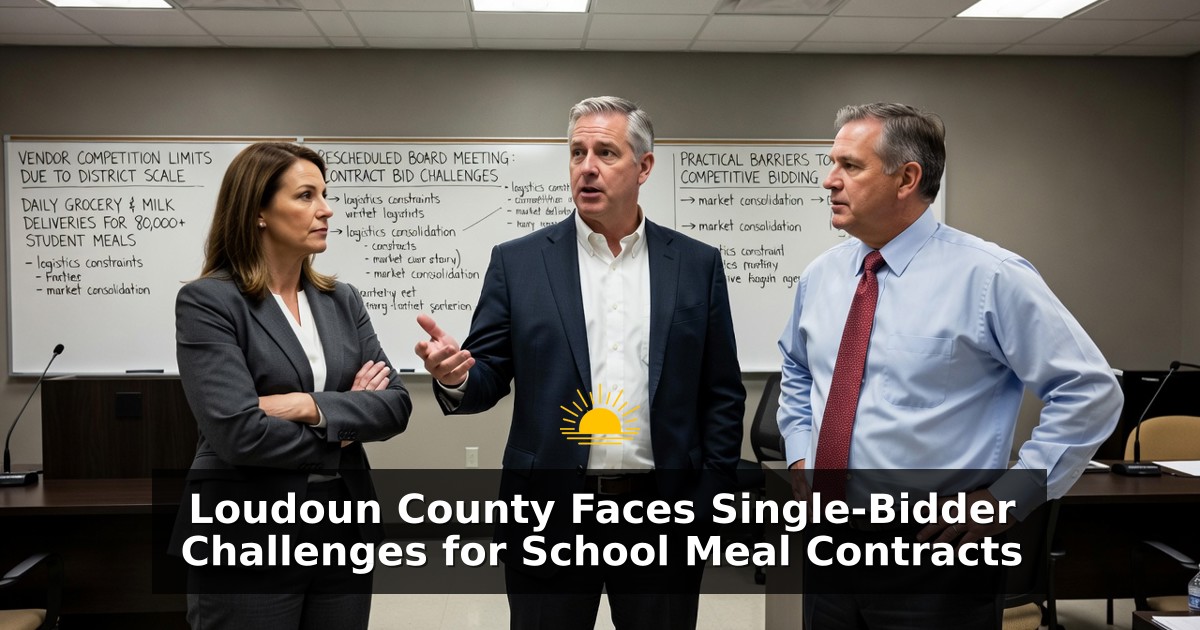
Loudoun County Public Schools officials addressed ongoing difficulties in securing competitive bids for grocery and dairy contracts during a rescheduled school board meeting. The discussion centered on the practical barriers created by the district’s large geographic footprint and the strict daily delivery requirements imposed on vendors. Officials explained that solicitations for essential items frequently attract only one responsive bidder, leaving the school system without meaningful competitor pricing. This situation affects the provision of thousands of meals served to students across the county each school day. Board members and staff noted that the pattern repeats annually when contracts come up for renewal.
The Loudoun County School Board oversees policy and major operational decisions for the district. Current members of the Loudoun County School Board are Chair Melinda Mansfield, Vice Chair Lauren Shernoff, Tiffany Deans, Deana Griffiths, Sumera Rashid, Anne Donohue, Andy Hawkins, Arben Istrefi, and Kari LaBell. These members represent the at-large seat and the eight election districts that span the county. The board regularly reviews procurement matters through its Finance and Operations committee. Staff presentations at the recent meeting prepared newer committee members for the upcoming grocery contract cycle.
Logistics Constraints Limit Vendor Participation
District staff highlighted the scale of operations as the primary reason for low bid responses. Loudoun County Public Schools operates approximately one hundred school sites that require timed daily deliveries of perishable goods such as milk. Vendors must possess sufficient fleet capacity, refrigerated storage, and routing expertise to meet prescribed delivery windows at every location. Few companies maintain the infrastructure needed to serve an entire large suburban county on a consistent daily schedule. As a result, solicitations often yield a single qualified response rather than a field of competing offers.
Milk contracts were cited as a clear illustration of the problem. The product must arrive fresh each day and be distributed under tight time constraints to protect food safety and meal program compliance. Officials recalled that recent milk solicitations produced only one responsive bidder. Without alternative proposals, the district lacks comparative pricing data that would normally drive costs downward. The same dynamic extends to broader grocery contracts that supply ingredients for thousands of breakfasts and lunches prepared daily.
Inflation Pressures Compound Limited Competition
Staff confirmed that the absence of multiple bidders amplifies the effects of inflation on food costs. When only one vendor meets the technical requirements, price negotiations occur without the leverage that competing offers normally provide. Rising costs for dairy, produce, and packaged goods therefore pass more directly into the meal program budget. Families who pay for full-price meals and the district’s overall nutrition fund both feel the impact. Officials stated that these combined pressures are discussed regularly with neighboring school divisions that face similar though often less severe constraints.
Conversations with surrounding districts reveal shared concerns about vendor capacity in Northern Virginia. Larger systems encounter comparable logistics hurdles when contracts demand daily service to dozens of schools. Smaller divisions sometimes attract more bidders because delivery routes remain manageable for regional suppliers. Loudoun’s size places it at a disadvantage in this regard. The exchange of information among districts helps identify potential process improvements, yet the fundamental geographic challenge persists.
Procurement Cycle and Committee Oversight
Grocery contracts for the coming school year typically advance to the Finance and Operations committee near the end of the current academic year. Committee members will examine the solicitation results, pricing terms, and any single-bidder justifications at that time. Staff already anticipate questions about response rates because the issue surfaces every cycle. Preparation includes documenting the outreach efforts made to potential vendors and the specific capacity requirements that limited participation. Transparency in these reviews remains a priority for the board.
Virginia public procurement rules require competitive sealed bidding for most significant purchases, yet they also recognize situations in which only one responsible source can meet the need. Loudoun County Public Schools follows these statutes while documenting the unique operational demands of its meal program. Federal regulations governing the National School Lunch Program and School Breakfast Program further layer nutritional, safety, and Buy American standards onto every contract. Meeting all of these overlapping requirements narrows the pool of eligible suppliers even before logistics are considered.
Student Meal Volume and Program Scope
The district serves tens of thousands of meals each day across elementary, middle, and high school campuses. Participation in free and reduced-price meal programs adds another dimension to cost management because reimbursement rates are set externally while local food expenses continue to fluctuate. When vendor prices rise without competitive checks, the gap between reimbursement and actual cost can widen. Officials monitor these trends closely to maintain program solvency and to keep paid meal prices as stable as possible for families.
Daily delivery of milk and other perishables is non-negotiable for food safety and menu consistency. Schools lack extensive on-site cold storage that would allow less frequent deliveries. Therefore contracts must guarantee morning arrivals timed to cafeteria preparation schedules. This service level exceeds what many regional grocery distributors are equipped to provide across an entire county the size of Loudoun. The resulting single-bidder outcomes have become a structural feature of the procurement landscape rather than an occasional anomaly.
Efforts to Broaden the Vendor Pool
Staff continue to explore methods for increasing interest among qualified suppliers. Pre-bid conferences, clearer specifications, and direct outreach to companies that serve other large districts form part of the routine. Even with these steps, the combination of volume, distance, and timing requirements remains a high barrier. Some potential bidders decline to respond once they calculate the fleet and labor investment needed for reliable daily service. Others submit proposals that fail to meet mandatory technical criteria and are therefore deemed non-responsive.
The cumulative effect is reduced pricing tension in a category that represents a substantial share of the nutrition services budget. Board members received the explanation as context for decisions they will face later in the year. Understanding the logistics reality helps frame expectations around cost containment and contract approval. The same information will inform any future policy discussions about meal program efficiency or potential adjustments to delivery models.
Broader Context for Virginia School Divisions
Large Virginia school divisions increasingly confront similar vendor-capacity limits as student enrollment and site counts grow. Loudoun’s experience offers a documented case of how geography and service intensity interact with public bidding rules. While inflation has affected food prices nationwide, districts that routinely secure multiple bids possess greater ability to offset those increases. Loudoun’s single-bidder pattern removes that buffer and places additional weight on careful menu planning and waste reduction inside school kitchens.
Officials emphasized that the challenges are structural rather than the product of inadequate outreach. The county’s rapid development over recent decades expanded the number of schools faster than the regional vendor base adapted to serve them all daily. Milk remains the clearest example, yet the constraint applies to the wider grocery basket as well. When the next contract package reaches the Finance and Operations committee, members will again weigh the documented market response against the operational necessity of uninterrupted meal service.
The rescheduled meeting provided an early opportunity to surface these facts before formal contract action is required. By outlining the size-related barriers, the limited bidder history, and the inflation interaction, staff equipped the board with a factual foundation for upcoming deliberations. The discussion underscored that competitive pricing remains elusive for core meal components when only one vendor can satisfy the full scope of daily delivery obligations across Loudoun County’s extensive school network.
bid solicitations competitive pricing contract challenges county size daily deliveries Finance and Operations grocery contract inflation limited competition Loudoun County meal contracts milk delivery Public Schools School Board School Board Meeting school meals school nutrition taxpayer costs vendor bids Virginia Schools
