Senator Seeks Broader Public Testimony Rules for Virginia Bodies
Updated
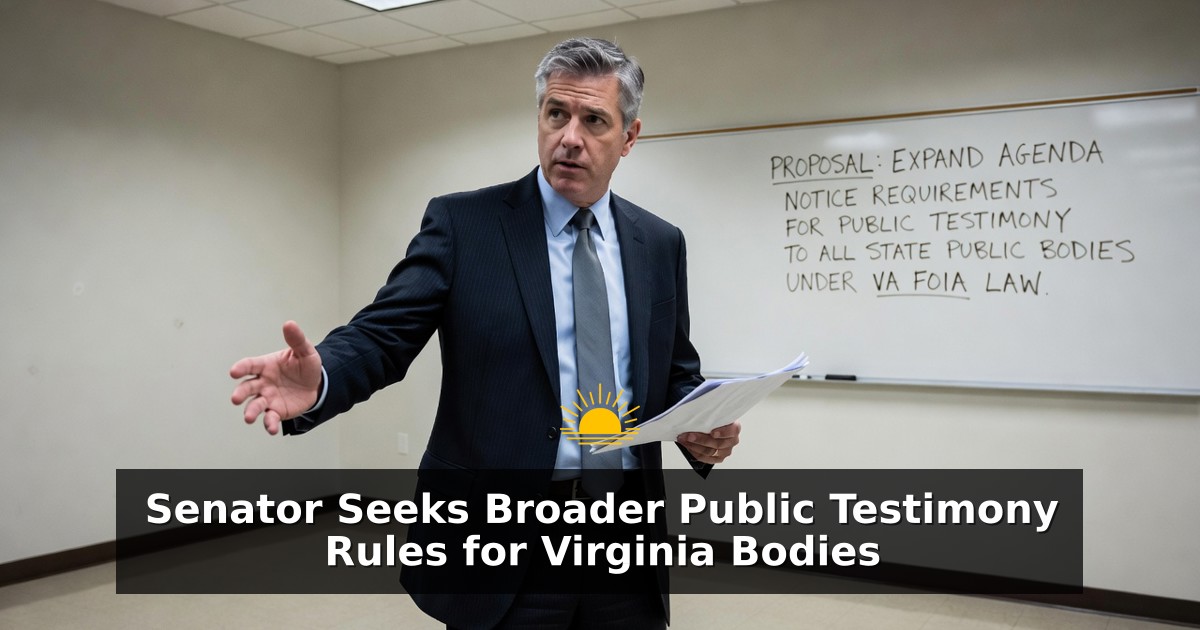
Senator Bennett Parker has introduced a proposal before a subcommittee of the Virginia Freedom of Information Advisory Council aimed at expanding requirements for public bodies to disclose whether public testimony will be accepted at meetings. Under current Virginia law, only state public bodies that include at least one member appointed by the governor must note on their agendas if public testimony will be offered. Parker argued that this narrow limitation lacks a clear rationale and creates inconsistent standards for public engagement across government entities.
The discussion took place during a recent meeting of the Freedom of Information Advisory Council Meetings Subcommittee. Parker explained that the existing restriction does not appear to serve a logical purpose and that prior conversations among council members revealed uncertainty about its origins. He presented draft language that would apply the agenda disclosure rule uniformly to all state public bodies, regardless of appointment methods. The goal, according to the senator, is greater consistency and improved opportunities for citizens to participate in governmental processes.
Current Scope of Virginia Public Testimony Notices
Virginia’s Freedom of Information Act establishes baseline expectations for open meetings and access to public records. One provision currently requires certain state-level bodies to indicate in advance whether members of the public will have a chance to speak. This obligation is limited to entities featuring a gubernatorial appointee, leaving other boards, commissions, and authorities without the same explicit agenda requirement. Stakeholders have long noted that the distinction can confuse residents who wish to prepare comments or attend sessions with the expectation of being heard.
Parker told the subcommittee that the selective application of the rule has puzzled observers for some time. He referenced earlier deliberations in which participants could not identify a historical justification for confining the notice duty to bodies with governor-appointed members. By removing that qualifier, the proposal would create a single standard applicable across the spectrum of state public bodies. Advocates for open government maintain that predictable notice practices help residents plan their involvement and hold officials accountable.
The senator circulated an earlier draft of the language to several major stakeholder organizations before the latest subcommittee session. Recipients included the Virginia Coalition for Open Government, the Virginia Press Association, the Virginia Association of Counties, and the Virginia Municipal League. Feedback from those groups informed revisions that appear in the version now under consideration. Parker indicated willingness to continue refining the text in collaboration with the subcommittee and interested parties.
Push for Uniformity and Greater Engagement
Supporters of broader disclosure rules often emphasize that public comment periods strengthen democratic legitimacy. When agendas clearly state whether testimony will be taken, citizens can decide whether to attend, prepare remarks, or submit written statements. Inconsistent practices among different bodies can leave some meetings more accessible than others, even when the underlying subject matter affects large numbers of Virginians. Parker’s measure seeks to eliminate that variability at the state level.
The Freedom of Information Advisory Council itself serves as a nonpartisan resource that issues opinions, conducts training, and reviews potential legislative adjustments to the Freedom of Information Act. Subcommittees routinely examine discrete issues such as meeting notices, electronic participation, and records exemptions before forwarding recommendations to the full council. If the Meetings Subcommittee endorses Parker’s concept, the full council could later decide whether to advance formal legislative suggestions to the General Assembly.
Parker framed the change as a modest but meaningful step toward transparency. He noted that the draft before members reflected discussions held at the preceding meeting and incorporated stakeholder input. The senator offered to answer technical questions and to keep working with local government associations and open-government groups. Such iterative drafting is common in FOIA policy work, where precise wording can affect hundreds of boards and commissions.
Stakeholder Input and Next Legislative Steps
Organizations representing local governments and the news media regularly monitor FOIA proposals because the statutes influence both day-to-day operations and public oversight. The Virginia Association of Counties and the Virginia Municipal League typically assess administrative burdens that new notice rules might impose on staff. Press and open-government advocates, by contrast, tend to focus on whether residents receive timely and reliable information about participation opportunities. Parker’s outreach to these groups before formal subcommittee review illustrates an effort to surface practical concerns early.
Any recommendation that emerges from the council would still require action by the General Assembly to become binding law. Lawmakers customarily consider FOIA amendments during regular sessions, often after receiving advisory council reports. The current proposal does not alter the substance of when or how public comment must be accepted; it addresses only the advance disclosure of whether testimony will be permitted. That limited scope may ease concerns about operational disruption while still advancing clarity for the public.
Observers of Virginia government note that public trust often correlates with accessible meeting processes. Clear agenda statements about testimony can reduce last-minute confusion and encourage broader attendance. At the same time, public bodies retain flexibility to structure comment periods according to their rules and time constraints. Parker’s initiative therefore centers on notice rather than on mandating specific formats or durations for citizen input.
Broader Context of Open-Government Reforms
Virginia has periodically updated its Freedom of Information Act to reflect evolving expectations around transparency and technology. Electronic meeting provisions, remote participation options, and refined records exemptions have all received attention in recent years. Agenda-notice requirements form part of that larger framework by ensuring that the public can anticipate the character of a given session. Expanding the testimony-disclosure rule aligns with the principle that similar bodies should follow similar baseline practices.
The absence of a documented rationale for the existing gubernatorial-appointee limitation has itself become a point of discussion. When statutory language appears arbitrary, lawmakers and advisory bodies frequently revisit it for possible simplification. Parker’s presentation underscored that no participant at the prior meeting could explain the original drafting choice. Removing an unexplained restriction can therefore serve both practical and symbolic purposes by demonstrating a commitment to coherent rules.
As the subcommittee continues its review, members may solicit additional comments from agencies that would be newly covered by the universal requirement. Training materials and model agenda templates maintained by the Freedom of Information Advisory Council could later be updated to reflect any enacted change. Implementation guidance would help smaller boards and commissions adapt without undue difficulty. Parker has signaled readiness to participate in those follow-up conversations.
The proposal ultimately rests on the premise that residents benefit when they know in advance whether their voices can be heard at a public meeting. By extending a straightforward agenda notation to all state public bodies, the measure seeks to foster more uniform opportunities for engagement. Whether the subcommittee recommends the language to the full council will determine the next stage of consideration. Further deliberation will allow stakeholders and legislators to weigh the balance between administrative simplicity and enhanced public notice.
accountability civic participation FOIA Council Freedom of Information government transparency gubernatorial appointee law change law revision meeting agenda policy proposal public access public bodies public engagement public testimony Senator Bennett Parker state law subcommittee testimony requirements transparency Virginia
