Loudoun Residents Urge School Board Action on Power Line Routes
Updated
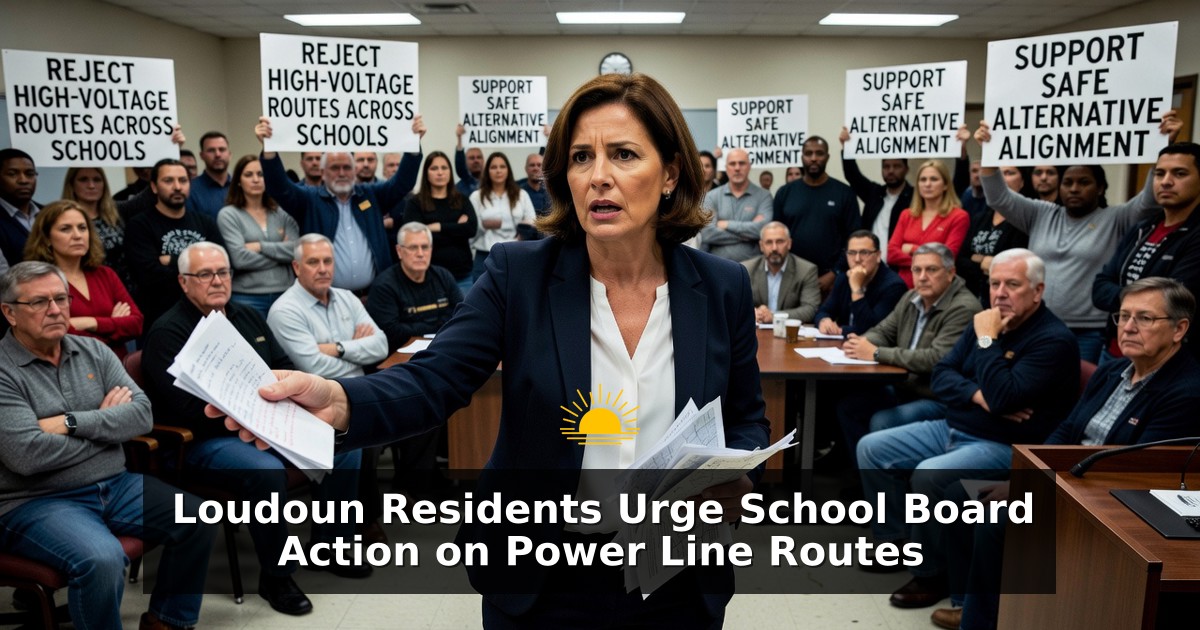
Residents of Loudoun County continue to raise detailed concerns about proposed high-voltage transmission lines that could pass near or across public school properties. At a recent Loudoun County School Board meeting, parent and resident Shrinivas Doma delivered public comments focused on community safety, student well-being, and long-term property impacts. Doma explained that he lives in the LV2 area and has two children enrolled in local middle and high schools. He asked the board to stand by earlier positions opposing overhead lines on school-owned land and to favor alignments that keep major infrastructure away from educational campuses.
The Loudoun County School Board oversees policy and facilities for the county’s public schools and is composed of nine elected members representing the at-large seat and eight magisterial districts. Current members are Melinda Mansfield, Lauren Shernoff, April Chandler, Deana Griffiths, John Beatty, Joy Maloney, Sumera Rashid, Erica Ogedegbe, and Ian Serotkin. These officials regularly hear public input on matters that affect school grounds, student transportation corridors, and the broader learning environment. Infrastructure proposals that intersect with school property fall within the board’s interest because they can influence both daily operations and future facility planning.
Doma specifically referenced the Golden Mars case while outlining risks he associates with high-voltage lines located close to schools. He urged the board to uphold its original decision rejecting all overhead transmission lines that would cross school board property. The routes he named for continued opposition include routes 2, 3, 3B, and 4. He further requested that the board use its upcoming closing brief to state clear opposition to any alignment running along school property boundaries.
In the same remarks, Doma identified newly proposed route 1F as the preferred option. He described that alignment as the best available path because it would avoid school sites entirely. Supporters of alternative corridors argue that careful route selection can still meet regional power delivery needs while reducing direct effects on classrooms, playgrounds, and athletic fields. The speaker framed the choice as one that protects both immediate safety considerations and longer-term neighborhood stability.
Loudoun County has experienced sustained population and commercial growth, much of it tied to data center development that requires substantial new electric transmission capacity. Utility planners have advanced multiple corridor options to move power across the county to serve these facilities and the wider grid. Some of the studied paths pass near residential neighborhoods and public schools, prompting repeated community testimony at local government meetings. Parents and homeowners frequently cite proximity to classrooms as a primary reason for seeking route adjustments.
Public discussion of transmission projects in the county often includes questions about electromagnetic fields, construction disruption, and visual impacts on school campuses. While scientific reviews of health effects continue to be examined by various agencies, residents at local meetings consistently ask decision-makers to apply caution when lines would border or cross land used by children. Property value studies presented in similar proceedings elsewhere have shown that homes and parcels adjacent to high-voltage corridors can experience measurable market effects, adding an economic dimension to the safety conversation.
School boards in growing jurisdictions sometimes submit formal comments or briefs into state-level utility review processes. In Virginia, transmission line applications typically proceed through regulatory channels that accept input from local governments and affected property owners. A closing brief offers the Loudoun County School Board a structured opportunity to restate its position on routes that involve school board land. Doma asked members to use that filing to reinforce rejection of the listed crossings and to endorse the 1F alternative.
Community members following the issue note that earlier board actions already signaled reluctance to allow overhead lines on school property. Maintaining that stance, they argue, provides consistency for families who chose neighborhoods based in part on school quality and campus environment. Alternative routes that bypass school sites can still connect generation resources to load centers, according to those favoring option 1F. The practical challenge lies in balancing county-wide energy reliability with localized protection of educational facilities.
Meetings such as the one at which Doma spoke form part of an extended public record on infrastructure siting. Speakers routinely supply personal context, including the ages and schools of their children, to illustrate why specific corridors matter to them. Board members receive these statements alongside technical presentations from utilities and planning staff. The cumulative testimony helps shape any formal position the school system later files with regulatory authorities.
Observers of Loudoun County land-use and utility debates point out that transmission projects often involve multi-year timelines from initial proposals through final construction. Early and clear statements from elected school officials can influence which alignments advance and which are set aside. By focusing on routes 2, 3, 3B, and 4 as unacceptable and on route 1F as preferable, residents aim to guide that longer process toward outcomes that keep high-voltage infrastructure away from school grounds.
The discussion also touches on the broader responsibility of local boards to safeguard the physical settings in which students learn. When major utility corridors are proposed across or beside campus property, school officials must weigh operational continuity, future expansion potential, and parental confidence. Doma’s comments reflect a segment of public opinion that places highest priority on eliminating direct crossings and minimizing adjacency. Continued attention to the closing brief and to route 1F will likely remain part of community advocacy in coming weeks.
As Loudoun County manages the dual pressures of economic expansion and quality-of-life protections, transmission line siting remains a prominent local issue. Public comment periods at School Board meetings give parents a direct channel to link energy infrastructure decisions with the daily experience of students. The specific requests voiced by Doma—rejection of named routes that cross school property, formal opposition in the closing brief, and support for alignment 1F—now stand as part of the official meeting record for members to consider.
Action alternative routes Call community impact community safety Golden Mars case Infrastructure Lines local government Loudoun County Loudoun County School Board Meeting Power power lines public hearing public testimony residential concerns School Board school property school safety Shrinivas Doma
