
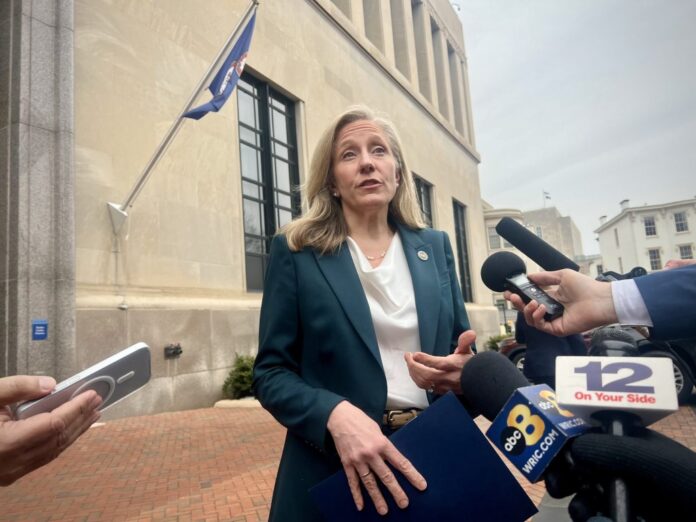
Democratic Gov. Abigail Spanberger on Wednesday formally ended the 287(g) agreement signed by her predecessor, former Republican Gov. Glenn Youngkin, that mandated state law enforcement agencies cooperate with federal Immigration and Customs Enforcement efforts.
Youngkin’s mandate, known as Executive Order 47, was rescinded by Spanberger on her first day in office, but that action did not automatically remove state law enforcement agencies from the 287(g) agreement with the federal agency. Youngkin’s order had mandated state law enforcement assist ICE in federal immigration enforcement and targeted undocumented immigrants with criminal records.
“On day one, I said that is no longer mandated and after a review of what equities and what 287(g)-specific relationships exist and are in place, I have put forth Executive Directive One that directs all state agencies to end any 287(g) agreements that exist between those agencies and ICE,” Spanberger, a former federal agent herself, said during an impromptu press conference Wednesday. “Taking Virginia law enforcement state agency personnel and basically giving them over to ICE is something that ends today.”
Her directive does not affect the ability of state law enforcement agencies to work with federal task forces. She added that state and local law enforcement are expected to continue working with federal law enforcement whenever there is a “judicial warrant in hand.”
An executive order that accompanied Spanberger’s directive requires state law enforcement agencies to review all policies, training and practices to conform to standards aimed at maintaining or rebuilding public trust in policing. That order was issued after federal agents recently shot and killed civilians in Minnesota.
“Sadly, the bad tactics, the bad training, the bad vetting that we have seen or witnessed or perceive in places like Minnesota that is degrading trust in law enforcement. I want to draw a very clear line in the sand and say I have strong trust in the law enforcement agencies in Virginia,” she said.
Spanberger said that, following her predecessor’s Executive Order 47, the use of 287(g) agreements and reallocation of Virginia State Police personnel to support ICE efforts has been “relatively minimal.”
She added that she has not heard from the Trump administration regarding her executive directive.
Lt. Gov. Ghazala Hashmi released a statement backing the executive order, stating the action “restores clarity and accountability to the role of state and local law enforcement and ensures their focus remains on public safety, justice, and community trust.”
“By ending agreements that cede discretion to the federal government, this directive reaffirms Virginia’s constitutional values and the integrity of our public safety institutions,” the statement said. “I fully support this decisive step by Governor Spanberger’s Administration to ensure our agencies operate justly, lawfully, and in service of all Virginians.”
Responses show the divide: ‘Powerful step’ or ‘danger for all involved’
Republican state Sen. Glen Sturtevant, of Chesterfield County, called Spanberger’s directive an example of the governor putting “politics over public safety.”
“Our federal law enforcement partners have worked well with our local and state police over the last year and 18 months, making sure that they are intervening and getting criminal illegal aliens out of the commonwealth of Virginia,” he said.
Congressman John McGuire, R-Goochland County, condemned the executive order in a statement that said the decision “sets a dangerous precedent.”
“This directive will put more Virginians and law enforcement in danger and sets a dangerous precedent,” McGuire said in the statement. “Law enforcement cooperation with local, state and federal agencies is vital to the safety of our Commonwealth.”
Monica Sarmiento, executive director of the Virginia Coalition for Immigrant Rights, said in a statement Wednesday that Spanberger’s decision is a “powerful step toward restoring basic constitutional protections and rebuilding trust between immigrant communities and law enforcement across Virginia.”
“These agreements have deputized state agencies into carrying out a federal detention and deportation agenda that relies on fear, racial profiling, and warrantless enforcement, undermining public safety for everyone,” Sarmiento said in the statement. “By ending statewide cooperation with ICE, the Governor is affirming that our state resources should be used to keep communities safe, not to tear families apart and tunnel people into a system that has repeatedly violated civil and human rights.”
The ACLU of Virginia also put out a statement Wednesday, stating that ending the agreements protects Virginia’s immigrant communities: “Together, Virginia is speaking with one voice: we will not be coopted into carrying out the Trump administration’s brutal and legally dubious anti-immigrant agenda.”
House Minority Leader Terry Kilgore, R-Scott County, said in a statement Wednesday that Spanberger’s directive “weakens public safety and cuts off cooperation that helped law enforcement remove dangerous criminals from our communities.”
Congressman Morgan Griffith, R-Salem, argued that Spanberger’s order would create “danger for all involved.”
“I believe Governor Spanberger’s action to terminate 287(g) agreements directly undermines this goal and potentially pits local communities, state law enforcement and federal law enforcement against each other,” he said in a statement Wednesday.
21 local agencies that have entered into 287(g) agreements not affected by executive order
Spanberger’s directive does not end 287(g) agreements between local law enforcement agencies and the federal immigration enforcement agency. There are nearly two dozen localities across the state that have signed the 287(g) agreement — 20 county sheriff’s offices and one jail authority in Southside and Southwest Virginia.
Cardinal News began requesting copies of local law enforcement agencies’ 287(g) agreements in 2025. Eighteen of these agencies have task force models, which enable local sheriff’s deputies, with 40 hours of online training, to “arrest without warrant” under multiple circumstances and to “interrogate any alien or person believed to be an alien as to his right to be or remain in the United States.”
Outside of that 40-hour training and certification, local agencies don’t get much in the way of benefits. Their personnel, under ICE “direct supervision … will carry out designated functions at the LEA’s [local law enforcement agency’s] expense.”
ICE will pay for any travel-related expenses of training, assuming the officers nominated for training are not being trained remotely or online.
Meanwhile, the local agency pays for everything else, including, but not limited to, “salaries and benefits, local transportation, and official issue material used in the execution of the LEA’s mission.” That includes overtime. Security equipment and “administrative supplies” are also the law enforcement agency’s responsibility to provide.
The local sheriff’s offices with Task Force Model agreements with ICE are listed below, with the most recent to sign up at the top:
Tazewell County
Pittsylvania County
Amherst County
Wise County
Scott County
Buchanan County
Washington County
Buckingham County
Craig County
Mecklenburg County
Appomattox County
Campbell County
Greene County
Grayson County
Franklin County
Shenandoah County
Smyth County
Bedford County
The Alleghany and Loudon County sheriff’s offices and the Southwest Virginia Regional Jail Authority have warrant service officer agreements with ICE, which allow ICE to “train, certify and authorize state and local law enforcement officers to serve and execute administrative warrants on aliens in their agency’s jail,” according to ICE’s website.
Pittsylvania County Sheriff’s Office has a warrant service officer agreement and a jail enforcement model, in addition to the task force model agreement. A jail enforcement model allows a local agency to identify and process “removable aliens — with criminal or pending criminal charges — who are arrested by state or local law enforcement agencies.”































