
Virginia is advancing toward banning transgenders from competing on women’s sports teams, even as the U.S. Supreme Court prepares to take up two cases that could set a national precedent.
After failed attempts in the legislature by lawmakers, the Virginia Board of Health held a special meeting this week and granted a petition to begin drafting regulations — a process that could take two years.
The board has authority to issue regulations affecting public health. In this case, cisgender student athletes petitioned the board, citing frustrations with losing to transgender women, discomfort sharing facilities, and concerns about safety when people assigned male at birth compete with those assigned female.
The regulatory process is expected to take 18 to 24 months, a Virginia Department of Health staffer told The Mercury Monday. The next steps include publishing a Notice of Intended Regulatory Action and holding additional public comment periods.
The petition heard on Monday had already undergone a public comment period in which 54% of respondents opposed the request, while 45% supported it. Three comments were ruled “irrelevant,” and 11 were deemed “unclear.”
While the new rules could take years to implement, Equality Virginia Director Narissa Rahaman emphasized that transgender people have already been under scrutiny.
“Over the last four years,” she said, referring to Gov. Glenn Youngkin’s administration, “Virginians and the General Assembly have made it clear that targeting transgender athletes is unfair and unpopular.”
In a statement released after Monday’s vote, Rahaman added: “Virginia’s women and girls face pressing real public health challenges, including HIV prevention and treatment, domestic violence, maternal health, and poverty. Addressing those challenges with urgency and intention should be the priority of the board. Instead of prioritizing the health of Virginians, the State Board of Health voted to prioritize politics.”
The petition stemmed from three college swimmers: former Virginia Tech Olympian Réka György and current Roanoke College swimmers Lily Mullins and Carter Satterfield.
Mullins said that she and her teammates felt “unsupported, vulnerable and unsafe” after raising concerns with coaches and administrators about a transgender woman joining the team.
György, who placed 17th in a 2022 competition, missed qualifying for the next round by one spot. She lost to Lia Thomas, who placed first and became the first openly transgender athlete to win a National Collegiate Athletic Association (NCAA) Division I championship. The University of Pennsylvania, Thomas’ former school, has since revoked her records and now bans transgender athletes.
Earlier this year, Virginia Attorney General Jason Miyares, Lt. Gov. Winsome Earle-Sears, and Youngkin hosted former athlete Riley Gaines to celebrate a similar legislative push.
Gaines, who tied for fifth place with Thomas in a competition in 2022, has become a national figurehead in efforts to ban transgender student athletes. Virginia’s latest legislative attempt earlier this year failed. Satterfield is also listed as a plaintiff in Gaines’ federal lawsuit against the NCAA.
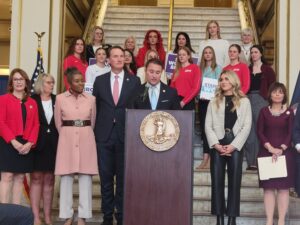
Transgender students and student athletes in recent years have faced scrutiny from state laws to local policies to federal courts.
Last month, the U.S. Supreme Court decided it will hear two cases over state bans on transgender athletes this year. Justices will consider whether such laws violate the Equal Protection Clause of the 14th Amendment or Title IX, the federal statute prohibiting sex discrimination in education.
The conservative-leaning court has already dealt setbacks to LGBTQ+ protections. In 2024, it struck down then- President Joe Biden’s attempt to use Title IX to protect LGBTQ+ students and upheld state bans on gender-affirming care for minors.































