
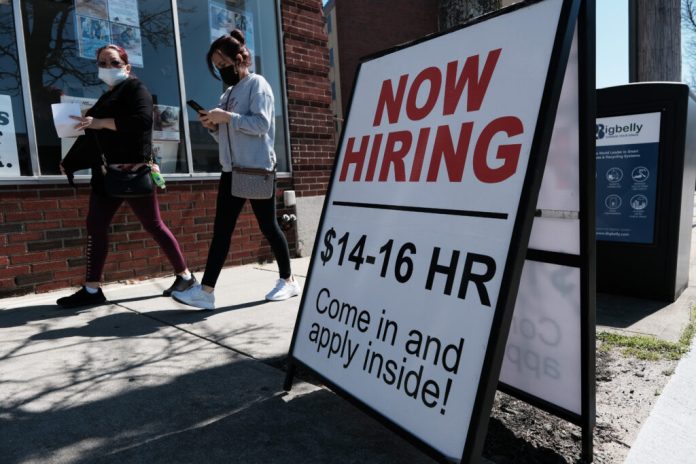
The new law, which took effect July 1, requires employers to include a good-faith wage or salary range in public and internal job postings for openings, promotions, transfers and other employment opportunities.
It also bars employers from asking applicants about their salary history or using prior pay when making hiring and compensation decisions. Employers may also not retaliate against applicants or employees who decline to provide their salary history or ask how much a position pays.
Gov. Abigail Spanberger said the ban on salary-history questions could prove just as significant as requiring pay ranges because it prevents a candidate’s previous salary from becoming the starting point for negotiations.
“Where it becomes impactful is that if I apply for a job with a certain salary range, and my salary history is $40,000, it is not legal anymore to ask what I made,” Spanberger told The Mercury in an interview earlier this month.
An applicant could instead base a salary request on the employer’s posted range without having to explain or defend what a previous employer paid, she said.
The law, sponsored as Senate Bill 215 by state Sen. Jennifer Boysko, D-Fairfax, and House Bill 636 by Del. Michelle Maldonado, D-Manassas, places Virginia among a growing number of states requiring employers to disclose pay information in job postings.
Many multistate employers were already posting salary ranges in the commonwealth because they operate in states with similar requirements. Others have had to update job postings, compensation policies and interview practices since the law took effect.
“We’re still in the very new stages of this,” Spanberger said.
Defining a good-faith range
One question the new law leaves unanswered is how broad a salary range an employer may advertise. It requires employers to establish a range in “good faith,” allowing for differences based on experience, education, credentials and other qualifications.
Spanberger acknowledged an employer could post a broad range — for example, $35,000 to $95,000 — and still comply with the law, even if it gives applicants only a rough idea of what the employer expects to pay.
“It doesn’t necessarily serve the benefit, which is intended to provide a bit of clarity for a potential employee related to what the salary range would legitimately be,” Spanberger said.
“You can then walk in and say, ‘OK, the top end of the range is $95,000, I’m here asking for this job, I’m asking for $95,000,” she said. “They can always play games with the lower limit, but the upper limit is a piece of it that does matter.”
Julie Schweber, lead specialist in the Knowledge Center at the Virginia SHRM State Council, said many employers — particularly multistate companies — were already familiar with similar laws in other states.
“From my HR opinion, it’s not all that difficult to add a salary range on a job posting and to not ask applicants about their previous salary,” Schweber said. “It’s not a big stretch to comply with that.”
Because the law also applies to internal job postings, Schweber said employees may begin asking why similar positions carry different salary ranges or why a new hire could earn more than someone already on staff.
“A lot of organizations are asking, ‘How is this going to impact our current staff? Will they potentially get upset when they see other jobs may have a higher pay range than their job?’” she said.
That means employers may have to explain how they established posted salary ranges and why workers in similar positions may earn different amounts.
“What exactly are we looking at when we develop a pay range?” Schweber said. “It’s not so simple to just say, ‘Hey, this is our pay range.’ We also want to explain how we get to that.”
The Virginia Chamber of Commerce said employers have already been updating hiring practices, compensation policies and job postings while seeking additional guidance on compliance.
“The Chamber is focused on helping employers understand the new requirements, and as implementation continues, we will evaluate whether any legislative or regulatory changes are needed to provide additional clarity, reduce unintended consequences, and ensure Virginia remains a competitive place to do business,” said spokeswoman Hannah Emerson.
Outreach and enforcement
Spanberger said the administration’s initial focus is educating employers, particularly small businesses that may advertise a position only occasionally.
“We want to make sure that we’re getting information out and doing educational efforts before we really start aggressively holding people accountable on this front,” she said.
The administration plans to work with business associations and local chambers of commerce to explain the new requirements. The Virginia Department of Labor and Industry also published guidance when the law took effect.
Spanberger said it’s still too soon to judge how consistently employers are complying.
“Some are already being compliant, because some know about it and have taken action quickly. But in terms of us sending out any sort of formal engagement to say, ‘You’re not being compliant, fix it,’ that is too early,” she said.
The law gives the office of attorney general authority to investigate violations and bring civil actions against employers. A first violation carries a penalty of up to $1,000, with subsequent violations subject to penalties of up to $5,000 each.
Prospective and current employees also may sue within one year of an alleged violation and seek actual damages or other legal and equitable relief.
“Attorney General (Jay) Jones was proud to support stronger protections for Virginia workers during the most recent General Assembly session,” spokeswoman Rae Pickett said. “This office will stand firmly with workers and ensure that Virginia’s pay transparency laws are fully enforced.”
Schweber encouraged employers to review the state’s guidance, train managers and evaluate their overall compensation policies rather than viewing the law as simply a requirement to add salary ranges to job postings.
Employees may ask why they fall at a certain point within a pay range or why another position pays more, she said. Those conversations could include factors beyond salary, such as health benefits, flexible work arrangements, professional development and or opportunities for advancement.
“It’s not a one-and-done type of communication,” Schweber said.
She said the law could also prompt employers to identify pay differences that developed over time without a clear compensation strategy and ensure salaries remain fair and competitive.
Lessons from other states
Virginia joins a total of 13 states, including California, Colorado, New York, which require pay transparency in job postings, though details vary. Washington, D.C. also has pay transparency standards.
Some of those laws only apply to employers above a certain size, while others also require companies to disclose benefits and other forms of compensation.
Research suggests the laws have significantly increased the amount of salary information available to job seekers. A 2025 study by the National Bureau of Economic Research found that disclosure requirements increased the share of job postings containing pay information by about 30%.
The researchers also found wage increases ranging from 1.3% to 3.6% across three data sets, but no measurable effect on employment, pay differences among workers or the education and skill requirements employers listed.
Colorado began requiring compensation information in job postings in 2021 and has since established a formal process for investigating complaints. New York’s statewide law took effect in 2023 and generally applies to employers with at least four workers, while Virginia’s new law has no minimum employee threshold.
But those laws have not eliminated job postings without salary information. A 2025 review by the New York City Council found thousands of listings on Indeed and Google for Jobs that lacked pay ranges, which the council attributed in part to the way those platforms pull postings from other websites.
Among 100 employers the council reviewed directly, 87 included salary information in every posting, 12 complied in some but not all listings and one included no salary information. The review also found that some employers posted wide salary ranges, underscoring that requiring a range does not always provide applicants with a precise estimate of what a job will pay.
But advocates argue salary-history bans can help reduce long-standing wage gaps because workers who were underpaid in one job no longer have to carry that salary into negotiations for the next.
Schweber pointed to federal labor statistics showing women, on average, earn less than men and that wage disparities also persist among women of different racial and ethnic backgrounds.
“The theory behind these regulations is not to give companies more work to do,” she said. “But it’s so that job applicants and employees will have more information that will enable them to negotiate their compensation more fairly, and ideally close those pay gaps.”
She said that job seekers increasingly expect to disclose pay before they apply. Citing a 2023 SHRM survey, Schweber said 82% of U.S. workers were more likely to consider applying for a job if the salary range was listed.
A separate 2024 survey of human resources professionals found that 60% of organizations were publishing salary ranges in job advertisements, up from 45% the previous year.
Schweber said many employers now see pay transparency as a recruiting and retention tool, even when the law does not require it.
“Companies are seeing the value of doing this as part of their recruitment and even retention strategy,” she said, “and it’s better for an organization when we are transparent with our job applicants and employees.”
Email the Manassas City Council at:
Michelle Davis-Younger (Mayor): mdavis-younger@manassasva.gov,
Mark Wolfe (Vice Mayor): mwolfe@manassasva.gov,
Theresa Coates Ellis: tellis@manassasva.gov,
Ashley Hutson: ahutson@manassasva.gov,
Sonia Vásquez Luna: sluna@manassasva.gov,
Tom Osina: tosina@manassasva.gov,
Ralph Smith: rsmith@manassasva.gov,