
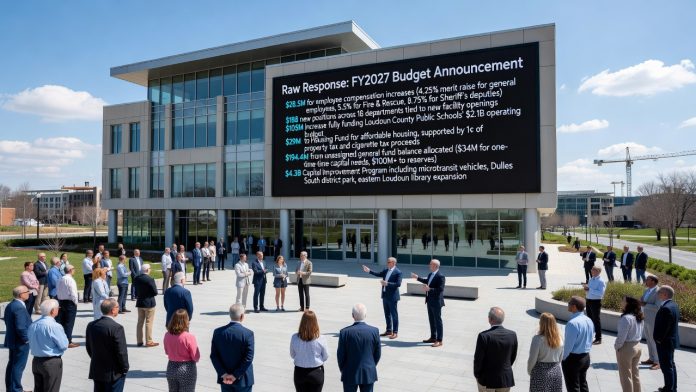
The Loudoun County Board of Supervisors has officially approved a $5.4 billion budget for Fiscal Year 2027, setting the financial framework for the rapidly growing region. This comprehensive spending plan, which takes effect on July 1, 2026, balances major investments in public services with efforts to manage taxpayer burdens. The adopted budget fully funds essential county operations while maintaining the current real property tax rate of $0.805 per $100 of assessed value. Local officials emphasize that the fiscal strategy is designed to accommodate population growth without placing undue strain on residents.
The current Loudoun County Board of Supervisors includes Phyllis Randall, Koran Saines, Juli Briskman, Sylvia Glass, Caleb Kershner, Matthew Letourneau, Michael Turner, Kristen Umstattd, and Laura TeKrony. County Administrator Tim Hemstreet stated that the proposed budget meets the guidance provided by the board regarding future fiscal planning. Hemstreet noted that the framework reflects his recommendations on constraining budget growth in anticipation of future economic conditions. These decisions aim to ensure the county government can sustainably deliver necessary services to its expanding constituency.
Employee Compensation and Workforce Expansion
A significant component of the new fiscal plan is a $28.5 million allocation dedicated specifically to employee compensation increases across multiple county departments. General county employees will receive a 4.25 percent merit raise along with a two percent salary adjustment. Public safety personnel will see even larger boosts, with Fire and Rescue staff receiving a 5.5 percent average increase that includes a scale adjustment and a step increase. Meanwhile, Sheriff deputies are slated for an 8.75 percent average pay increase, combining a 5.75 percent scale adjustment with a step increase. County documents justify these financial commitments by stating the funding helps keep Loudoun competitive in the regional labor market.
In addition to raising pay for current staff, Loudoun County is adding 188 new positions spread across 18 different departments. Many of these newly created roles are directly tied to the scheduled opening of new county facilities over the next two years. The budget also includes $30 million in generic base budget adjustments intended to sustain current municipal services. This broad categorization covers various departmental spending increases necessary to maintain operational standards as the county expands. Together, these workforce investments reflect the local government’s response to increasing demands for public services.
Education and Housing Initiatives
Public education remains a massive priority in the newly adopted fiscal plan, reflecting the continuing growth of the student population. The budget fully funds a requested $105 million increase for Loudoun County Public Schools, ensuring educational resources remain robust. This substantial financial injection brings the total school operating budget to an unprecedented $2.1 billion for the upcoming fiscal year. Local leaders have consistently prioritized school funding to maintain educational standards and support facility maintenance across the district. The allocation ensures that both instructional programs and administrative functions are fully supported throughout the academic year.
Affordable housing also emerges as a major spending priority within the comprehensive fiscal framework. The county has allocated $29 million to the local Housing Fund to address ongoing affordability challenges within the region. This specific funding stream is supported by the equivalent of one cent of the real property tax rate combined with proceeds from the county cigarette tax. These targeted investments are designed to expand housing options for lower-income and middle-income families struggling with the high cost of living in Northern Virginia. The dedicated funding mechanism ensures a reliable revenue source for housing initiatives moving forward.
Capital Improvements and Tax Implications
The long-term physical infrastructure of the region is addressed through a massive $4.3 billion Capital Improvement Program. This extensive program dedicates $1.8 billion for transportation infrastructure, $1.3 billion for county government facilities, and $1.2 billion for school construction. Specific community investments feature funding for new microtransit vehicles, a district park in the Dulles South area, and expanded library space in eastern Loudoun. Additional public safety infrastructure projects include the Hamilton Fire Station replacement, Western Loudoun Sheriff Station upgrades, and crucial improvements to the Goose Creek Bridge. These capital expenditures are designed to modernize aging infrastructure while building new facilities to serve developing neighborhoods.
To finance these extensive projects responsibly, the Board of Supervisors approved the use of $194.4 million in unassigned general fund balance. From this total, the board allocated $34 million for one-time needs in the capital budget and debt service, alongside over $100 million directed to reserve and self-insurance funds. An additional $17.49 million goes to the school system, while $13.7 million supports various county capital projects. County officials noted that they historically used any available fund balance for one-time purposes aligned with existing projects to help avoid new debt and real property tax increases. Notably, this $194.4 million fund balance is actually lower than the balances recorded in each of the previous two fiscal years.
While the real property tax rate remains unchanged at $0.805, the average homeowner will still see their tax bill increase by approximately $141 in tax year 2026 due to rising property assessment values. However, residents will experience some financial relief regarding their personal vehicles. The vehicle personal property tax rate is being reduced to $3.09 per $100 in 2026, saving the owner of a $30,000 vehicle approximately $352. This vehicle tax rate is planned to drop even further to $2.94 in 2027, offering continued savings for local commuters. Ultimately, the FY2027 budget represents a complex balancing act between funding essential community growth and managing the overall financial impact on local taxpayers.
Email the Board of Supervisors at:
Phyllis J. Randall (Chair, At-Large) – Phyllis.Randall@loudoun.gov,
Michael R. Turner (Vice Chair, Ashburn District) – Mike.Turner@loudoun.gov,
Juli E. Briskman (Algonkian District) – Juli.Briskman@loudoun.gov,
Sylvia R. Glass (Broad Run District) – Sylvia.Glass@loudoun.gov,
Caleb Kershner (Catoctin District) – caleb.kershner@loudoun.gov,
Matthew F. Letourneau (Dulles District) – Matt.Letourneau@loudoun.gov,
Kristen C. Umstattd (Leesburg District) – Kristen.Umstattd@loudoun.gov,
Laura A. TeKrony (Little River District) – Laura.TeKrony@loudoun.gov,
Koran Saines (Sterling District) – Koran.Saines@loudoun.gov