
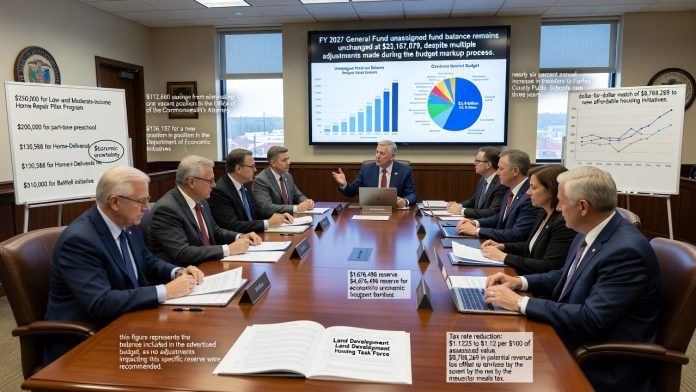
The Fairfax County Board of Supervisors recently finalized the markup for the Fiscal Year 2027 General Fund budget, navigating complex financial pressures. Despite numerous adjustments made during the intensive markup process, the available unassigned fund balance remains entirely unchanged at $23,167,079. According to markup documents, this figure represents the balance included in the advertised budget, as no adjustments impacting this specific reserve were recommended in the subsequent add-on package. The overall budget now stands at a massive $5.9 billion, reflecting the immense scale of local government operations in the region.
The current Board of Supervisors worked collaboratively to balance competing departmental needs without draining the unassigned reserves. The board consists of Chairman Jeff McKay, James Walkinshaw, Jimmy Bierman, Rodney Lusk, Walter Alcorn, Andres Jimenez, Dan Storck, Dalia Palchik, Pat Herrity, and Kathy Smith. These ten elected officials scrutinized spending proposals, ultimately deciding to maintain the $23.17 million unassigned balance as a fiscal safeguard. Their final markup decisions reflect a highly strategic allocation of resources across a rapidly growing jurisdiction.
Tax Rate Adjustments and Homeowner Impacts
A central component of the FY 2027 budget agreement involves a targeted reduction in the local real estate tax rate. Officials authorized lowering the rate by a fraction of a cent, dropping it from $1.1225 to $1.12 per $100 of assessed value. This specific tax rate reduction will cost the county treasury approximately $8,788,269 in potential revenue over the fiscal year. However, because the average residential property assessment increased by 3.77 percent, the average homeowner will still experience a tax bill increase of approximately $337.
Chairman Jeff McKay highlighted the necessity of this tax relief measure, noting that people are suffering right now under difficult financial conditions. He explained that revenue generated from the county’s newly implemented meals tax provided a crucial alternative funding stream, making the real estate tax reduction mathematically possible. Budget markup documents reiterate this sentiment, stating that the board is acutely aware of the financial pressures and uncertainty many residents continue to face and believes it is important to moderate the impact on homeowners where possible. Furthermore, other specialized tax districts saw rate decreases, with the Route 28 tax rate dropping to $0.105 and the Phase II Dulles Rail tax rate falling to $0.12 per $100 of assessed value.
Restored Funding and Departmental Shifts
During the detailed markup sessions, the board successfully restored funding to several vital community programs that had previously faced elimination or reduction. The Low- and Moderate-Income Home Repair Pilot Program received a critical restoration of $250,000 to continue its operations. Simultaneously, a popular part-time preschool program saw $200,000 returned to its operational budget to serve local families. Officials also restored $130,588 to the Home-Delivered Meals program, which will allow the service to provide a full seven meals per week to vulnerable residents. Finally, the BeWell initiative benefited from a $310,000 restoration, ensuring the continued employment of three contracted peer support specialists.
To financially balance these community program restorations, the county executed several strategic staffing and funding adjustments across multiple government departments. The Office of the Commonwealth’s Attorney generated $112,680 in savings by eliminating one vacant full-time equivalent position from its roster. Conversely, the Department of Economic Initiatives received an additional $136,137 to fund a brand new position aimed at bolstering regional economic competitiveness. Additionally, Land Development Services gained authorization for a new staff member specifically designated to support the ambitious goals of the Housing Task Force.
Future Economic Outlook and Education Transfers
Economic uncertainty remains a dominant theme for county leadership as they prepare for the upcoming fiscal cycle. To mitigate potential revenue shortfalls, the FY 2027 budget includes a dedicated reserve for economic uncertainty totaling exactly $4,676,496. County Executive Bryan Hill expressed a degree of optimism in his official budget message regarding the long-term health of the local commercial real estate market. He stated that as the county continues to right-size its office market inventory, officials are hopeful that they have turned a corner and a stronger commercial real estate market is beginning to emerge.
Education and affordable housing continue to represent the most significant financial commitments within the newly approved local budget framework. The county allocated an exact dollar-for-dollar match to the tax reduction cost, dedicating $8,788,269 specifically toward new affordable housing initiatives. Concurrently, existing funding for Fairfax County Public Schools was carefully realigned to better support the Middle School After School and Values in Prevention programs. These adjustments follow a broader historical trend, as the total financial transfer from the county to the public school system has increased by an average of nearly six percent annually over the past three years.
Email At:
Jeff McKay → chairman@fairfaxcounty.gov,
Kathy Smith (Sully District) sully@fairfaxcounty.gov,
Rachna Heizer (Braddock District) braddock@fairfaxcounty.gov,
James Bierman (Dranesville District) dranesville@fairfaxcounty.gov,
Rodney Lusk (Franconia District) franconia@fairfaxcounty.gov,
Walter Alcorn (Hunter Mill District) huntermill@fairfaxcounty.gov,
Andres Jimenez (Mason District) mason@fairfaxcounty.gov,
Daniel Storck (Mount Vernon District) mtvernon@fairfaxcounty.gov,
Dalia Palchik (Providence District) providence@fairfaxcounty.gov,
Pat Herrity (Springfield District) springfield@fairfaxcounty.gov,