
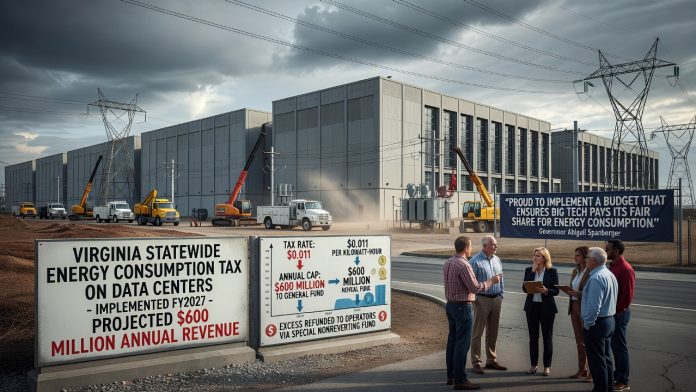
The state of Virginia has officially implemented a first-of-its-kind statewide energy consumption tax on data centers within the FY2027 budget. This unprecedented measure is projected to generate up to $600 million annually by targeting the massive electricity usage of tech corporations. For years, conservative watchdogs have warned about the unchecked expansion of data centers and the resulting strain on the public power grid. This new fiscal policy represents a critical step toward ensuring that multi-billion-dollar technology companies cover the steep infrastructure costs they create, rather than passing the burden onto hardworking residential ratepayers.
Under the newly adopted framework, data center operators will be assessed a tax rate of $0.011 per kilowatt-hour of electricity consumed. The legislation strategically caps the total revenue collected at $600 million per year, directing these funds straight into the state’s General Fund to support essential services. Any tax collected in excess of this annual ceiling will be deposited into a Special Nonreverting Fund and subsequently refunded pro rata to the data center operators. While this cap provides predictability for businesses, fiscal conservatives must closely monitor the refund mechanism to ensure it does not become an administrative burden or a backdoor corporate loophole.
Reining in Decades of Unchecked Corporate Welfare
To fully understand the necessity of this new consumption tax, taxpayers must examine the explosive growth of the state sales and use tax exemption for data center equipment. When Virginia first created this specific corporate tax carve-out in 2008, it was projected to cost the state a modest $1.54 million annually. By fiscal year 2024, the cost of this exemption had skyrocketed to an astonishing $1.02 billion, with estimates projecting a staggering $1.9 billion loss in fiscal year 2025. The new $600 million energy tax effectively recoups roughly one-third of the massive revenue lost to this ongoing exemption, highlighting a desperate need to balance corporate incentives with fiscal responsibility.
For over a decade, data centers were largely viewed as an unmitigated economic boon that supposedly helped lower electricity rates by spreading out grid costs. However, the FY2027 budget reflects a harsh reality and a necessary shift in state policy regarding these massive technology hubs. Surging electricity demand from big tech companies is now severely straining Virginia’s energy infrastructure, requiring massive capital investments to keep the lights on. Lawmakers faced mounting public pressure to act, driven by legitimate fears that the exorbitant infrastructure costs required for data center expansion would ultimately be passed onto everyday citizens through higher utility bills.
Expanding Government Bureaucracy to Manage Grid Strain
The administrative duties for this complex new taxation system have been assigned to the State Corporation Commission. This regulatory body is now tasked with issuing detailed implementation guidelines and receiving direct remittances for self-supplied electricity from massive tech campuses. While regulating utility costs is a core function of the state, adding new layers of tax collection and refund distribution requires careful oversight to prevent bureaucratic waste. Taxpayers must demand total transparency from the commission to ensure that the costs of managing the Special Nonreverting Fund do not eat into the very revenues meant to offset grid infrastructure expenses.
In conjunction with the new consumption tax, the budget also establishes a newly created cabinet-level position known as the Chief Energy Officer. Governor Abigail Spanberger introduced this executive role to specifically address energy affordability, manage grid strain, and coordinate directly with regional transmission organizations like PJM. Creating a new government office inevitably raises concerns among fiscal conservatives who are wary of expanding state bureaucracy and increasing administrative spending. The true test of this new office will be whether it successfully protects residential ratepayers from footing the bill for big tech’s energy demands or simply becomes another bloated government agency.
Political Compromise and Protecting the Taxpayer
The passage of this first-of-its-kind tax was ultimately achieved as a legislative compromise meant to pacify both industry lobbyists and frustrated taxpayers. Governor Abigail Spanberger praised the measure, stating she was proud to get a budget across the finish line that includes the consumption tax she proposed earlier in the spring. She emphasized that Virginia has a distinct responsibility to make sure the rapidly expanding data center industry is finally paying its fair share for the massive amounts of energy it consumes. By targeting energy consumption directly, the state is attempting to link the financial burden of grid expansion directly to the corporate entities causing the strain.
Moving forward, conservative lawmakers and taxpayer advocates must remain vigilant regarding how these new tax revenues are utilized within the General Fund. While capturing $600 million from highly profitable tech companies is a victory for everyday ratepayers, the preservation of the $1.9 billion equipment tax exemption remains a glaring example of ongoing corporate welfare. True fiscal conservatism demands that the state continuously evaluate these massive tax carve-outs to eliminate waste and prevent unnecessary government subsidies. Ultimately, Virginia must prioritize the financial well-being of its hardworking citizens over the insatiable infrastructure demands of multi-billion-dollar technology conglomerates.