
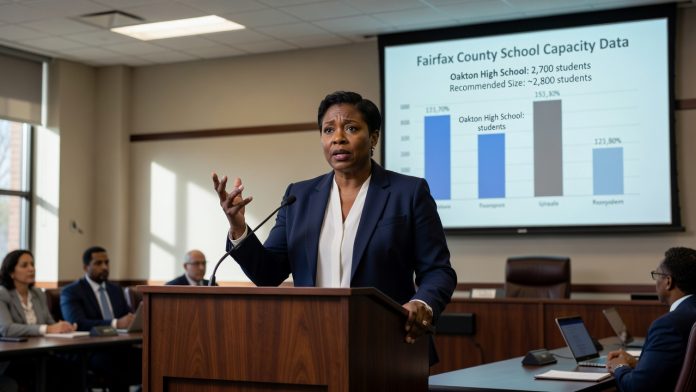
Fairfax County School Board member Ricardy Anderson spoke at a board meeting about the use of outdated data in school capacity planning efforts. She referenced Oakton High School’s enrollment of 2,700 students and noted that the numbers do not indicate balanced conditions. Anderson further mentioned that the recommended size for schools stands around 2,800 students.
The comments occurred as the board examined enrollment figures and facility standards. Anderson questioned aspects of the data related to what the district considers optimal for schools such as Oakton. This exchange took place amid broader discussions on educational infrastructure in the county.
Overview of the Capacity Planning Discussion
School capacity planning involves evaluating enrollment against facility limits to guide decisions on resources and adjustments. Anderson’s remarks focused on specific examples where current data may not fully represent present-day conditions. The board reviewed these points during the session to assess potential next steps.
Meetings like this allow members to raise questions about methodologies used in reports. Enrollment at Oakton High School served as a key illustration in the exchange. The recommended school size figure of approximately 2,800 students provided context for the comparison.
Details on Oakton High School Enrollment
Oakton High School reports an enrollment of 2,700 students according to the information shared in the meeting. Anderson stated that this level does not meet balanced criteria based on district guidelines. The recommended size of 2,800 students was cited as a benchmark for evaluation.
Such figures help inform how the board views overall district balance. The discussion highlighted the need to align planning with accurate and current metrics. Board members considered these details alongside other schools in Fairfax County.
Broader Context for School Board Deliberations
The Fairfax County School Board addresses multiple topics related to facilities and student distribution in its regular sessions. Anderson’s input contributed to the examination of data reliability in these areas. Questions about optimal sizes for schools like Oakton reflect ongoing efforts to refine planning approaches.
Public sessions provide opportunities for members to clarify positions on key issues. The exchange remained centered on the presented enrollment and size recommendations. Further reviews may build on the points raised during the meeting.
To Contact Fairfax School Board Members:
All Members – FairfaxCountySchoolBoard@fcps.edu,
Tom Dannan – tfdannan@fcps.edu,
Robyn Lady – ralady1@fcps.edu,
Marcia St. John-Cunning – mstjohncunni@fcps.edu,
Melanie Meren – HunterMillStaff@fcps.edu,
Ricardy Anderson – randerson@fcps.edu,
Mateo Dunne – mdunne@fcps.edu,
Karl Frisch – kfrisch@fcps.edu,
Sandy Anderson – sanderson@fcps.edu,
Seema Dixit – sdixit@fcps.edu,
Kyle McDaniel – kmcdaniel@fcps.edu,
Ryan McElveen – rlmcelveen@fcps.edu,
Ilryong Moon – imoon@fcps.edu,