
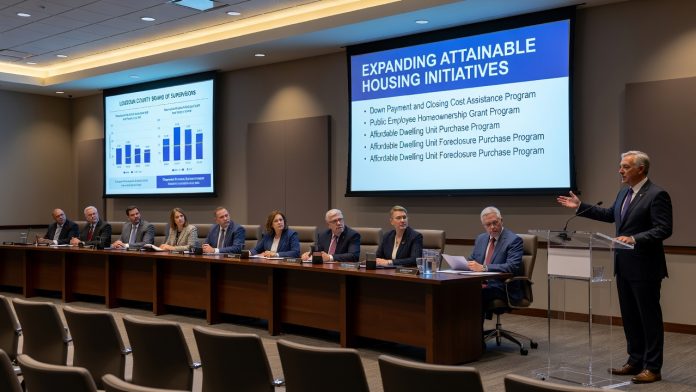
Loudoun County officials have announced a massive financial commitment to address regional affordability with a newly proposed budget allocating twenty-nine million dollars to the local Housing Fund. This significant investment relies on the dedication of one cent of the real property tax rate alongside proceeds generated from the county cigarette tax. County administrators view this move as a critical step toward expanding housing access for residents facing an increasingly expensive real estate market. The funding will directly support various established programs managed by the Department of Housing and Community Development.
The Loudoun County Board of Supervisors, tasked with finalizing the massive municipal financial plan, includes Chair Phyllis Randall, Koran Saines, Juli Briskman, Sylvia Glass, Laura TeKrony, Matthew Letourneau, Caleb Kershner, Michael Turner, and Kristen Umstattd. These elected officials provided clear guidance to prioritize attainable living arrangements while simultaneously managing overall municipal expenditure growth. During a presentation on February 11, 2026, County Administrator Tim Hemstreet stated that the proposed framework meets the guidance established by the supervisors and reflects his recommendations on constraining budget growth. The overarching fiscal blueprint represents a total county budget of five point four billion dollars for the upcoming cycle.
EXPANDING ATTAINABLE HOUSING INITIATIVES
The newly approved twenty-nine million dollar allocation represents a substantial increase in dedicated resources compared to previous fiscal cycles. Prior to the 2026 fiscal year, the county only budgeted one-half cent of the real property tax rate for these specific housing initiatives. The equivalent of a full one-cent dedication is now estimated to generate nineteen point four million dollars independently before factoring in the supplemental cigarette tax proceeds. County officials emphasized that affordable housing remains a priority, which is clearly reflected in this expanded financial commitment to the Housing Fund.
Capital from this dedicated fund will be initially held in a non-departmental budget before being transferred to support multiple targeted assistance frameworks. The Department of Housing and Community Development will utilize these resources to bolster the Down Payment and Closing Cost Assistance Program for prospective buyers. Additional funding will also flow into the Public Employee Homeownership Grant Program, ensuring local civil servants can afford to live in the communities they serve. Furthermore, the capital will sustain both the Affordable Dwelling Unit Purchase Program and the Affordable Dwelling Unit Foreclosure Purchase Program to preserve existing accessible housing stock. By financing these interconnected programs, the county aims to provide comprehensive support across various income brackets for the local workforce.
BALANCING TAX RATES AND PROPERTY ASSESSMENTS
Funding these ambitious housing projects requires careful navigation of local taxation rates amid fluctuating property assessments across the region. The real property tax rate will remain entirely unchanged at zero point eight zero five dollars per one hundred dollars of assessed value. Despite this static rate, the average homeowner will still experience an estimated increase of one hundred forty-one dollars on their tax bill due to steadily rising property values. This current rate sits exactly one cent above the equalized tax rate of zero point seven nine five dollars, which is the exact threshold where average tax bills would mathematically remain flat.
To help offset the increased financial burden on homeowners, the county has implemented strategic reductions in other taxation categories. The vehicle personal property tax rate will be significantly reduced to three point zero nine dollars per one hundred dollars of assessed value in 2026. Planners have already scheduled this vehicle tax rate to drop even further to two point nine four dollars by the 2027 fiscal year. For a resident owning a vehicle assessed at thirty thousand dollars, this adjustment translates to an approximate savings of three hundred fifty-two dollars annually.
LONG-TERM FISCAL STRATEGY
The substantial investment in the Housing Fund materialized only after administrators successfully capped broader municipal spending increases. The Board of Supervisors explicitly directed remaining funding to the Housing Fund to support attainable housing initiatives after successfully constraining operating budget growth. This fiscal discipline limited the operating budget expansion to nine percent for general county services and eight percent for the public school system. By restricting these broader operational expenditures, local leaders freed up the necessary capital to directly target the pressing affordability crisis.
As Loudoun County continues to experience dynamic population growth, the demand for accessible residential options is expected to remain exceptionally high. The dedication of twenty-nine million dollars signals a robust institutional commitment to ensuring diverse economic demographics can maintain residency within the jurisdiction. Local leaders will continue to monitor the effectiveness of the Down Payment and Closing Cost Assistance Program alongside the other subsidized initiatives. Ultimately, the success of this multifaceted financial strategy will depend on the sustained generation of property and cigarette tax revenues in the coming years.
Email the Loudoun County Board of Supervisors at:
Phyllis J. Randall (Chair, At-Large) – Phyllis.Randall@loudoun.gov,
Michael R. Turner (Vice Chair, Ashburn District) – Mike.Turner@loudoun.gov,
Juli E. Briskman (Algonkian District) – Juli.Briskman@loudoun.gov,
Sylvia R. Glass (Broad Run District) – Sylvia.Glass@loudoun.gov,
Caleb Kershner (Catoctin District) – caleb.kershner@loudoun.gov,
Matthew F. Letourneau (Dulles District) – Matt.Letourneau@loudoun.gov,
Kristen C. Umstattd (Leesburg District) – Kristen.Umstattd@loudoun.gov,
Laura A. TeKrony (Little River District) – Laura.TeKrony@loudoun.gov,
Koran Saines (Sterling District) – Koran.Saines@loudoun.gov