
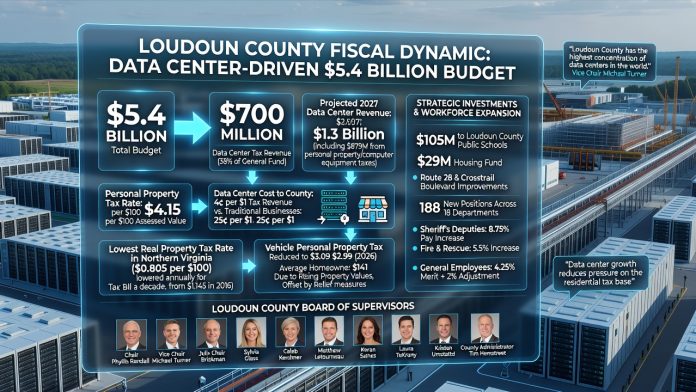
Loudoun County has officially moved forward with a massive $5.4 billion budget that relies heavily on the rapidly expanding data center industry to fund public services. This unique fiscal dynamic allows local government officials to support extensive infrastructure and workforce investments while simultaneously lowering the tax burden on individual residents. The data center sector currently generates approximately $700 million in tax revenue, accounting for a staggering 38 percent of all general fund revenues.
The local government operations are overseen by the Loudoun County Board of Supervisors, which manages the strategic direction of this multibillion-dollar budget. The current board consists of Chair Phyllis Randall, Vice Chair Michael Turner, Juli Briskman, Sylvia Glass, Caleb Kershner, Matthew Letourneau, Koran Saines, Laura TeKrony, and Kristen Umstattd. These elected officials have navigated the complexities of funding comprehensive county services while managing the explosive growth of technology infrastructure within their districts.
The Engine of Local Revenue
The financial impact of the technology sector is projected to grow significantly over the next few years, reaching an estimated $1.3 billion in data center tax revenue by fiscal year 2027. This projected total includes roughly $417 to $418 million derived from real property taxes and a massive $879 million generated through personal property and computer equipment taxes. The computer equipment is currently taxed at a general personal property rate of $4.15 per $100 of assessed value, a rate that remains unchanged in the current financial plan.
Local leaders frequently point to the extreme fiscal efficiency of the industry as a primary driver of the region’s economic stability and low residential tax rates. Officials highlighted the financial benefits by noting that a data center costs the county merely four cents for every single dollar of tax revenue received, whereas traditional businesses cost about twenty-five cents per dollar of revenue. County Administrator Tim Hemstreet noted in his budget message that the growth in data center real property continues to reduce pressure on the residential tax base to fund the growth of services.
Because of this commercial revenue stream, officials justified the budget’s reliance on the industry by stating that Loudoun County has the lowest real property tax rate in Northern Virginia, which is about 25 percent lower than neighboring jurisdictions. The real property tax rate has actually been lowered every consecutive year for a decade, dropping from $1.145 in tax year 2016 to the current $0.805 per $100 of assessed value. Despite this flat real estate tax rate for the upcoming 2026 cycle, the average homeowner will still see a tax bill increase of $141 driven entirely by rising property values across the local housing market.
To help offset the rising costs associated with increased residential property assessments, the county has implemented targeted tax relief measures for local citizens. The vehicle personal property tax rate has been explicitly reduced to $3.09 per $100 of assessed value for 2026. Furthermore, financial planners have already scheduled an additional planned reduction of this vehicle tax rate down to $2.94 in 2027 to provide continued relief to working families.
Strategic Investments and Workforce Expansion
The massive influx of commercial tax dollars is being directed toward significant personnel investments and public service expansions across multiple local government sectors. The approved budget adds 188 new positions across 18 different departments to keep pace with the region’s expanding population and administrative needs. Among these additions, the Department of Information Technology is adding a dedicated security operations manager to specifically address ongoing span-of-control challenges within the agency.
First responders and law enforcement personnel are receiving substantial compensation adjustments under the newly approved financial framework. Deputies within the Sheriff’s Office are slated to receive an average pay increase of 8.75 percent to maintain regional competitiveness in law enforcement recruiting. Meanwhile, Fire and Rescue personnel will receive an average 5.5 percent pay increase, and general county employees are designated to receive a 4.25 percent merit raise alongside a 2 percent overall salary adjustment.
Beyond personnel costs, the budget allocates heavy funding toward critical community infrastructure, transportation networks, and the local education system. Loudoun County Public Schools will benefit from a massive $105 million budget increase to support educational programs and facility maintenance. Additionally, the county has set aside $29 million for a dedicated Housing Fund to promote affordable living options, while also funding major capital transportation projects including improvements to Route 28 and Crosstrail Boulevard.
The concentration of technology infrastructure in this single jurisdiction remains unmatched on a global scale, creating a highly specialized local economy. Vice Chair Michael Turner stated during a recent town hall that Loudoun County, and particularly Data Center Alley in the eastern portion of the county, has the highest concentration of data centers in the world. He noted that approximately 250 data centers are already built in the area, with more than 100 additional facilities currently sitting in the development pipeline. As data center taxes continue rising at a sixfold rate compared to other local tax funding, the county’s financial dependence on this single industry is expected to deepen over the coming decade.
Email the Board of Supervisors at:
Phyllis J. Randall (Chair, At-Large) – Phyllis.Randall@loudoun.gov,
Michael R. Turner (Vice Chair, Ashburn District) – Mike.Turner@loudoun.gov,
Juli E. Briskman (Algonkian District) – Juli.Briskman@loudoun.gov,
Sylvia R. Glass (Broad Run District) – Sylvia.Glass@loudoun.gov,
Caleb Kershner (Catoctin District) – caleb.kershner@loudoun.gov,
Matthew F. Letourneau (Dulles District) – Matt.Letourneau@loudoun.gov,
Kristen C. Umstattd (Leesburg District) – Kristen.Umstattd@loudoun.gov,
Laura A. TeKrony (Little River District) – Laura.TeKrony@loudoun.gov,
Koran Saines (Sterling District) – Koran.Saines@loudoun.gov
Email the Board of Supervisors at:
Phyllis J. Randall (Chair, At-Large) – Phyllis.Randall@loudoun.gov,
Michael R. Turner (Vice Chair, Ashburn District) – Mike.Turner@loudoun.gov,
Juli E. Briskman (Algonkian District) – Juli.Briskman@loudoun.gov,
Sylvia R. Glass (Broad Run District) – Sylvia.Glass@loudoun.gov,
Caleb Kershner (Catoctin District) – caleb.kershner@loudoun.gov,
Matthew F. Letourneau (Dulles District) – Matt.Letourneau@loudoun.gov,
Kristen C. Umstattd (Leesburg District) – Kristen.Umstattd@loudoun.gov,
Laura A. TeKrony (Little River District) – Laura.TeKrony@loudoun.gov,
Koran Saines (Sterling District) – Koran.Saines@loudoun.gov