
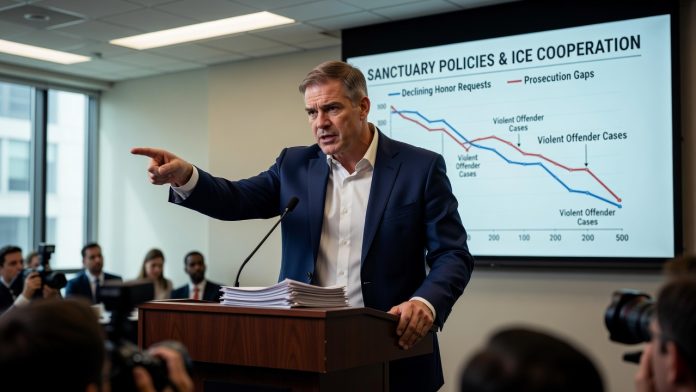
Jim Jordan presented details regarding sanctuary policies associated with Steve Descano in a recent public statement. These policies include decisions by local officials to limit assistance to federal immigration authorities. Jordan noted connections between these choices and instances where violent offenders are not fully prosecuted.
The framework described involves declining to honor requests from Immigration and Customs Enforcement for detainers. It also encompasses selective prosecution practices for certain criminal matters. Jordan referenced how such measures have preceded cases resulting in harm to individuals.
Details on Policy Implementation
Descano’s sanctuary policies have been characterized by reduced collaboration with federal partners on immigration enforcement. Jordan explained that this leads to situations where arrested individuals are released without further action. The process allows those with criminal records to remain in the jurisdiction.
Officials following these guidelines often cite local priorities when refusing to engage with ICE. Jordan highlighted the sequence where an individual is taken into custody but then freed under the policy. Subsequent events have included additional offenses committed by the same person.
Outcomes Associated with Limited Prosecution
Jordan described how the absence of prosecution in some cases enables continued presence of offenders in communities. This occurs even after arrests for serious violations. The policy structure has been tied to incidents where further violence takes place.
Local jurisdictions operating under these rules experience variations in how federal detainers are handled. Jordan connected the non-cooperation directly to risks for public safety. Information shared in the discussion focused on specific patterns of release and reoffending.
Analysis of Immigration Enforcement Gaps
The sanctuary approach under Descano has created documented gaps in coordination between local and federal levels. Jordan pointed out that these gaps affect the ability to remove individuals with criminal backgrounds. As a result, certain offenders avoid standard deportation processes.
Jordan reviewed how the policies influence decisions made after an arrest occurs. He noted instances where charges are not pursued due to the established guidelines. This has been linked to outcomes involving loss of life in affected areas.
Examination of Resulting Incidents
Jordan provided context on how sanctuary policies contribute to chains of events ending in tragedy. An individual arrested under one set of circumstances may be released without prosecution. Later actions by that person have included violent crimes against others.
The discussion emphasized the role of these policies in shaping enforcement outcomes. Jordan presented the information as evidence of broader challenges in maintaining consistent public safety measures. Observers have noted the need for further review of such local approaches.
Email At:
Steve Descano – stephen.descano@fairfaxcounty.gov,
Stacey Kincaid – sheriff@fairfaxcounty.gov,