
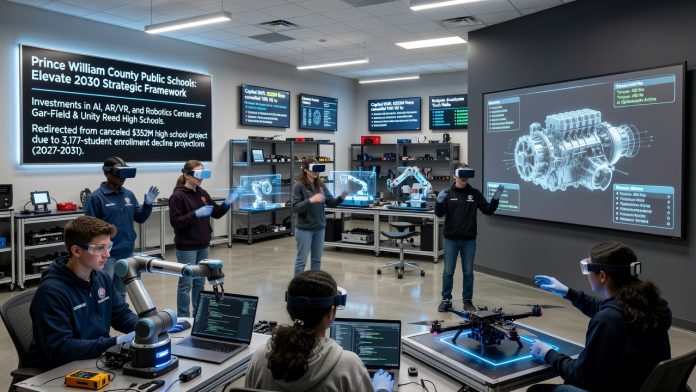
The Prince William County Public Schools system has introduced a comprehensive budget that dramatically shifts its educational investments toward advanced technology. This newly proposed financial plan totals an unprecedented $2.9 billion for the upcoming fiscal year. Officials have structured the budget to prioritize cutting-edge educational tools over traditional infrastructure expansion. The proposal specifically outlines major investments in artificial intelligence, augmented reality, and virtual reality integration across the district.
SHIFTING STRATEGIC FRAMEWORKS
The Prince William County School Board, consisting of Babur Lateef, Adele Jackson, Lisa Zargarpur, Jennifer Wall, Lillie Jessie, Justin Wilk, Loree Williams, and Diane Raulston, is guiding this major financial transition. Superintendent LaTanya McDade noted that this budget represents a highly pivotal moment for the school division. She explained that the financial plan serves to bridge the transition from the previous Vision 2025 strategic plan to the newly adopted Elevate 2030 framework. This deliberate shift in long-term planning reflects changing demographics and a renewed focus on modernizing the daily student educational experience. The administration expects this strategic realignment will better prepare graduates for future technological challenges.
A central element of this updated financial strategy involves the complete cancellation of the previously planned fourteenth high school. District officials abandoned the construction project after experiencing a massive cost increase of $128.2 million over the past year. The projected expenses for the new facility skyrocketed from an initial estimate of $223.8 million to a staggering $352 million. Consequently, administrators decided to redirect these substantial capital improvement funds toward specialized technology centers and digital upgrades.
CAPITAL ADJUSTMENTS AND DEMOGRAPHIC CHANGES
These sweeping financial changes are officially codified within the district’s Capital Improvement Program for fiscal years 2027 through 2031. This five-year capital planning document outlines the precise timeline for reallocating the funds originally earmarked for traditional school construction. By adjusting the capital improvement strategy, the district avoids the massive financial burden associated with the canceled high school project. The revised capital plan instead directs targeted investments into specialized technology centers located at existing high school campuses. This careful restructuring of capital funds ensures the district remains fiscally responsible while still modernizing its educational facilities.
This major infrastructure cancellation is heavily influenced by significant shifts in local population dynamics and long-term student enrollment projections. Unlike previous years characterized by rapid growth, the district is now projecting a notable decline in student enrollment over the next half-decade. Forecasters anticipate a total drop of 3,177 students across the county school system. This decline is attributed to lower birth rates since 2016, escalating housing costs, and increasing out-migration from the immediate region. These demographic realities ultimately made the construction of a massive new comprehensive high school practically unfeasible.
INVESTMENTS IN ROBOTICS AND IMMERSIVE TECHNOLOGY
Instead of building a new campus, the school system is aggressively investing in highly specialized regional technology hubs. The budget allocates $8.5 million to construct a state-of-the-art robotics center at Gar-Field High School, which will serve students on the eastern side of the county. An identical $8.5 million investment is designated for a corresponding robotics center at Unity Reed High School to accommodate students in the western region. These dedicated facilities will provide unprecedented access to advanced engineering and programming resources for high schoolers across the district. The dual-center approach ensures equitable access to robotics education regardless of a student’s geographic location.
Beyond the physical robotics centers, the budget introduces unique and unusual investments in immersive digital learning environments. The financial plan includes dedicated funding for the widespread integration of artificial intelligence tools into standard academic curricula. Additionally, the district will invest heavily in augmented and virtual reality technologies to create highly interactive classroom lessons. Educators will utilize these immersive technologies to prepare students for an increasingly digitized global economy. This forward-thinking approach aims to equip graduates with practical experience in the exact technologies currently transforming the modern workforce.
COMPENSATION INCREASES AND EARLY EDUCATION
The comprehensive budget also prioritizes human resources and early childhood education alongside its technological advancements. District employees will receive an average salary increase of 6.27 percent to help maintain competitive compensation in a challenging economic climate. Specifically, certified staff members are slated for a 6.5 percent pay raise, while classified staff will see a 6.2 percent increase. Furthermore, the financial plan provides the foundational funding required to begin a major expansion of universal pre-kindergarten programs across the county. These combined investments aim to attract top-tier educators while expanding early learning opportunities.
School Board Chairman At-Large Babur Lateef expressed strong support for the superintendent’s proposed financial direction and strategic initiatives. He publicly commended the extensive work that district staff dedicated to crafting a budget that perfectly aligns with the new Elevate 2030 goals. Lateef emphasized his excitement regarding the initial funding for universal pre-kindergarten and the continued provision of vital classroom supports for both students and teachers. He stated that he fully supports the budget and looks forward to seeing the strategic plan actively implemented. His full endorsement signals strong localized backing for this technological and strategic pivot within the school division.
Email the School Board at:
Babur B. Lateef, M.D. (Chairman At-Large) blateef@pwcs.edu,
Richard M. Jessie (Vice Chairman, Occoquan District) rjessie@pwcs.edu,
Erica C. Tredinnick (Brentsville District) etredinnick@pwcs.edu,
Lisa A. Zargarpur (Coles District) \u2014 lzargarpur@pwcs.edu,
Jennifer T. Wall (Gainesville District) jwall@pwcs.edu,
Tracy L. Blake (Neabsco District) tblake@pwcs.edu,
Justin David Wilk (Potomac District) jwilk@pwcs.edu,
Loree Y. Williams (Woodbridge District) lwilliams@pwcs.edu,