
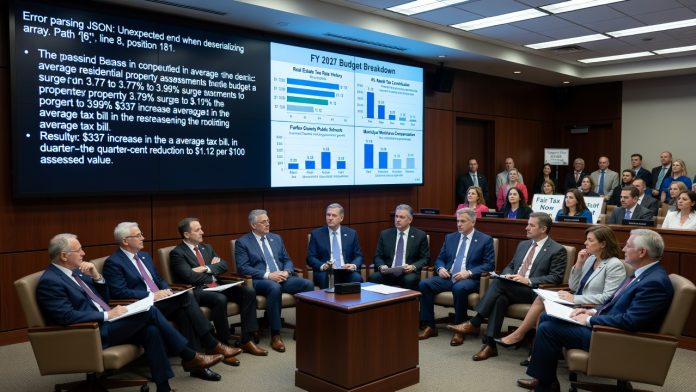
The Virginia budget for fiscal year 2027 contains a massive expenditure that should raise immediate red flags for fiscal conservatives and taxpayers across the commonwealth. Lawmakers have approved a staggering $400.4 million allocation designated merely as a one-time flexible payment supplement for local school divisions. By categorizing hundreds of millions of taxpayer dollars under such a generic label, the state risks effectively concealing specific local expenditures from public scrutiny. When government bureaucrats are handed flexible funding without rigorous, line-item mandates, the door is left wide open for unchecked waste and administrative bloat.
The financial breakdown of this massive supplement reveals a complex distribution network that funnels money directly into local school districts with minimal friction. Approximately $100.0 million is distributed based purely on the school-age population of the locality. An additional $200.8 million is allocated as a basic aid add-on, adjusted by the Local Composite Index, while another $99.6 million is distributed based on the concentration of at-risk students. Because the state requires absolutely no local funding match for these dollars, local school boards are insulated from the direct taxpayer accountability that typically accompanies new spending initiatives.
Bypassing Meaningful Taxpayer Relief
While the state claims to have attached some strings to this massive payout, the conditions ultimately force higher baseline spending rather than encouraging fiscal restraint. To access these funds, school divisions are required to certify a two percent compensation increase in each year of the biennium. Furthermore, the legislation explicitly dictates that localities cannot use these state funds to reduce their total local operating expenditures for public education. Instead of allowing this massive state influx to provide meaningful tax relief to local property owners, the mandate ensures that overall government spending remains artificially inflated.
Proponents of the budget amendment point to reporting requirements as a safeguard against the misuse of these funds, but these measures lack serious teeth. School divisions are merely required to report on the use of the funds by specifying amounts budgeted in categories prescribed by the Virginia Department of Education. They must also provide a simple narrative explanation detailing how they utilized the money to address local needs. However, authorizing school districts to spend hundreds of millions of dollars to broadly address local needs is a recipe for funding unnecessary pet projects rather than core academic instruction.
Legislative Shifts and Budgetary Bloat
This massive flexible spending package emerged after the General Assembly significantly altered the initial education budget proposed by the governor. Lawmakers shifted away from several proposed one-time initiatives in favor of increased and targeted recurring funding, yet they still managed to carve out this unique $400.4 million flexible supplement. Alongside this change, the legislature also replaced a previously proposed two percent bonus with a flat $1,500 bonus for instructional and support positions in fiscal year 2026. These legislative maneuvers demonstrate a troubling willingness to inject massive sums of cash into the education system without demanding corresponding academic improvements.
Fiscal conservatives understand that so-called one-time flexible payments frequently create dangerous financial dependencies within local government agencies. Even though this allocation is designated for fiscal year 2027 with carryover permitted into 2028, school districts often use these windfalls to expand programs that require ongoing financial support. When this temporary state funding inevitably dries up, local school boards routinely demand tax increases to sustain the very programs they started with the one-time money. This predictable cycle of government expansion is exactly why broad, flexible spending blocks are detrimental to the long-term financial health of the state.
Demanding True Fiscal Accountability
The primary duty of the state legislature is to serve as a responsible steward of the hard-earned money collected from Virginia taxpayers. Funneling over four hundred million dollars into a generic educational supplement fundamentally contradicts the principles of transparent, conservative budgeting. Taxpayers deserve to know exactly how every single dollar is being spent, rather than having to decipher vague narrative explanations submitted by local school administrators long after the money is gone. True fiscal responsibility requires strict line-item budgeting that explicitly prevents wasteful spending and prioritizes essential classroom instruction over administrative flexibility.
Moving forward, lawmakers must prioritize protecting the taxpayer by rejecting these massive, vaguely defined funding supplements. If the state government genuinely has an excess of $400.4 million in the general fund, that money should be returned to the citizens through direct tax cuts. Alternatively, if the funds must be spent on education, they should be strictly earmarked for measurable academic interventions with rigid oversight. Virginians simply cannot afford to finance massive slush funds that encourage reckless local spending and obscure the true cost of public education.