
The Fairfax County Board of Supervisors recently finalized the fiscal year 2027 budget, restoring critical funding to several community programs that were initially slated for reduction. Following extensive community input, local officials reversed planned cuts to preschool education, senior nutrition, behavioral health, and low-income housing assistance. This financial restoration was made possible largely through the implementation of a new local meals tax that provided alternative revenue streams for the municipal government. The finalized budget aims to balance ongoing fiscal constraints with the immediate need to maintain essential social safety nets for vulnerable residents across the region.
The current Fairfax County Board of Supervisors consists of Chairman Jeff McKay, James Walkinshaw, Jimmy Bierman, Walter Alcorn, Rodney Lusk, Andres Jimenez, Dan Storck, Dalia Palchik, Pat Herrity, and Kathy Smith. These elected officials navigated a highly complex budgetary environment to finalize a spending plan that addresses ongoing community needs while managing unavoidable agency reductions. Fiscal year 2027 marks the fourth consecutive year of structural agency reductions, bringing total cumulative cuts since fiscal year 2024 to approximately $124.5 million. Despite these broad financial pressures, the board ultimately prioritized specific community investments to prevent drastic public service losses.
RESTORING ESSENTIAL COMMUNITY PROGRAMS
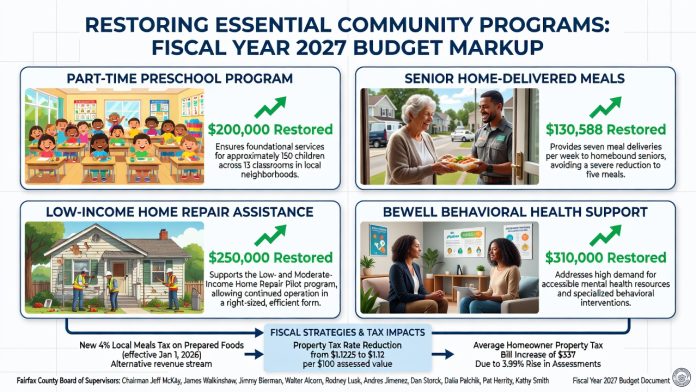
Among the most significant adjustments in the budget markup was the partial restoration of $200,000 for a contract providing a crucial part-time preschool program. This specific funding ensures that approximately 150 children across 13 classrooms will continue to receive foundational early childhood education services in their local neighborhoods. Additionally, officials formally restored $250,000 for the Low- and Moderate-Income Home Repair Pilot program, an initiative managed directly by the Department of Housing and Community Development. These targeted restorations allow both vital initiatives to continue operating in a right-sized form while still maintaining a more efficient overall footprint.
The board also heavily prioritized the health and well-being of older residents by restoring $130,588 to the home-delivered meals program managed by Senior and Vulnerable Adult Nutrition Services. This essential funding allows the county to provide seven meal deliveries per week to homebound seniors, successfully avoiding a proposed cut that would have severely reduced the service to just five meals per week. During the height of the pandemic, federal stimulus funding had temporarily increased these deliveries to eleven per week before officials faced pressure to revert to pre-pandemic levels. Furthermore, the county restored $310,000 for the BeWell behavioral health support initiative. This particular restoration recognizes the continued high demand for accessible mental health resources and specialized behavioral intervention in the region.
FISCAL STRATEGIES AND TAX IMPACTS
To successfully fund these restored programs without placing an undue burden on property owners, the county leveraged a new four percent meals tax on prepared foods that took effect on January 1, 2026. This alternative revenue source provided the exact fiscal flexibility necessary to reduce the real estate tax rate by one-quarter cent, dropping it from $1.1225 to $1.12 per $100 of assessed value. Board of Supervisors Chairman Jeff McKay noted that people are suffering right now, emphasizing the critical importance of lowering the property tax rate wherever mathematically possible. The combination of the newly implemented meals tax and the modestly reduced property tax rate represents a major structural shift in how the county funds its municipal operations.
Despite the nominal decrease in the baseline real estate tax rate, the average local homeowner will still experience a property tax bill increase of $337 compared to the previous fiscal year. This net financial increase is directly driven by a 3.99 percent average rise in residential real estate assessments across the highly competitive local housing market. County Executive Bryan Hill explained that the initial budget required difficult choices, noting that some proposed cuts were initially necessary to allow for reinvestments in deferred building maintenance and information technology infrastructure. Hill pointed out that these specific maintenance and infrastructure sectors had relied heavily on temporary one-time funding since the Great Recession, creating a pressing need for dedicated baseline revenue.
LOOKING AHEAD TO FUTURE BUDGETS
The official fiscal year 2027 budget markup document highlights that the targeted funding restorations were made in direct response to community input and a focused desire to align resources with actual utilization. By partially restoring financial support for these four vital programs, local leaders have attempted to strategically mitigate the localized impact of broad, ongoing agency reductions. The county government will continue diligently monitoring the financial performance of the meals tax and real estate assessments to guide future budgetary decisions. Ultimately, the finalized budget reflects a careful, ongoing compromise between maintaining essential public services and addressing long-term municipal infrastructure needs.
Jeffrey McKay (chairman@fairfaxcounty.gov),
Kathy Smith (sully@fairfaxcounty.gov),
Rachna Sizemore Heizer (braddock@fairfaxcounty.gov),
James Bierman (dranesville@fairfaxcounty.gov),
Rodney Lusk (franconia@fairfaxcounty.gov),
Walter Alcorn (huntermill@fairfaxcounty.gov),
Andres Jimenez (mason@fairfaxcounty.gov),
Daniel Storck (mtvernon@fairfaxcounty.gov),
Dalia Palchik (provdist@fairfaxcounty.gov),
Pat Herrity (springfield@fairfaxcounty.gov),