
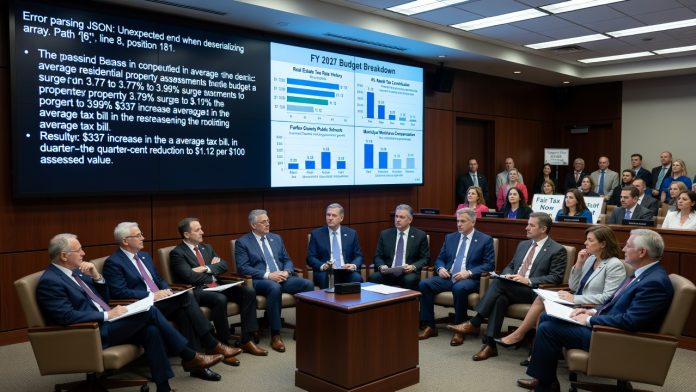
The Fairfax County Board of Supervisors recently adopted the comprehensive fiscal year 2027 budget, navigating a complex economic landscape characterized by rising property values and newly implemented revenue streams. The approved financial plan includes a slight reduction in the real estate tax rate, officially lowering it by a quarter-cent to $1.12 per $100 of assessed value. Despite this nominal rate decrease, the vast majority of homeowners will experience higher overall tax burdens due to steadily climbing residential property assessments across the region. Ultimately, the finalized budget aims to delicately balance necessary taxpayer relief with the continuously growing funding requirements of local schools and essential county services.
The approval of this extensive financial plan required months of rigorous deliberation among the elected officials representing the various magisterial districts of Fairfax County. The current Board of Supervisors includes Chairman Jeff McKay, alongside district supervisors James Walkinshaw, Jimmy Bierman, Walter Alcorn, Rodney Lusk, Andres Jimenez, Dan Storck, Dalia Palchik, Pat Herrity, and Kathy Smith. These ten officials spent the spring season reviewing community feedback, analyzing departmental funding requests, and evaluating long-term economic forecasts before finalizing the fiscal year 2027 appropriations. Their final legislative decisions reflect a necessary compromise between maintaining high-quality public services and addressing the escalating cost of living for local residents.
Property Assessments and Tax Bill Impact
The primary driver behind the increased financial burden on residents is the continued upward trajectory of the local real estate market throughout the county. Average residential property assessments across the jurisdiction increased by approximately 3.77 percent to 3.99 percent over the course of the past year. Because these underlying property values surged so significantly, the quarter-cent reduction in the tax rate was simply not enough to prevent out-of-pocket costs from rising for the average homeowner. Consequently, the average residential property tax bill will increase by approximately $337 compared to the previous fiscal year’s financial obligations.
Prior to this newly approved legislative adjustment, the real estate tax rate stood slightly higher at $1.1225 per $100 of assessed property value. County financial staff projected that keeping the rate completely flat would have resulted in an even steeper increase in the average annual property tax bill for local families. By trimming the rate to exactly $1.12, officials actively attempted to soften the blow of the surging property assessments while still capturing enough revenue to adequately fund government operations. This delicate mathematical balancing act highlights the ongoing structural challenge of relying so heavily on residential real estate taxes to fund expanding local government initiatives.
Revenue Streams and the Meals Tax
The ability to implement even a modest property tax reduction was largely facilitated by the successful introduction of a brand new alternative revenue stream. Board Chairman Jeff McKay publicly indicated that the tax rate cut was directly made possible by the county’s new four percent meals tax, which officially took effect on January 1, 2026. This specific consumption tax on prepared foods and beverages diversifies the county’s overall income portfolio, actively reducing its historical overreliance on traditional residential property owners. The immediate influx of capital from the meals tax provided the exact fiscal padding needed to lower the real estate rate without slashing essential public services or delaying infrastructure projects.
The final decision to reduce the tax rate by a quarter-cent was not completely unanimous, reflecting diverse fiscal philosophies and priorities among the individual board members. Supervisors ultimately split their final votes eight to two in favor of the specific tax rate cut adopted in the finalized budget document. Supervisor Walter Alcorn did not support any reduction, arguing consistently that the county needed to retain those specific funds for critical infrastructure maintenance and expanding service needs. Conversely, Supervisor Pat Herrity opposed the measure because he firmly believed the reduction should go much further to provide truly meaningful financial relief to taxpayers currently facing inflation.
Funding Priorities and Public Schools
A highly significant portion of the newly adopted county budget is strictly dedicated to supporting the educational infrastructure of the broader region. Fairfax County Public Schools will officially receive an increased financial transfer that is directly commensurate with the overall economic growth rate of the county itself. This specific funding boost is strategically designed to help the massive school system manage rapidly rising operational costs, retain highly qualified educators, and maintain specialized academic programming. Educational advocates and parent groups had lobbied heavily throughout the entire budget process to ensure the monetary transfer kept pace with the region’s broader economic expansion.
Beyond direct educational funding, the approved budget also heavily addresses the necessary compensation and healthcare benefits for the extensive municipal workforce. The fiscal plan notably includes specific financial components explicitly required by newly established collective bargaining agreements with various county employee labor unions. These binding contractual obligations ensure highly competitive wages and benefits, which county leaders consistently argue are absolutely essential for recruiting and retaining a high-quality public sector workforce. Accommodating these newly negotiated labor costs was a central, unavoidable factor in determining the final departmental expenditure levels for the upcoming fiscal year.
Future Fiscal Outlook
As Fairfax County officially transitions into fiscal year 2027, financial analysts and civic watchdogs will closely monitor the performance of these newly implemented revenue strategies. The actual financial yield of the four percent meals tax will be heavily scrutinized to determine if it consistently meets the initial revenue projections used to justify the property tax cut. If the meals tax significantly underperforms, the Board of Supervisors may face incredibly difficult decisions regarding future property tax rates or potential service reductions in subsequent budget cycles. Conversely, robust local consumer spending could easily provide additional financial flexibility for further taxpayer relief or major infrastructure investments in the years immediately ahead.
The complete implementation of this budget marks a truly pivotal shift in exactly how the county funds its extensive array of daily public services. Local residents will directly see the new real estate tax rates reflected in their upcoming billing cycles, alongside the continued daily application of the meals tax at local dining establishments. Local government departments will immediately begin operating under these revised financial parameters, seamlessly integrating the updated employee compensation structures and the massive school funding transfers. The ultimate long-term success of this specific fiscal framework will depend heavily on the ongoing stability of the local housing market and the continued economic vitality of the entire region.
Jeffrey McKay (chairman@fairfaxcounty.gov),
Kathy Smith (sully@fairfaxcounty.gov),
Rachna Sizemore Heizer (braddock@fairfaxcounty.gov),
James Bierman (dranesville@fairfaxcounty.gov),
Rodney Lusk (franconia@fairfaxcounty.gov),
Walter Alcorn (huntermill@fairfaxcounty.gov),
Andres Jimenez (mason@fairfaxcounty.gov),
Daniel Storck (mtvernon@fairfaxcounty.gov),
Dalia Palchik (provdist@fairfaxcounty.gov),
Pat Herrity (springfield@fairfaxcounty.gov),































