
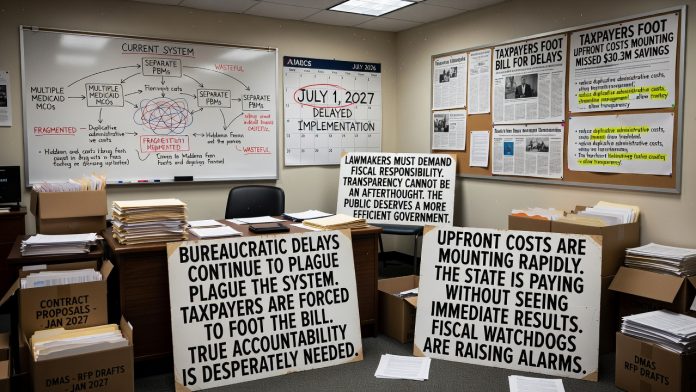
Virginia taxpayers are once again bearing the financial burden of bureaucratic delays as state officials push back the implementation of a single pharmacy benefit manager system. The Department of Medical Assistance Services originally planned to consolidate the state Medicaid pharmacy benefits to save millions, but this cost-saving measure is now delayed until at least July 2027. Fiscally conservative advocates argue that stalling this vital reform allows wasteful administrative spending to continue unchecked while taxpayers foot the bill. This delay directly impacts the Virginia Medicaid Program and the Cardinal Care managed care program, keeping a fragmented and highly costly system in place for several more years.
Bureaucratic delays continue to plague the system. Taxpayers are forced to foot the bill. True accountability is desperately needed
The transition to a single, state-contracted pharmacy benefit manager was projected to capture an impressive $30.3 million in savings over the biennium. However, state officials have postponed the timeline, originally targeted for July 2026, meaning these critical savings will not materialize as promised to the public. The revised schedule now dictates that a request for proposals will not be issued until January 2027, with the contract awarded in July 2027 and full implementation delayed until January 2028. Every single month of delay represents a missed opportunity to trim the bloated state budget and return value to hard-working Virginia families who demand fiscal prudence.
Under the current inefficient framework, the Department of Medical Assistance Services delivers pharmacy benefits through multiple Medicaid managed care organizations. Each of these organizations utilizes its own separate pharmacy benefit manager, creating a tangled web of duplicative administrative costs and hidden operational fees. This fragmented approach lacks the necessary transparency in drug costs and dispensing fees, leaving taxpayers vulnerable to overspending and potential financial mismanagement. Consolidating into a single system is a common-sense conservative reform designed to eliminate this exact type of government waste and streamline essential healthcare operations.
Upfront costs are mounting rapidly. The state is paying without seeing immediate results. Fiscal watchdogs are raising alarms.
Adding insult to injury, the state has already allocated $2.2 million in start-up costs just to develop the request for proposals and conduct preliminary analysis. Taxpayers are essentially funding millions in bureaucratic paperwork for a project that will not yield actual savings for several more years. Fiscal watchdogs argue that allocating such heavy upfront funding without demanding strict adherence to the original implementation timeline is a classic hallmark of government overspending. Citizens rightfully expect their tax dollars to be used efficiently, rather than being sunk into delayed administrative processes that fail to deliver timely and measurable economic results.
State officials justified the delay by claiming that general fund support and additional legislative authority will be necessary to implement a single statewide pharmacy benefit manager. This explanation highlights a frustrating reality of state governance, where red tape and complex funding requests continually stall practical financial reforms. The stated goal of the single system is to ‘reduce duplicative administrative costs, streamline management of the pharmacy benefit and allow transparency in drug costs and dispensing fees’ across the board. However, achieving these conservative goals requires decisive executive action and strict timelines, neither of which are currently present in the heavily delayed rollout plan.
Lawmakers must demand fiscal responsibility. Transparency cannot be an afterthought. The public deserves a more efficient government
The delay of the pharmacy benefit manager consolidation is a prime example of why conservative lawmakers continually push for smaller, more efficient government operations. When multiple contractors and middlemen handle public funds, the risk of fraud, waste, and abuse naturally increases exponentially across the board. A unified system would provide necessary oversight, ensuring that every dollar spent on the Cardinal Care managed care program is strictly accounted for and effectively utilized. Lawmakers must hold the Department of Medical Assistance Services fully accountable for these delays to prevent any further squandering of valuable public resources.
Moving forward, Virginia taxpayers must demand greater urgency from state agencies tasked with implementing vital budget-reducing measures. The projected $30.3 million in savings is not just a line item; it represents money that could be kept in the pockets of citizens or used to pay down existing state debt obligations. Bureaucrats must not be allowed to endlessly extend deadlines while continuing to operate a bloated, multi-tiered pharmacy management system that drains the public treasury. True fiscal conservatism requires that state agencies prioritize efficiency, cut unnecessary administrative overhead, and respect the financial sacrifices made by taxpayers every single day.