
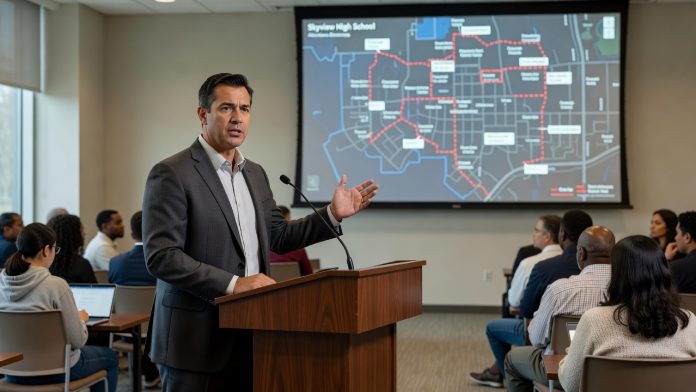
Fairfax County School Board member Mateo Dunne addressed a proposed transportation plan during a recent meeting focused on the new Skyview High School. The plan features a phase-in structure for bus services that has drawn attention for its complexity. Dunne presented observations on how the approach might affect students living inside the designated boundaries. The discussion centered on service levels and implementation details for the coming school year.
The phase-in model under review does not extend full bus coverage to all students within the boundaries. Instead, it incorporates elements such as depot stops rather than direct door-to-door service for every participant. Dunne noted that this setup creates distinctions based on timing and location factors. Board members reviewed how the plan aligns with earlier agreements made for the remainder of the rollout period.
Details of the Phase-In Approach
Several aspects of the bus plan involve voluntary arrangements made by some families in July. These choices placed certain students outside the standard service area yet still connected to the school. The plan specifies that rides to school would depend on individual circumstances rather than uniform application. Dunne highlighted the resulting variations in access for those affected.
The conversation included references to the boundary limits and how they intersect with the new high school enrollment. Not all students will receive the same form of transportation support under the current proposal. This has prompted examination of whether adjustments could improve consistency. The board continues to evaluate the operational implications of these decisions.
Student Participation and Service Variations
Questions have arisen regarding how the plan treats students who opted into Skyview High School. The phase-in timeline appears to create different service categories depending on when participation occurred. Dunne outlined the potential effects on daily commutes for those groups. Additional consideration has been given to the depot component as an alternative to traditional stops.
The overall framework reflects efforts to manage transportation resources during the school’s initial years. Board members have discussed the balance between full coverage and phased implementation. Dunne’s remarks focused on clarifying the scope of services available to families. This review process aims to address logistical challenges before the plan takes full effect.
To Contact Fairfax School Board Members:
All Members – FairfaxCountySchoolBoard@fcps.edu,
Tom Dannan – tfdannan@fcps.edu,
Robyn Lady – ralady1@fcps.edu,
Marcia St. John-Cunning – mstjohncunni@fcps.edu,
Melanie Meren – HunterMillStaff@fcps.edu,
Ricardy Anderson – randerson@fcps.edu,
Mateo Dunne – mdunne@fcps.edu,
Karl Frisch – kfrisch@fcps.edu,
Sandy Anderson – sanderson@fcps.edu,
Seema Dixit – sdixit@fcps.edu,
Kyle McDaniel – kmcdaniel@fcps.edu,
Ryan McElveen – rlmcelveen@fcps.edu,
Ilryong Moon – imoon@fcps.edu,