
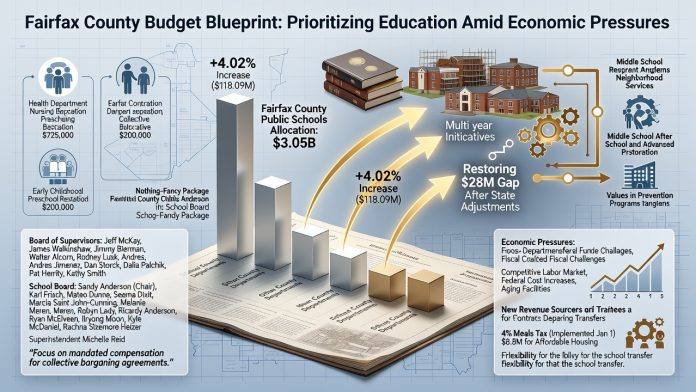
Fairfax County officials have introduced a $5.9 billion budget that directs a historic amount of funding toward the public school system. Fairfax County Public Schools will receive $3.05 billion under the proposed spending plan, which accounts for more than half of the entire county budget. The allocation represents a 51.2 percent share of the general fund disbursements and highlights the local government’s commitment to educational investments.
The comprehensive budget plan requires approval from the Fairfax County Board of Supervisors, which includes Jeff McKay, James Walkinshaw, Jimmy Bierman, Walter Alcorn, Rodney Lusk, Andres Jimenez, Dan Storck, Dalia Palchik, Pat Herrity, and Kathy Smith. The school funding allocation specifically provides an increase of $118.09 million over the previous fiscal year, translating to a 4.02 percent boost. Despite this massive financial commitment, the county allocation actually falls approximately $44 million short of the amount originally requested by the school system. This discrepancy leaves local education officials tasked with finding operational efficiencies to balance their books.
Navigating Budget Gaps and Collective Bargaining. Local officials must balance competing financial priorities to maintain services. The school board faces significant operational hurdles in the upcoming year
The Fairfax County School Board, comprising Sandy Anderson, Karl Frisch, Mateo Dunne, Seema Dixit, Marcia Saint John-Cunning, Melanie Meren, Robyn Lady, Ricardy Anderson, Ryan McElveen, Ilryong Moon, Kyle McDaniel, and Rachna Sizemore Heizer, must navigate a remaining $28 million budget gap after state funding adjustments. Superintendent Michelle Reid emphasized that the proposed $4.1 billion operating budget focuses heavily on mandated employee compensation required to meet collective bargaining agreements. The financial package also aims to restore cuts made last year to balance the budget while continuing vital multiyear initiatives. These educational priorities reflect a stabilization strategy following recent periods of economic uncertainty.
This budget fully funds the third and final year of the established collective bargaining agreements for school employees. The move addresses a significant shortfall from the previous year when the county did not fully fund the requested seven percent pay raises for school staff. School Board Chair Sandy Anderson described the current school budget as a nothing-fancy package that appropriately fits the economic times. She noted that the requested funding simply keeps the school system functioning without adding extravagant new programs.
Cross-Departmental Shifts and Restorations. The proposed budget reallocates funds across various local agencies. These strategic moves aim to streamline community services and support networks
Beyond direct compensation, the new budget directs funding toward reducing class sizes and restoring essential educational positions. Specifically, the spending plan aims to bring back special education and advanced academic positions that were previously eliminated during prior budget reductions. The budget also introduces several cross-departmental transfers, shifting funding from the Department of Neighborhood and Community Services to the school system. This specific transfer will cover the operational costs for both the Middle School After School program and the Values in Prevention program.
Additional departmental shifts involve the Fairfax-Falls Church Community Services Board, which is transferring funding for transition services for high school seniors with Individualized Education Plans directly to the school district. The Fairfax County Health Department is simultaneously receiving a $725,000 increase to support contracts providing nursing services to medically fragile students within the schools. Meanwhile, the early childhood sector will see $200,000 in partial funding restored to support the part-time preschool program. These targeted investments aim to bolster comprehensive support networks for the most vulnerable student populations across the county.
Economic Pressures and County Revenue. The local government continues to navigate a challenging economic landscape. New revenue streams have provided some crucial financial relief for the county
County Executive Bryan Hill addressed the ongoing fiscal challenges in his budget message, noting that the total transfer to the school system has increased by an average of nearly six percent annually over the past three years. He explained that fiscal pressures persist due to a highly competitive labor market, cost increases stemming from recent federal legislation, and growing demands associated with aging facilities across the county. These economic realities have forced county leaders to carefully balance massive educational investments with other critical municipal needs. The resulting budget proposal attempts to honor existing commitments while maintaining overall government stability.
Outside of the education sector, the proposed budget includes an $8.8 million additional investment directed toward affordable housing initiatives. Board of Supervisors Chair Jeff McKay noted that the board was able to balance these investments and cut the property tax rate because of newly generated local revenues. Specifically, the county collected additional revenue from a four percent meals tax that was officially implemented on January 1. This new revenue stream provided crucial flexibility in funding both municipal services and the massive public school transfer.
The $3.05 billion transfer to the school system remains the defining feature of the upcoming fiscal year’s financial blueprint. As the local government finalizes its spending plans, the focus remains on stabilizing the workforce through honored collective bargaining agreements and restoring core academic services. The massive allocation underscores the enduring priority placed on public education within Fairfax County despite persistent economic headwinds and competing departmental needs. Final approval of the budget will cement these financial strategies and dictate the operational capacity of the school system for the coming year.
Jeffrey McKay (chairman@fairfaxcounty.gov),
Kathy Smith (sully@fairfaxcounty.gov),
Rachna Sizemore Heizer (braddock@fairfaxcounty.gov),
James Bierman (dranesville@fairfaxcounty.gov),
Rodney Lusk (franconia@fairfaxcounty.gov),
Walter Alcorn (huntermill@fairfaxcounty.gov),
Andres Jimenez (mason@fairfaxcounty.gov),
Daniel Storck (mtvernon@fairfaxcounty.gov),
Dalia Palchik (provdist@fairfaxcounty.gov),
Pat Herrity (springfield@fairfaxcounty.gov),