
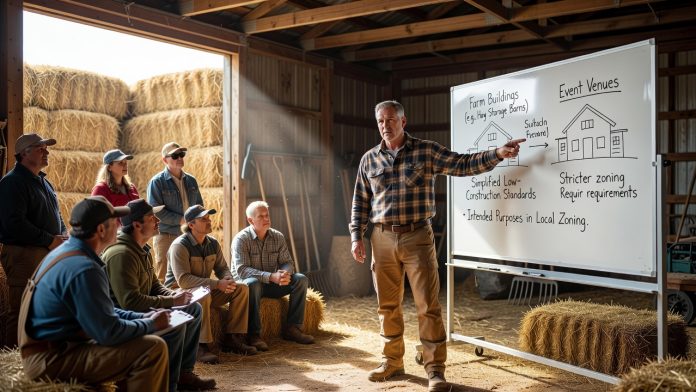
A representative from the Loudoun County Farm Bureau provided details on how agricultural exemptions apply differently to various structures. The presentation focused on the intended purposes of such rules in local zoning contexts. Barns used for storing hay represent typical agricultural buildings with specific lower standards for construction.
Event centers seeking similar treatment must demonstrate alignment with farming activities according to the remarks. The speaker clarified that exemptions target operations involving resource management and related educational efforts. This framework helps separate qualifying farm uses from other commercial enterprises.
Agricultural buildings are designed for practical utilization in ongoing farm work rather than public events. The lower standards reflect the functional needs of these facilities in rural settings. Venues for gatherings operate under different expectations and should meet corresponding requirements.
The discussion highlighted the importance of compliance for all parties involved in land development. Legitimate farming businesses depend on consistent application of these exemptions to remain viable. Misalignment between structure use and exemption criteria can create challenges for regulatory oversight.
Residents and officials benefit from understanding these distinctions to support balanced growth in the area. The Farm Bureau role includes sharing information on how rules intersect with daily agricultural practices. This helps ensure that exemptions continue to serve their core objectives without unintended consequences.
Further points addressed the need for buildings to match their envisioned agricultural functions. Structures holding equipment or supporting crop storage fit within the exemption parameters. Other uses may require separate approvals under zoning ordinances.
The presentation underscored ongoing efforts to maintain clear guidelines for rural development. Enforcement mechanisms play a part in upholding the standards across properties. Accurate classification supports both farming continuity and community planning processes.
Overall the information shared contributes to informed decision making on land use issues. Stakeholders can reference these clarifications when evaluating projects in agricultural zones. The focus remains on practical distinctions that affect local regulations and operations.
Email the Board of Supervisors at:
Phyllis J. Randall (Chair, At-Large) – Phyllis.Randall@loudoun.gov,
Michael R. Turner (Vice Chair, Ashburn District) – Mike.Turner@loudoun.gov,
Juli E. Briskman (Algonkian District) – Juli.Briskman@loudoun.gov,
Sylvia R. Glass (Broad Run District) – Sylvia.Glass@loudoun.gov,
Caleb Kershner (Catoctin District) – caleb.kershner@loudoun.gov,
Matthew F. Letourneau (Dulles District) – Matt.Letourneau@loudoun.gov,
Kristen C. Umstattd (Leesburg District) – Kristen.Umstattd@loudoun.gov,
Laura A. TeKrony (Little River District) – Laura.TeKrony@loudoun.gov,
Koran Saines (Sterling District) – Koran.Saines@loudoun.gov,