
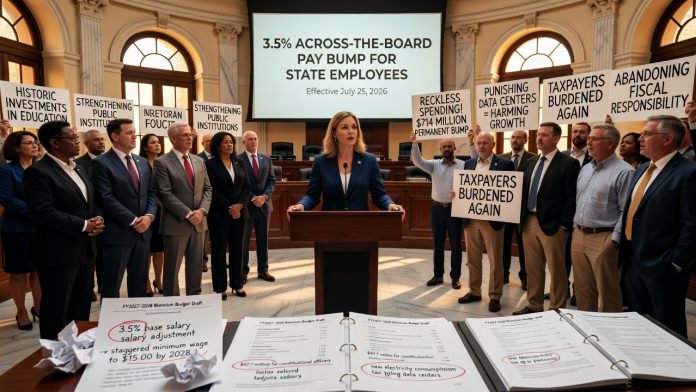
As Virginia lawmakers finalize the massive budget for the upcoming 2026-2028 biennium, fiscal conservatives are raising urgent alarms over a reckless expansion in permanent state spending. Governor Abigail Spanberger and Democratic legislative leaders have agreed to a 3.5 percent across-the-board pay bump for state employees, which will cost hardworking taxpayers an estimated $714 million. This permanent increase replaces a previously proposed one-time bonus, effectively locking the Commonwealth into long-term financial obligations that will be difficult to reverse. Critics argue this move represents a dangerous departure from fiscal restraint at a time when everyday citizens are already struggling with crippling inflation and economic uncertainty.
The sweeping compensation package mandates a 3.5 percent base salary adjustment in each year of the biennium, officially taking effect on July 25, 2026. Public school teachers and support staff will receive an even larger 4 percent raise during both years of the budget cycle, significantly ballooning the education budget. Furthermore, the legislation forces a staggered minimum wage increase across the state, aggressively pushing the rate to $13.75 in 2027 and ultimately $15.00 in 2028. This broad approach to government compensation expands the size and cost of the state bureaucracy without requiring any corresponding efficiency measures or audits to eliminate existing waste.
Abandoning Fiscal Responsibility for Permanent Liabilities
Initially, the introduced budget included a modest and manageable 2 percent salary increase alongside a fiscally prudent $1,500 one-time bonus for state workers. However, lawmakers opted to scrap the one-time bonus entirely, redirecting those essential funds to bankroll the permanent 3.5 percent base salary hike. Fiscal watchdogs warn that converting one-time surplus funds into permanent base pay increases is a classic recipe for future budget deficits and structural financial failures. By aggressively inflating the baseline budget, lawmakers are virtually guaranteeing that future administrations will face severe funding shortages or be forced to raise taxes yet again to cover these unfunded liabilities.
To pay for this staggering $714 million compensation package, the legislature has introduced a highly controversial new electricity consumption tax specifically targeting data centers. Proponents expect this new tax scheme to generate up to $600 million annually to sustain the bloated compensation levels compared to previous, more restrained budget cycles. Conservative leaders argue that specifically targeting one of Virginia’s most successful and rapidly growing industries will ultimately drive away future investments and severely harm long-term economic growth. Punishing successful private enterprises to fund permanent government expansion directly contradicts the core principles of free-market economics and responsible, pro-business governance.
Democratic Leaders Defend Massive Spending Surge
Governor Abigail Spanberger actively defended the massive spending package, predictably claiming it addresses affordability issues and strengthens public institutions across the Commonwealth. She stated that the budget reflects a shared commitment to expanding economic opportunity and countering policies originating from Washington, despite relying on heavy taxation. Similarly, Senator Louise Lucas and Delegate Luke Torian praised the agreement, arguing it makes historic investments to lower costs for families feeling squeezed by economic uncertainty. The Virginia House Democratic Caucus echoed these exact sentiments, celebrating the targeted investments in housing, energy, and what they proudly call the largest public education funding in state history.
Despite these optimistic declarations from Democratic leaders, conservative financial analysts point out that growing the state payroll does absolutely nothing to lower the cost of living for everyday, private-sector Virginians. Instead, the heavy burden of funding the $47.7 million explicitly allocated for constitutional officers, home healthcare workers, and state employees falls squarely on the shoulders of hardworking taxpayers. Expanding the state budget during a period of widespread economic instability demonstrates a fundamental disregard for taxpayer money and basic fiscal discipline. True financial relief for struggling families would come from cutting burdensome taxes and aggressively reducing government waste, rather than expanding the bureaucratic payroll.
As the FY2027 budget moves steadily toward full implementation, taxpayers must remain incredibly vigilant about how their hard-earned money is being managed by politicians in Richmond. The deliberate decision to prioritize permanent government salary increases over structural tax relief highlights a sharp, undeniable divide in political philosophies regarding state spending and government overreach. Conservatives will continue to fiercely advocate for smaller government, reduced regulatory burdens, and strict limits on the reckless expansion of state agency budgets. Ultimately, protecting Virginia’s economic future requires a desperate return to prudent financial management and a firm, unwavering rejection of unnecessary tax hikes.