
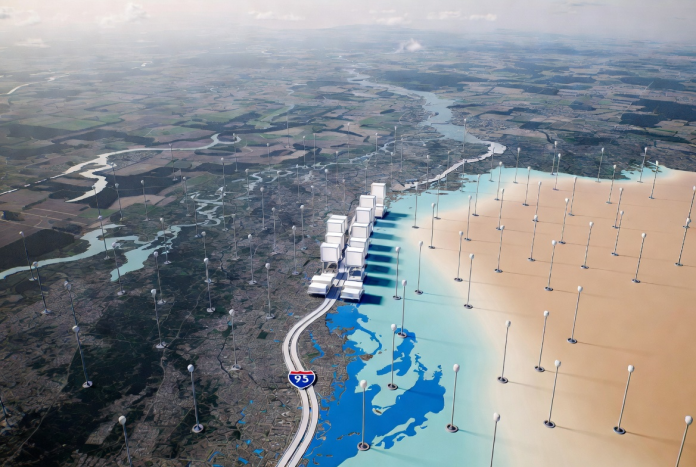
A 2026 report from the Virginia Department of Environmental Quality concludes that a typical hyperscale data center requiring approximately three million gallons of groundwater per day would fail current permit evaluation criteria in nearly all locations across the Coastal Plain east of Interstate 95. The analysis forms part of a broader examination of groundwater supply directed by Senate Joint Resolution 25 from the 2024 General Assembly session.
The study focused on the Virginia Coastal Plain aquifer system, which underlies most of the area between Interstate 95 and the Chesapeake Bay. Researchers tested hypothetical industrial withdrawals of three million gallons per day at the centroid of each groundwater budget region, along with one additional site in Northumberland County selected for relatively favorable hydrogeologic conditions. Technical evaluations determined that none of the tested locations would meet the standards required for a groundwater withdrawal permit under existing regulations.
Modeled Capacity Limits Across the Region
Maximum withdrawals projected to satisfy permit criteria varied significantly by location. The highest estimated capacity reached 360,000 gallons per day in Northumberland County. In contrast, several western regions closer to the Interstate 95 corridor, including parts of Henrico and Sussex counties, fell below 30,000 gallons per day, the lower limit of the analysis. These figures indicate limited remaining capacity for significant new withdrawals under current conditions.
The report notes that only the upper end of the estimated range would approach the water needs of a typical hyperscale data center employing evaporative cooling. Even that higher estimate is located well away from existing concentrations of data center infrastructure and supporting power and fiber networks near the Interstate 95 corridor. Most existing and planned data centers in Virginia draw water from public supply systems that rely primarily on surface sources rather than direct groundwater withdrawals.
Broader Aquifer Conditions and Use Patterns
Across the Eastern Virginia and Eastern Shore Groundwater Management Areas, industrial users account for roughly 35 percent of total reported and estimated withdrawals. Private domestic users represent about 34 percent, and public water supply accounts for 26 percent. Private domestic withdrawals remain largely unpermitted and are estimated from census and water-use data. The study projects that growth in these household wells will add an average of 200,000 to 300,000 gallons per day to total annual withdrawals each year through 2050.
Historical large-scale pumping, particularly from paper mills near Franklin and West Point, has lowered inland groundwater levels below sea level and altered predevelopment flow patterns. Groundwater now generally moves inward toward major withdrawal centers and downward through the aquifer layers. These conditions contribute to land subsidence and create potential pathways for saltwater intrusion. Localized increases in chloride concentrations have been documented in portions of Eastern Virginia and on the Eastern Shore.
Regulatory Framework and Recent Trends
The Ground Water Management Act of 1992 established the current permitting system for withdrawals of 300,000 gallons or more in any month within designated management areas. The report describes the act’s outcomes as mixed. Regional water levels in the Potomac aquifer experienced a rebound and broad stabilization for approximately a decade following the 2010 closure of the Franklin Mill and subsequent management actions. Rising trends stalled around 2021, and more recent observations indicate the beginning of renewed declines.
The statewide groundwater observation well network, operated cooperatively by the Department of Environmental Quality and the U.S. Geological Survey, includes more than 440 wells. Many provide continuous data on water levels, with dedicated subsets monitoring climate response, drought conditions, and chloride. Expansion of the network continues in both the Coastal Plain and areas west of Interstate 95.
Quality Findings and Policy Recommendations
Comparison of groundwater quality data from 2007–2024 with earlier records shows general consistency in regional chloride concentrations and the position of the saltwater-transition zone. Localized chloride increases were identified through trend analysis and were most often linked to nearby withdrawals. Declining water levels create conditions that could favor further lateral movement of saline water over longer periods.
The Department of Environmental Quality presents several recommendations for legislative consideration. These include clarifying authority to deny or reduce permits when alternative sources such as surface water or reuse are reasonably available, requiring local comprehensive plans in management areas to reflect groundwater constraints when no other supply is feasible, and addressing scientific and legal questions before any groundwater trading system is authorized. Managed aquifer recharge projects are noted as potential future tools for enhancing capacity.
The findings supply a technical foundation for decisions by the General Assembly, the State Water Control Board, local governments, and industrial applicants regarding water allocation and development in the Coastal Plain. The modeled results demonstrate that large groundwater-dependent facilities on the scale of a typical hyperscale data center would not currently qualify for permits across nearly the entire region east of Interstate 95.
Email the House of Delegates at:
Jessica Anderson: DelJAnderson@house.virginia.gov,
Bonita Anthony: DelBAnthony@house.virginia.gov,
Alex Askew: DelAAskew@house.virginia.gov,
Terry Austin: DelTAustin@house.virginia.gov,
Jason Ballard: DelJBallard@house.virginia.gov,
Robert Bloxom, Jr.: DelRBloxom@house.virginia.gov,
Gretchen Bulova: DelGBulova@house.virginia.gov,
Katrina Callsen: DelKCallsen@house.virginia.gov,
Karen Carnegie: DelKCarnegie@house.virginia.gov,
Betsy Carr: DelBCarr@house.virginia.gov,
Stacey Carroll: DelSCarroll@house.virginia.gov,
Mike Cherry: DelMCherry@house.virginia.gov,
Nadarius Clark: DelNClark@house.virginia.gov,
Laura Cohen: DelLJCohen@house.virginia.gov,
Joshua Cole: DelJCole@house.virginia.gov,
Nicole Cole: DelNCole@house.virginia.gov,
Kelly Convirs-Fowler: DelKConvirs-Fowler@house.virginia.gov,
Mitchell Cornett: DelMCornett@house.virginia.gov,
Rae Cousins: DelRCousins@house.virginia.gov,
Will Davis: DelWDavis@house.virginia.gov,
Karrie Delaney: DelKDelaney@house.virginia.gov,
Lindsey Dougherty: DelLDougherty@house.virginia.gov,
Mark Downey: DelMDowney@house.virginia.gov,
Michael Feggans: DelMFeggans@house.virginia.gov,
Hyland Fowler, Jr.: DelBFowler@house.virginia.gov,
Lily Franklin: DelLFranklin@house.virginia.gov,
Margaret Franklin: DelMFranklin@house.virginia.gov,
Debra Gardner: DelDGardner@house.virginia.gov,
Thomas Garrett, Jr.: DelTGarrett@house.virginia.gov,
Jackie Glass: DelJGlass@house.virginia.gov,
Timothy Griffin: DelTGriffin@house.virginia.gov,
Elizabeth Guzman: DelEGuzman@house.virginia.gov,
Karen Hamilton: DelKHamilton@house.virginia.gov,
Cliff Hayes, Jr.: DelCHayes@house.virginia.gov,
Dan Helmer: DelDHelmer@house.virginia.gov,
Rozia Henson, Jr.: DelRHenson@house.virginia.gov,
Phil Hernandez: DelPHernandez@house.virginia.gov,
Charniele Herring: DelCHerring@house.virginia.gov,
Keith Hodges: DelKHodges@house.virginia.gov,
Patrick Hope: DelPHope@house.virginia.gov,
Hillary Kent: DelHKent@house.virginia.gov,
Karen Keys-Gamarra: DelKKeys-Gamarra@house.virginia.gov,
Terry Kilgore: DelTKilgore@house.virginia.gov,
Paul Krizek: DelPKrizek@house.virginia.gov,
Amy Laufer: DelALaufer@house.virginia.gov,
Destiny LeVere Bolling: DelDLeVereBolling@house.virginia.gov,
Jay Leftwich, Jr.: DelJLeftwich@house.virginia.gov,
Alfonso Lopez: DelALopez@house.virginia.gov,
Fernando Martinez: DelMMartinez@house.virginia.gov,
John McAuliff: DelJMcAuliff@house.virginia.gov,
Adele McClure: DelAMcClure@house.virginia.gov,
Garrett McGuire: DelGMcGuire@house.virginia.gov,
Ellen McLaughlin: DelEMcLaughlin@house.virginia.gov,
Joseph McNamara: DelJMcNamara@house.virginia.gov,
Kirk McPike: DelKMcPike@house.virginia.gov,
Delores McQuinn: DelDMcQuinn@house.virginia.gov,
Leslie Mehta: DelLMehta@house.virginia.gov,
Will Morefield: DelJMorefield@house.virginia.gov,
May Nivar: DelMNivar@house.virginia.gov,
Israel O’Quinn: DeliOquinn@house.virginia.gov,
Delores Oates: DelDOates@house.virginia.gov,
Justin Pence: DelJPence@house.virginia.gov,
Eric Phillips: DelEPhillips@house.virginia.gov,
Kimberly Pope Adams: DelKPopeAdams@house.virginia.gov,
Cia Price: DelMPrice@house.virginia.gov,
Sam Rasoul: DelSRasoul@house.virginia.gov,
Atoosa Reaser: DelAReaser@house.virginia.gov,
David Reid: DelDReid@house.virginia.gov,
Andrew Rice: DelARice@house.virginia.gov,
Chris Runion: DelCRunion@house.virginia.gov,
Charles Schmidt, Jr.: DelCSchmidt@house.virginia.gov,
Don Scott: DelDScott@house.virginia.gov,
Phillip Scott: DelPScott@house.virginia.gov,
Holly Seibold: DelHSeibold@house.virginia.gov,
Briana Sewell: DelBSewell@house.virginia.gov,
Irene Shin: DelIShin@house.virginia.gov,
Marcus Simon: DelMSimon@house.virginia.gov,
Shelly Simonds: DelSSimonds@house.virginia.gov,
JJ Singh: DelJSingh@house.virginia.gov,
Rip Sullivan, Jr.: DelRSullivan@house.virginia.gov,
Anne Tata: DelAFTata@house.virginia.gov,
Josh Thomas: DelJThomas@house.virginia.gov,
Virgil Thornton, Sr.: DelVThornton@house.virginia.gov,
Luke Torian: DelLTorian@house.virginia.gov,
Kathy Tran: DelKTran@house.virginia.gov,
Howard Wachsmann, Jr.: DelOWachsmann@house.virginia.gov,
Wendell Walker: DelWWalker@house.virginia.gov,
Jeion Ward: DelJWard@house.virginia.gov,
Lee Ware: DelLWare@house.virginia.gov,
Vivian Watts: DelVWatts@house.virginia.gov,
Michael Webert: DelMWebert@house.virginia.gov,
Madison Whittle: DelMWhittle@house.virginia.gov,
Bill Wiley: DelBWiley@house.virginia.gov,
Rodney Willett: DelRWillett@house.virginia.gov,
Wren Williams: DelWWilliams@house.virginia.gov,
Tony Wilt: DelTWilt@house.virginia.gov,
Thomas Wright, Jr.: DelTWright@house.virginia.gov,
Scott Wyatt: DelSWyatt@house.virginia.gov,
Eric Zehr: DelEZehr@house.virginia.gov,































