
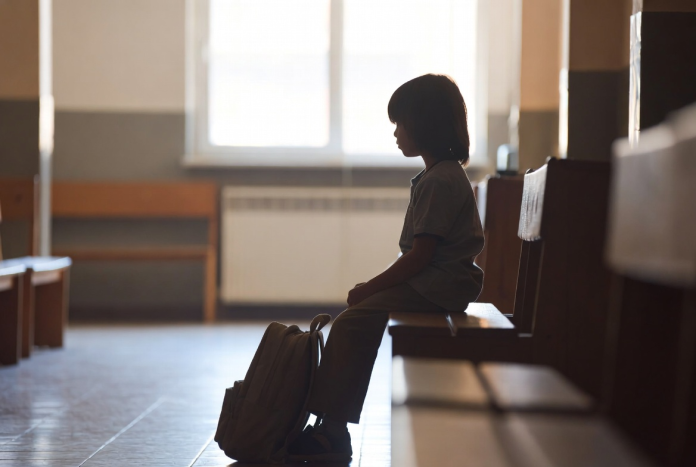
She is eleven years old and already carries a weight no child should have to bear.
On some mornings she still wakes with the quiet hope that today might be different — that the classroom will feel manageable, that the adults will notice when her body starts to tighten, that someone will offer the support her private doctors have already recommended instead of another referral to the office. On other mornings the hope is gone before she even reaches the bus. Her disabilities are documented. Her needs are clear to the clinicians who know her. Yet the system she enters each day continues to meet those needs with delay, denial, and, too often, removal.
Names in this account have been changed to protect the identities of the minors involved.
Her story is not unique. It belongs to a growing pattern of Virginia children with disabilities whose families have spent years asking, documenting, evaluating, and pleading for the specialized instruction, behavioral supports, and fair processes that federal law already requires. Across Northern Virginia the same themes surface again and again: children whose private evaluations point toward IEPs and behavior plans but who remain on 504 plans or no formal supports at all; nonverbal students whose primary language is American Sign Language yet who are left without consistent interpreters or functional communication tools; middle-schoolers whose mental health crises are answered with suspension and alternative placements rather than timely evaluation; elementary students whose escalating behaviors are withheld from parents until a crisis forces hospitalization.
All Virginia News has recorded parent after parent standing at school board microphones in Arlington, Prince William, Loudoun, and beyond, describing unimplemented plans, institutional deflection, shortened instructional days for disabled students, and a deep distrust of the administrative hearings meant to protect their rights. The pattern is no longer anecdotal. It is systemic.
A Pattern Written Across Multiple Districts and Years
In one Prince William County case, a young girl with autism and sensory processing differences spent months cycling through mental health deterioration, rejected medical recommendations for home-based services, and a hearing process her family described as so procedurally flawed that it itself became a second injury. In another, a nonverbal middle-school student who relies on American Sign Language watched his communication device fail daily, his one-to-one support remain inconsistent, and his due process complaint dismissed before the merits could be heard. In a third, a bright thirteen-year-old with ADHD and Disruptive Mood Dysregulation Disorder asked for help, wrote apologies, and still accumulated suspensions that kept her out of regular instruction for months while eligibility was delayed and an alternative placement was ordered against the advice of her treating providers.
In Loudoun County a fourth-grader with complex behavioral and processing needs reached crisis after years of unmet requests for counseling, timely functional behavior assessments, and transparent communication about what was happening inside the classroom. His mother ultimately placed him unilaterally in a private school and sought reimbursement after documenting regression and withheld information.
These are not isolated failures. They are the same failure repeating across different children, different diagnoses, and different school buildings.
The Cry for Reform That Has Gone Unanswered
Families and advocates have not remained silent. They have brought the crisis to the attention of the Virginia Commission on Youth. They have pointed to the Merced Report’s findings that the special education due process system is widely perceived as biased against parents, that hearing officers are seen as inadequately trained or partial, and that the parent win rate has hovered near one to two percent for years. They have documented hearing officers who confuse dates, deny access to transcripts, require motions by U.S. mail only, refuse to recuse despite clear grounds, and dismiss cases before evidence can be fully presented. They have described the financial and emotional toll of being forced to fight the same battles in federal court after administrative processes collapse.
They have specifically asked elected leaders to turn the Commission’s adopted recommendations into binding legislation that would move the selection and oversight of hearing officers to a more independent entity, raise qualifications, increase transparency, and shift structural imbalances that leave parents bearing the full burden of proof while school divisions control the records and the resources.
Senator Barbara Favola, who chairs the Virginia Commission on Youth, has publicly recognized the need for reform. Under her leadership the Commission adopted the Merced Report recommendations. She previously partnered on legislation aimed at overhauling aspects of special education. Yet the deeper structural changes to the due process system itself — the changes families say are required to stop the cycle of biased hearings and delayed justice — have not been enacted. The pleas for urgent legislative action have been received. The system remains largely unchanged.
Delegate Stacey Carroll has been approached by families and advocates seeking a direct meeting to discuss the same urgent need for reform. The request for her engagement sits alongside the broader call for lawmakers to treat the documented crisis as the civil-rights emergency families experience it to be. To date, the comprehensive legislative response that would implement the independent recommendations and restore confidence in the hearing process has not materialized.
What Continued Inaction Will Cost
If Virginia’s elected officials continue to leave these warnings unaddressed, the consequences will not stay confined to case files and commission reports. More children will lose months or years of accessible education while their families exhaust savings and emotional reserves in administrative and federal litigation. More parents will conclude that the only path to justice runs through the federal courthouse, flooding the Eastern District of Virginia with cases that should have been resolved fairly at the state level. Public trust in the Commonwealth’s commitment to students with disabilities will erode further. And the children themselves — the nonverbal student waiting for someone who can sign, the middle-schooler whose mental health is collapsing under repeated removals, the elementary student whose escalating behaviors were hidden until crisis — will pay in the only currency that cannot be reimbursed: time they will never get back.
The families are still asking. The independent reports are still on the table. The pattern is still unfolding in real time across Virginia classrooms. The question now is whether the Commonwealth’s elected leaders will finally treat the documented suffering of children with disabilities as the urgent legislative priority it has already been shown to be — or whether another generation of students will be left to wait.
Email the School Board at:
Babur B. Lateef, M.D. (Chairman At-Large) — blateef@pwcs.edu,
Richard M. Jessie (Vice Chairman, Occoquan District) — rjessie@pwcs.edu,
Erica C. Tredinnick (Brentsville District) — etredinnick@pwcs.edu,
Lisa A. Zargarpur (Coles District) — lzargarpur@pwcs.edu,
Jennifer T. Wall (Gainesville District) — jwall@pwcs.edu,
Tracy L. Blake (Neabsco District) — tblake@pwcs.edu,
Justin David Wilk (Potomac District) — jwilk@pwcs.edu,
Loree Y. Williams (Woodbridge District) — lwilliams@pwcs.edu,